Contents
History & cultureBY TELLBY8 sections · numbered as on the map01 Orientation
Welcome to Mitaoli village in the Morena district of Madhya Pradesh India. Right now you are standing at the base of an isolated tabletop hill that rises approximately one hundred feet or thirty meters above the surrounding countryside. Atop this elevated hill stands the Chausath Yogini Temple, also locally recognized and revered as the Ekattarso Mahadeva Temple. On November twenty eighth nineteen fifty one under Act Number seventy one, this historic site was officially declared an ancient and protected monument under the Archaeological Survey of India Bhopal circle. The local name Ekattarso Mahadeva translates to seventy one or many Shivas, reflecting the modern devotional identity of the sanctuary where numerous Shivalingas are worshipped in individual outer cells. The historical origins of this structure are deeply rooted in medieval Central Indian history. According to stone inscriptions found at the site written in Devanagari script and dated to thirteen twenty three Common Era or Vikram Samvat thirteen eighty three, the temple is closely associated with King Devapala of the Kachchhapaghata dynasty who ruled between ten fifty five and ten seventy five Common Era. The Kachchhapaghatas were prominent regional rulers in the Gwalior and Morena territories and were feudatories of major imperial powers. While some historical references and local chronicles attribute its earlier foundations to the ninth century under Emperor Devpal Gurjar of the Gurjara Pratihara dynasty, modern architectural historians generally view the eleventh century as the most accurate period for its original construction, treating the thirteen twenty three inscription as evidence of a later royal restoration or rededication event. Beyond its sacred role as a esoteric spiritual sanctuary, local traditions and historical surveys suggest that this hilltop shrine once functioned as an advanced academic center for higher learning in mathematics and astronomy based on the transits of the sun. As you prepare to ascend toward the summit, take a moment to absorb the peaceful rural atmosphere of this historic landscape. Today this protected monument remains one of the very few surviving circular yogini temples in India, standing as an enduring testament to the sophisticated engineering, rich religious diversity, and artistic mastery of medieval India. This comprehensive audio guide will accompany you as you explore the hundred stone steps, the open entrance porch, the circular colonnade, and the central sanctum.
02 The Hundred Stone Steps Leading to the Hilltop
As you begin your steady ascent up the roughly one hundred stone steps leading to the hilltop, take a relaxed and rhythmic pace. These durable red sandstone steps provide the sole connecting pathway between the valley floor below and the ancient circular sanctuary above. While climbing these historical steps, consider the distinct religious, philosophical, and geographical principles that governed the location of this extraordinary monument. …
03 The Open Porch and Main Entrance Passage
After completing the climb up the stone steps, you arrive at the open eastern porch terrace, which serves as the main entrance passage into the circular temple complex. Standing at this elevated entrance threshold, the immediate visual impression is one of striking geometric clarity, monumental balance, and extraordinary openness. …
04 The Outer Ring of Sixty-Four Shrine Chambers
Stepping past the entrance porch, you now enter the grand circular colonnade, which features an outer radius of approximately one hundred and seventy feet or fifty two meters. As you begin walking clockwise along the stone pathway in the traditional manner of sacred circumambulation, observe the extraordinary symmetry and rhythmic alignment of the continuous outer ring. The perimeter wall is lined with a total of sixty five small shrine chambers. …
05 Individual Chambers Housing Shivalingas
As you pause to inspect the interior of the individual chambers along the perimeter wall, you will observe that every cell now houses a Shivalinga, the aniconic representation of Lord Shiva. This present day iconographic arrangement explains why the site is widely known among local worshippers as the Ekattarso Mahadeva Temple, referring to seventy one or many Shivas. …
06 The Central Sanctum Sacred to Lord Shiva
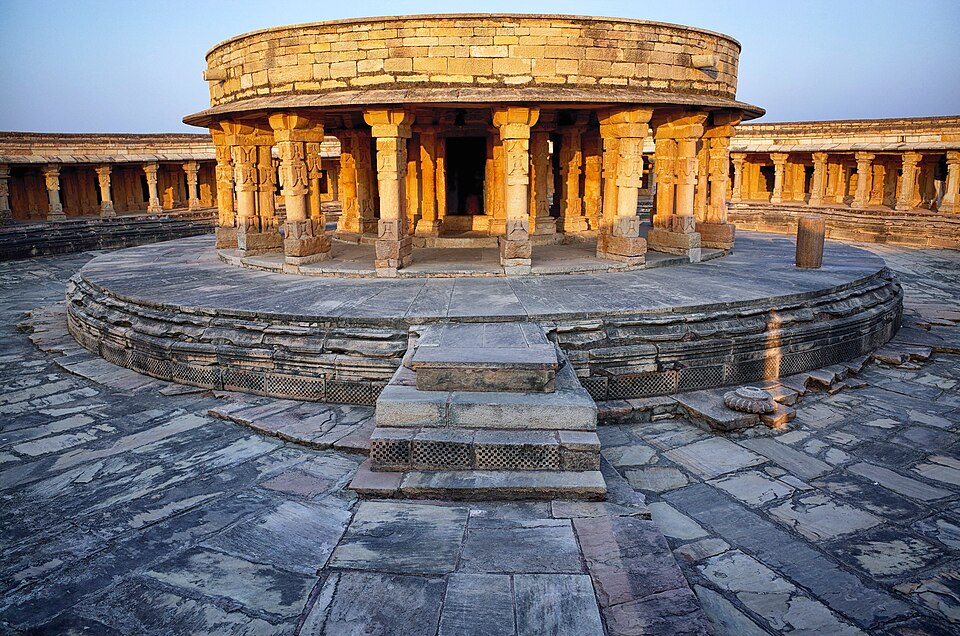
Leaving the perimeter colonnade, step out into the spacious central courtyard and approach the freestanding central sanctum. This central structure, designed as an open mandapa with a flat roof, forms the architectural and spiritual heart of the temple complex and houses the primary Shivalinga. Standing here in the middle of the courtyard, you can fully appreciate the grand circular geometry that defines Mitaoli. …
07 Ancient Rainwater Drainage and Earthquake Resistant Structure
If you look closely at the roofing slabs and floor channels of the central sanctum, you will discover the remarkable engineering systems integrated into this ancient structure. The roof slabs of the central shrine feature specialized perforations that connect to hidden drainage pipes and stone channels embedded in the floor. …
08 Closing
As our audio guide tour comes to a thoughtful conclusion, walk over to the outer perimeter wall and look out across the sweeping hilltop views. Spread before you is the quiet rural landscape of Mitaoli village and the vast expanses of the Chambal valley. Take a moment to savor the peaceful atmosphere, the gentle hillside breeze, and the historic ambiance of this extraordinary medieval sanctuary. …