Contents
History & cultureBY TELLBY8 sections · numbered as on the map01 Orientation
Welcome to Bhandasar Jain Temple, an exceptionally refined and sacred monument located in the desert city of Bikaner, Rajasthan, India. Also widely known as Seth Bhandasar Jain Temple or Sumatinatha Temple, this majestic three-storied architectural masterpiece stands as one of the most remarkable Svetambara Jain shrines in northern India, renowned for its extraordinary historical significance, profound religious devotion, and magnificent artistic craftsmanship.
This sacred sanctuary is dedicated to Lord Sumatinatha, who is revered as the fifth Tirthankara among the twenty-four enlightened spiritual teachers of Jainism. In the Jain spiritual tradition, a Tirthankara represents a liberated soul who has conquered the cycles of rebirth and established a ford across the ocean of worldly existence to guide humanity toward eternal truth, spiritual purity, and non-violence. Lord Sumatinatha is especially venerated as the divine emblem of pure wisdom, right perception, flawless intellect, and inner tranquility, inspiring countless pilgrims who seek spiritual clarity.
The historical origin of this grand temple is deeply entwined with the profound devotion and generosity of a wealthy Jain merchant named Bhanda Shah Oswal, belonging to the Sankhawal gotra. According to epigraphical research and historical records noted by scholar Ram Vallabh Somani, Bhanda Shah constructed and consecrated the Sumatinatha shrine in Vikram Samvat 1571, corresponding to the years 1514 to 1515 of the Common Era. Meanwhile, official documentation from the Archaeological Survey of India stylistically attributes the earliest foundational origins of the monument to approximately the twelfth century CE, while emphasizing that the structure underwent extensive periodic renovations, expansions, and artistic embellishments in later centuries to attain its current magnificent appearance.
As you stand before the entrance of Bhandasar Jain Temple, you are about to step into a sanctified realm where enduring red sandstone architecture seamlessly harmonizes with luminous gold-leaf paintings and vibrant interior frescoes that have braved the harsh desert climate for centuries. Before advancing deeper into the sacred precincts, take a quiet moment to absorb the serene atmosphere created by the weathered stone facades and meticulously sculpted architectural elements. Allow this audio guide to accompany your steps as we explore the three floors of this remarkable temple, uncovering its rich historical layers, architectural subtleties, and extraordinary artistic treasures step by step.
02 Red Sandstone Exterior and the Legend of Ghee
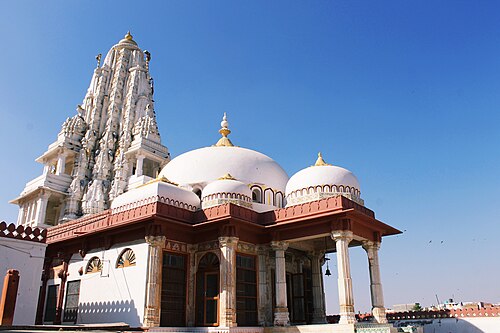
Please pause here and direct your gaze toward the magnificent red sandstone exterior of Bhandasar Jain Temple. From this viewing position, you can fully appreciate the commanding three-storied structural hierarchy of the monument. Constructed primarily using high-quality red sandstone sourced from the Rajasthan region, the temple features a tall, sturdy outer facade that rises gracefully into the desert sky, presenting an aura of timeless strength, architectural balance, and profound historic…
03 Mandapa Halls and Yellow Stone Pillar Carvings
Step forward into the interior chambers of the temple, transitioning from the entrance porch known as the ardhamandapa into the magnificent assembly halls of the mahamandapa and the rangmandapa. As you step across the sacred threshold, the bold red sandstone of the exterior facade gives way to a breathtaking display of warm yellow stone carvings that adorn the pillars, beams, and interior walls. …
04 Garbhagriha Sanctum Dedicated to Lord Sumatinatha
Now, approach the sacred threshold of the garbhagriha, the innermost sanctum of the temple, and stand quietly before the principal main vedi. The garbhagriha represents the absolute spiritual heart of the entire architectural ensemble, a sacred sanctuary defined by profound quietude, meditative reverence, and timeless sanctity. At the center of this sanctum, elevated upon an intricately carved main vedi, rests the holy icon of Lord Sumatinatha, to whom this historic monument is dedicated. …
05 Pancharatha Sanctum Wall and Shikhara Tower
Please move to the outer ambulatory corridor surrounding the sanctum, where you can observe the exterior structural profile of the garbhagriha and the majestic shikhara tower soaring high above. From this vantage point, the extraordinary architectural complexity of the temple becomes strikingly apparent. …
06 Interior Frescoes and Life Stories of 24 Tirthankaras
Position yourself within the interior gallery where you can admire the surrounding walls, ceiling panels, and upper pillar faces. One of the primary reasons Bhandasar Jain Temple enjoys worldwide acclaim among art historians and heritage enthusiasts is its astounding collection of vibrant interior wall paintings, fine miniature frescoes, and delicate leaf art. …
07 Upper Floor Mirror Work and Gold-Leaf Ceiling View
Ascend the staircase to step onto the upper floor galleries of the second and third levels of Bhandasar Jain Temple. As you reach the upper floors, an entirely new layer of opulent artistic brilliance unfolds around you. The upper story of the monument is world-famous for its dazzling combination of ornate mirror work and lavish gold-leaf ceiling decorations, transforming the interior architectural spaces into a brilliant, light-filled showcase of medieval Rajasthani craftsmanship. …
08 Closing
Our audio guide tour of Bhandasar Jain Temple has now reached its conclusion. From the robust red sandstone architecture and the legendary forty thousand kilograms of ghee to the intricate yellow stone pillars, sacred garbhagriha sanctum, narrative frescoes of the twenty-four Tirthankaras, and glittering gold-leaf ceilings, this extraordinary monument offers an unforgettable journey into the heart of Indian art and spiritual heritage. …