Contents
History & cultureBY TELLBY8 sections · numbered as on the map01 Orientation
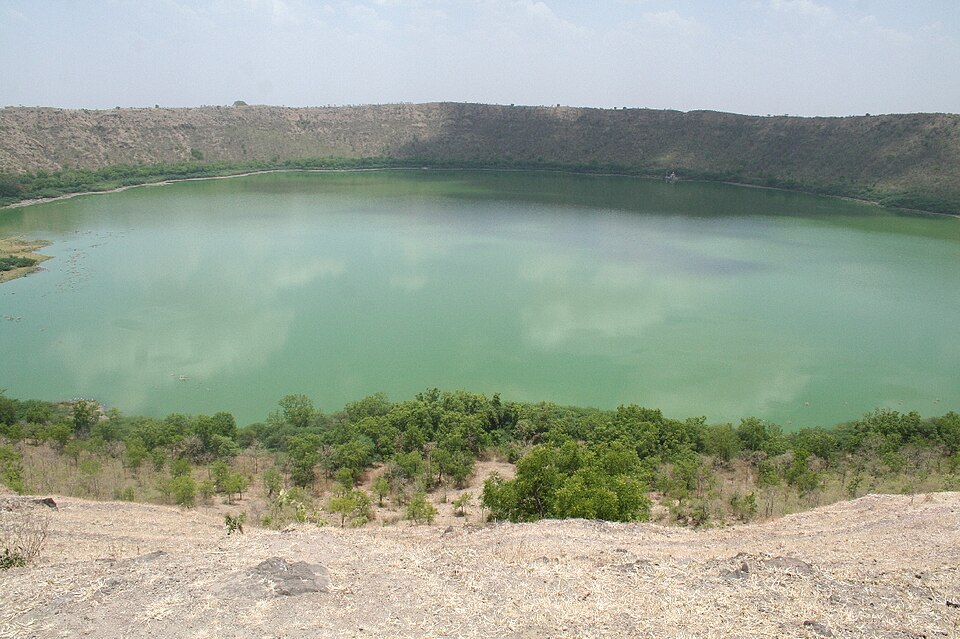
Welcome to Lonar Crater Lake, an extraordinary sanctuary where the infinite wonders of outer space meet the ancient geological history of Earth. You are currently standing at the crater rim panorama observatory, elevated approximately twenty meters above the vast basaltic plateau of the volcanic Deccan Traps. This colossal circular depression was carved out nearly fifty thousand years ago, or up to five hundred seventy thousand years ago according to argon dating measurements, when a colossal meteorite weighing over two million tons plunged into the terrestrial crust at hypervelocity. Hurtling in from the eastern sky at an entry angle between thirty five and forty degrees, the kinetic impact released an explosive blast equivalent to millions of tons of trinitrotoluene. Within a matter of mere seconds, the cosmic collision shattered the rigid volcanic rock, excavating a massive basin measuring one point eight kilometers in diameter, one hundred fifty meters in depth, and over six kilometers in circumference. Lonar is famous across the globe as the only terrestrial impact crater formed entirely within dense, compact basaltic lava flows. The catastrophic pressure and intense temperatures generated during impact altered the fundamental mineral structures beneath the surface, transforming plagioclase feldspar into maskelynite glass and forming distinctive shatter cones within crushed breccia rocks. Geological drill cores extracted from deep beneath the basin floor have recovered these shock-metamorphosed materials, providing undeniable physical proof of a celestial collision. Furthermore, the immense force ejected a continuous blanket of shattered debris extending up to two kilometers beyond the crater rim, flowing radially at speeds of tens of meters per second and creating layered landforms remarkably similar to impact structures observed on Mars and the Moon. In nineteen seventy nine, the Geological Survey of India officially designated Lonar Crater Lake as a National Geological Monument, and in twenty twenty, it received international protection as a Ramsar Wetland site. This otherworldly site was first documented for modern science in eighteen twenty three by British officer C J E Alexander. As you gaze down at the tranquil emerald waters and the verdant slopes below, prepare to walk down the ancient pathways where planetary history and sacred heritage reside in harmony.
02 Gomukh Temple & Freshwater Spring
Leaving the panorama observatory to walk gently down the upper inner slope of the crater, you will encounter the tranquil and sacred Gomukh Temple. The name Gomukh translates from ancient Sanskrit as the mouth of the cow, referring to the meticulously carved stone spout shaped like a bovine head through which a continuous stream of pure freshwater flows year round. …
03 Crater Slope Forest & Wildlife Sanctuary
Leaving Gomukh Temple behind to follow the winding dirt trail toward the floor of the basin, you enter a cool and dense forest covering the inner walls of the crater. The microclimate inside the crater depression retains ambient moisture and shades the inner slopes from the scorching sun, creating an isolated ecological island that contrasts sharply with the dry, arid plains of the surrounding Deccan region. …
04 Kamalja Devi Temple on the Shore
Reaching the flat ground of the crater basin brings you directly to the rustic basalt structure of Kamalja Devi Temple, standing serenely near the edge of the quiet water. This ancient shrine is a magnificent example of Hemadpanthi architecture, a distinguished building style that flourished between the twelfth and fourteenth centuries under the Seuna Yadavas of Devagiri and named after their renowned prime minister Hemadpant. …
05 The Saline & Alkaline Water Edge
You are now standing directly at the shore of Lonar Lake, observing its uniquely colored and chemically complex waters. Because this closed endorheic basin has no natural outlet, dissolved sodium carbonate and minerals brought in by rain runoff have concentrated over thousands of years through relentless evaporation. Consequently, the water exhibits high salinity and extreme alkalinity, with pH values ranging between nine and ten point five. …
06 Sasu-Sune chi Vihir — The Dual-Water Well
Walking across the plain near the base of the crater slope brings you to a historical well structure known locally as Sasu Sune chi Vihir. In the regional Marathi language, Sasu means mother in law, Sune means daughter in law, and Vihir means well, giving this site its famous title of the Mother-in-law and Daughter-in-law Well. This location is celebrated for an extraordinary hydrological anomaly occurring inside a single masonry structure. …
07 Daitya Sudan Temple in Lonar Town
Moving three point five kilometers from the crater rim into the heart of Lonar town brings you to the Daitya Sudan Temple, a magnificent thirteenth century architectural marvel constructed from dense black basalt. Measuring thirty two meters in length and twenty five point eight meters in width, the temple rests upon a raised plinth one point five meters high. …
08 Closing
Our journey through the cosmic and historic wonders of Lonar Crater Lake now comes to a conclusion. From the panoramic heights of the crater rim where a two million ton meteorite struck Earth, down through the refreshing Dhar spring at Gomukh Temple, the vibrant wildlife sanctuary on the slopes, the ancient stone walls of Kamalja Devi, the color-shifting alkaline lake edge, the dual water well of Sasu Sune chi Vihir, and finally to the architectural brilliance of Daitya Sudan Temple in town, we…