 Photo Wikimedia Commons
Contents
History & cultureBY TELLBY8 sections · numbered as on the map01 Orientation
Welcome to the Darjeeling Peace Pagoda, located on the serene slope of Charlimont Hill in Darjeeling, India. As you stand here at the threshold of this sacred grounds, take a slow, deep breath of the cool Himalayan mountain air. You are entering a spiritual sanctuary created to foster universal harmony and to unite people of all races, nationalities, and creeds in a shared devotion to world peace. This striking white monument is fundamentally tied to the rich history of Nipponzan Myohoji, a global Japanese Buddhist order founded in 1917 in Liaoyang by the Most Venerable Nichidatsu Fujii, revered affectionately by his followers as Fuji Guru. Grounded in the ancient tradition of Nichiren Buddhism, the order reveres the Lotus Sutra as the ultimate culmination of Buddhist wisdom, dedicating its entire spiritual practice to achieving international non-violence and peaceful human reconciliation.
The historical path leading to the foundation of peace pagodas across the globe was shaped by key moments in twentieth-century history. In 1933, Fuji Guru traveled throughout India and met Mahatma Gandhi, an extraordinary encounter that profoundly influenced his worldview. Inspired by Gandhi's unwavering commitment to non-violence and moral truth, Fuji Guru vowed to spend his life promoting active peace through Buddhist devotion. Following the devastating atomic bombings of Hiroshima and Nagasaki in 1947, which cost the lives of over one hundred fifty thousand innocent civilians at the close of World War II, Fuji Guru initiated a global sacred mission. He resolved to build Peace Pagodas across the earth as living beacons of peace and moral awakening for a world suffering from war. The very first of these stupas was inaugurated in 1954 atop Mount Hanaoka in Kumamoto, Japan, built over seven arduous years using simple hand tools by dedicated monastics and lay volunteers.
The story of the Darjeeling Peace Pagoda began in 1972 under the direct personal vision and guidance of Fuji Guru. Construction on this steep Charlimont Hill site required two decades of steadfast labor and community support, culminating in its grand dedication on November 1, 1992. Today, this monument stands as an indispensable sanctuary within an international network of over eighty Peace Pagodas spanning Asia, Europe, and North America. As you prepare to explore this peaceful sanctuary, step forward mindfully, allowing the deep history of compassion, non-violence, and spiritual fellowship to envelope your heart.
02 Access Walkway: Footsteps of Peace and the Sacred Drum
Now, please walk slowly up the main access walkway leading toward the main temple complex. As your feet touch the gently sloping path, observe the tall pine trees and lush mountain vegetation lining both sides of the trail. This path is far more than a simple approach to a building; it is a sacred space designed for mindful transition. It invites every visitor to step away from the anxiety and noise of daily modern life, preparing the heart to enter a sanctuary of deep inner quietude. …
03 Nipponzan Myohoji Temple: Resonance of Prayer and Unity
As you reach the end of the forest path, please step off to your left and stand before the handsome wooden structure of the Nipponzan Myohoji Temple. This traditional hall serves as the active spiritual heart of the entire Charlimont Hill sanctuary. Built with warm timber and designed in traditional Japanese monastic style, the temple provides a quiet, welcoming interior where monastics and visitors gather twice daily for morning and evening prayer services. …
04 Lower Base of the Pagoda: Architecture of the White Stupa
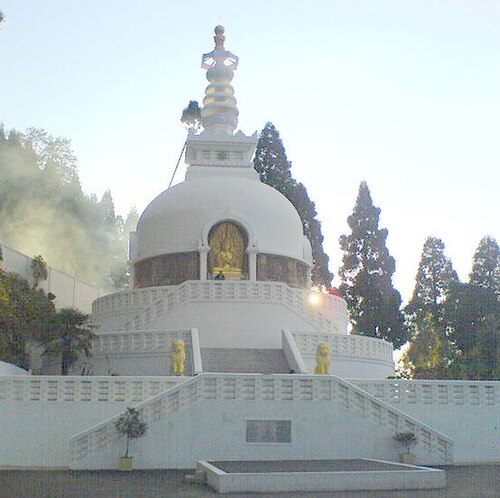
Now, walk over to the base of the massive white stupa that stands prominently in the center of the plaza. Stand at the broad concrete perimeter platform and gaze up at the spectacular white dome soaring gracefully into the clear blue sky. In Buddhist sacred tradition, a stupa is far more than a decorative monument; it is a physical embodiment of the Enlightened Mind of the Buddha and a focal point meant to radiate spiritual harmony throughout the surrounding country. …
05 Four Four-Direction Buddha Statues: Sacred Relics and Symbols
Please ascend the wide stone steps leading up to the elevated circular balcony surrounding the main dome. Walk slowly in a clockwise direction around the pagoda. As you circumambulate, you will encounter four large, masterfully carved golden statues of Lord Buddha set into arched niches facing the four cardinal directions: East, West, South, and North. These radiant figures portray the Buddha in sacred postures, extending a serene, compassionate gaze outward across the earth. …
06 Life of Buddha Relics and Relief Murals: From Birth to Nirvana
As you continue your walk along the upper balcony, lower your gaze slightly to examine the detailed stone artwork relief panels set into the circular wall. These artwork relief panels tell the complete life story of Shakyamuni Buddha, presenting a visual narrative that has guided millions of seekers for over two thousand five hundred years. Carved with remarkable detail, the reliefs bring key moments of Buddhist history to life in stone. …
07 Charlimont Garden and Himalayan Overlook: Mountain Harmony
Now, descend the steps and walk toward the stone railing at the edge of the landscaped gardens surrounding the pagoda. From this mountain vantage point, enjoy the broad views of Darjeeling's famous tea-covered hills, pine forests, and distant Himalayan peaks. The placement of this stupa within the natural landscape reflects the Buddhist teaching of living in harmony with the natural world.
The quiet setting of Charlimont Hill was chosen to offer visitors a calm space for reflection. …
08 Closing
As our audio guide tour of the Darjeeling Peace Pagoda comes to a close, pause to take one final look at the white stupa on Charlimont Hill. We hope this exploration of its history and spiritual legacy has provided you with a quiet moment of stillness and thoughtful reflection. The lifelong work of Most Venerable Nichidatsu Fujii reminds us that peace is a practical journey built through daily choices of understanding and non-violence. …