Contents
History & cultureBY TELLBY8 sections · numbered as on the map01 Orientation
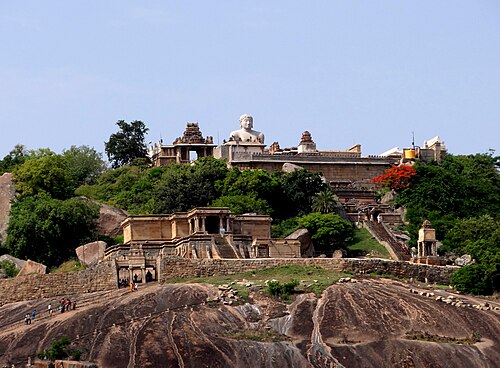
Welcome to Shravanabelagola, the most radiant spiritual sanctuary in Karnataka, India, and the historic pinnacle of Jain art, architecture, and philosophy. Located in the Channarayapatna taluk of Hassan district, this sacred town lies approximately 144 kilometers from Bengaluru, 83 kilometers from Mysuru, and 51 kilometers southeast of the district headquarters of Hassan. Nestled at an elevation of 871 meters above sea level, Shravanabelagola has served as a sanctuary for monks and ascetics for over two millennia. The name Shravanabelagola itself encapsulates the rich cultural and religious identity of the town. The prefix Shravana refers to a revered Jain monk or ascetic, while Belagola is derived from the Kannada words bel, meaning white, and kola or gola, meaning pond. Thus, Shravanabelagola translates to the White Pond of the Monks. In classical Sanskrit inscriptions, this holy location is referred to as Svetasarovara, Dhavalasarovara, or Dhavalasarasa, all echoing the same poetic allusion to the pristine body of water at the center of the settlement. The geography of Shravanabelagola is framed by two stark, magnificent granite hills that rise dramatically on either side of the town pond. To the north sits the smaller, older hill known as Chandragiri or Chikkabetta, while to the south rises the towering monolith hill known as Vindhyagiri, Indragiri, or Doddabetta. The recorded history of this sacred space stretches back more than 2,300 years to the third century BCE. According to venerable tradition, Acharya Bhadrabahu, one of the most revered early Jain saints, migrated from Ujjain in North India to Shravanabelagola along with his disciples. Among his devoted followers was Emperor Chandragupta Maurya, the founder of the mighty Mauryan Empire. Overwhelmed by spiritual yearning, Emperor Chandragupta abdicated his vast throne, entrusted his empire to his son, and embraced a life of strict asceticism and meditation on Chandragiri Hill, where he spent his final years in solemn devotion. This profound royal renunciation established Shravanabelagola as an enduring epicenter of Jainism. Centuries later, under the patronage of the Western Ganga Dynasty of Talakad, the site achieved unprecedented artistic and architectural glory. In the late tenth century, Chavundaraya, the illustrious military commander and prime minister to King Rachamalla IV, commissioned the creation of the colossal monolithic statue of Lord Gomateshwara Bahubali atop Vindhyagiri Hill. Subsequent rulers from the Hoysala Empire, the Vijayanagara Empire, and the Wodeyar Dynasty of Mysuru continued to enrich the site with majestic temples, intricately carved memorial pillars, and over eight hundred historical inscriptions written in Kannada, Sanskrit, Prakrit, Marathi, and Tamil. Today, this audio guide will lead you on a contemplative walking journey. We will explore the ancient, silent temples of Chandragiri Hill, descend to the historic white pond at the heart of the town, climb the six hundred rock-cut steps of Vindhyagiri Hill, and finally stand in awe before the magnificent fifty-eight foot statue of Bahubali. As you begin your tour, take a moment to absorb the tranquility of this holy ground, where granite, devotion, and centuries of silent meditation converge into a timeless testament of human spirituality.
02 Chandragiri Hill and the Ancient Chandragupta Basadi
You are currently standing on Chandragiri Hill, the smaller of the two sacred granite eminences that define Shravanabelagola. Known locally as Chikkabetta, which translates directly to the Small Hill, this location represents the oldest historically documented holy site in the region. As you walk along the weathered granite slopes, you are surrounded by a serene complex of ancient Jain temples, traditionally referred to as basadis, alongside hundreds of historic inscriptions carved directly…
03 The Architectural Jewel of Chandragiri: Chamundaraya Basadi
As you move near the summit ridge of Chandragiri Hill, you are confronted by Chamundaraya Basadi, also known as Chavundaraya Basadi, one of the largest, most monumental, and historically revered temples on this sacred hill. Constructed in 982 CE, this magnificent temple bears the name of its illustrious founder, Chavundaraya, who served as the chief minister and supreme military commander under King Rachamalla IV of the Western Ganga Dynasty. …
04 The Heart of the Town: The White Pond and Bhandari Basadi
Descending from the historic slopes of Chandragiri Hill into the beating heart of the town, you arrive at the edge of the serene water tank that gives Shravanabelagola its historic name. This is the Belagola or White Pond, framed by neat granite steps descending into the clear waters. For well over a thousand years, this central reservoir has served as the physical and spiritual anchor of the town, offering pilgrims a place for ablution, reflection, and quiet contemplation between their ascents…
05 Ascent up Vindhyagiri Hill and Tyagada Brahmadeva Pillar
Leaving the town plain behind, you now begin your ascent up Vindhyagiri Hill, the towering granite landmark that dominates the southern skyline of Shravanabelagola. Known historically as Doddabetta, meaning the Big Hill, or Indragiri, this imposing geographical formation consists of a single monolithic mass of smooth granite rising high above the surrounding landscape. Reaching the summit requires climbing more than six hundred steps carved directly into the living rock face. …
06 Odegal Basadi: The Soapstone Temple of Vindhyagiri
Reaching the high upper ridge of Vindhyagiri Hill just below the supreme summit enclosure, you are greeted by Odegal Basadi, the largest and structurally most imposing temple complex situated on this monolith. Built upon a massive granite stone terrace that projects dramatically over the hillside, Odegal Basadi commands an impressive architectural presence. …
07 The Apex of Devotion: The Monolithic Gommateshwara Bahubali Statue
Stepping through the final pillared gateway onto the open-air summit courtyard of Vindhyagiri Hill, you stand directly before one of the most awe-inspiring achievements of human artistic history, the monolithic statue of Lord Gomateshwara Bahubali. Rising sheer against the sky to a height of nearly fifty-eight feet, or approximately 17.88 meters, this colossal figure is universally recognized as the world's largest freestanding monolithic statue carved from a single mass of solid granite. …
08 Closing
As you stand near the upper ramparts of Vindhyagiri Hill, looking out over the panoramic expanse of Shravanabelagola, our audio tour comes to its peaceful conclusion. Below us lie the twin granite hills of Chandragiri and Vindhyagiri, framing the crystal waters of the White Pond that has mirrored the sky for more than two thousand years. …