Contents
History & cultureBY TELLBY8 sections · numbered as on the map01 Orientation
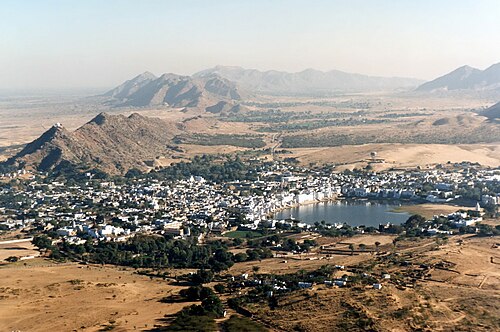
Hello and a very warm welcome to the orientation for the Pushkar Main Market and Holy Lake, where sacred ripples and the vibrant energy of colourful bazaars breathe in harmony. Located about ten kilometres northwest of Ajmer city across Nag Pahar, the Snake Mountain of the Aravalli Range, this ancient town rests at an elevation of five hundred and ten metres. It lies one hundred and fifty kilometres southwest of Jaipur and was historically known by the name Padmavati. Pushkar holds a revered position among the five primary pilgrimage sites of Hinduism and is exalted as Tirtha Raj, which translates to the king of pilgrimage sites.
The antiquity of this sacred ground traces back to the second century Before Common Era. Archeological discoveries, including microliths found near Khera and Kaderi, pre Ashokan Brahmi script inscriptions near Badli village, and an assemblage of coins from the Indo Bactrian, Greek, Kshatrapa, and Gupta periods, demonstrate that a flourishing settlement existed here since ancient times. Over centuries, ruling dynasties including the Chauhams and Mughals shaped its trade economy. Ancient Hindu epics including the Ramayana, the Mahabharata, and various Puranas record the sacred presence of Pushkar with great reverence.
The name Pushkar originates from the Sanskrit word pushkara, meaning blue lotus flower. According to the legend recorded in the Padma Purana, Lord Brahma, the creator god of the universe, entered this lush forest adorned with trees, creepers, and birdsong to perform long penance. To destroy a demon named Vajranabha who took the lives of children, Lord Brahma dropped a lotus flower onto the earth. The impact shook the earth to its core and caused a holy lake to emerge at the exact spot where the lotus fell. This divine body of water came to be known as Pushkar Sarovar.
The semi circular lake reaches a depth of eight to ten metres and is framed by fifty two holy ghats and over five hundred temples. Magical chants resonating from the temples along the perimeter create a deeply spiritual atmosphere. The town is also celebrated as the rose garden of Rajasthan, as extensive rose cultivation produces exquisite rose essence exported internationally. To preserve its holy sanctity, the consumption of meat, eggs, alcohol, and drugs is strictly prohibited throughout the town, making it a pure vegetarian haven.
Every year during the month of Kartik in October or November, marking Kartik Purnima, the world famous Pushkar Camel Fair takes place. Over fifty thousand camels and livestock are brought for trade, accompanied by vibrant folk music, dance, and camel races, drawing hundreds of thousands of pilgrims for sacred dips. Today we embark on a three point one seven kilometre Heritage Walk designed by Pushkar Nagar Palika and the Dronah Foundation. Starting from Mahal Badshahi and concluding at Jaipur Ghat, this journey invites you to immerse yourself in the profound history, traditional architecture, and sensory delight of Pushkar.
02 Mahal Badshahi
Welcome to Mahal Badshahi, the very first historical milestone on our Pushkar heritage journey. Standing with majestic pride right at the lively gateway where the bustling main market begins, this grand historic structure was erected in sixteen thirteen Common Era by Jahangir, the fourth emperor of the Mughal Empire. It was constructed as an enduring symbol of military triumph and political authority to commemorate the imperial victory over the formidable Maharajas of Mewar. …
03 Mukhya Brahma Ghat
Welcome to Mukhya Brahma Ghat, the spiritual heart and central purification sanctuary of holy Pushkar Lake. Constructed between the eighteenth and nineteenth centuries Common Era, this site holds immense historical and religious significance among the fifty two ghats lining the sacred lake. Since ancient times, the vast majority of sacred bathing rituals, purification ceremonies, and major religious offerings dedicated to Lord Brahma have been performed at Mukhya Brahma Ghat. …
04 Jagatpita Brahma Mandir
Welcome to the Jagatpita Brahma Temple, one of the few places in the entire world dedicated to Lord Brahma, the creator god, and the most revered culmination of our Pushkar heritage journey. Among the principal Hindu trinity of Brahma, Vishnu, and Shiva, temples consecrated specifically to Lord Brahma are exceedingly rare across India, making this sanctuary in Pushkar exceptionally unique and prominent. …
05 Malpua Gali
Stepping away from the quiet reverence of the temple, welcome to Malpua Gali, the most sweet, vibrant, and sensory filled alleyway in all of Pushkar. Pushkar has long enjoyed international fame for its traditional sweets and delectable culinary arts, with this narrow alley standing as the beating heart of the town gastronomic heritage. Lined along both sides of the alley are family run sweet shops boasting nearly fifty years of continuous history. …
06 Varaha Temple
Welcome to the historic Varaha Temple, recognized as one of the largest and most ancient sanctuaries in all of Pushkar. Dedicated to Lord Varaha, the boar incarnation of Lord Vishnu who rescued the earth from cosmic depths, this temple stands as a monumental witness to the dramatic history of Pushkar. During the seventeenth century, the original structure suffered devastating destruction under the orders of Mughal Emperor Jahangir. …
07 Jaipur Ghat
Welcome to Jaipur Ghat, the breathtaking finale of our Pushkar heritage walk and one of the most enchanting lakeside destinations in all of Rajasthan. Constructed between the eighteenth and nineteenth centuries Common Era, Jaipur Ghat is widely celebrated as the premier sunset viewpoint among the fifty two ghats surrounding Pushkar Sarovar. …
08 Closing
Dear valued travelers, our three point one seven kilometre Heritage Walk spanning the Pushkar Main Market, beginning from the grand Mahal Badshahi and journeying through Mukhya Brahma Ghat, the Jagatpita Brahma Temple, Malpua Gali, and Varaha Temple to reach Jaipur Ghat, has now come to a warm and successful conclusion. …