Contents
History & cultureBY TELLBY8 sections · numbered as on the map01 Orientation
Welcome to the sacred sanctuary of Achal Nath Shivalaya, situated in the historic neighborhood of Sodagaran Mohalla within the vibrant city of Jodhpur, Rajasthan, India. Widely known as the Achal Nath Temple or Achal Nath Shivalaya, this esteemed shrine stands as one of the most prominent places of Hindu worship dedicated to Lord Shiva, revered locally as Mahadev. In the rich cultural fabric of Rajasthan and the daily lifestyle of Jodhpur, religion forms an irreplaceable foundation, where the daily worship of Hindu deities is considered the most vital task of everyday life. This historic shrine traces its royal origins back to the sixteenth century, built on the explicit instructions of Queen Nanak Devi, who was the queen of King Rao Ganga. Following a period of dedicated construction, the temple was officially completed on May twenty first, 1531. Since its completion in 1531, this ancient shrine has served as a focal point of religious faith for the people of Jodhpur, drawing pilgrims and visitors seeking spiritual peace and divine grace. The temple welcomes visitors every day during its operating hours from 10 am to 1 pm in the morning, and from 2 pm to 4 30 pm in the afternoon. Reaching the temple is remarkably convenient through multiple transport options. Located at Sodagaran Mohalla in Jodhpur city, travelers can easily arrive by road using local buses or taxis. For those traveling by rail, the nearby Jodhpur Railway Station offers extensive direct connections to major city stations across India, including Delhi, Agra, Mumbai, Chennai, Bikaner, Jaipur, and Ahmedabad. If you are arriving by air, the nearest airport is Jodhpur Airport, situated just six kilometers away from the temple, providing regular domestic flights connecting to major metropolitan centers such as Delhi and Mumbai. Within the shrine complex, visitors will observe three distinct architectural sections carved from yellow Chhitar stones, namely the inner sanctum Garbha Griha housing the Shiva Linga, the Mandap Bhavan where the priest conducts regular prayers, and the Kirtan Bhawan where devotees gather to sing devotional songs. Additionally, located near the central Shivling inside the shrine is the famous Ganga Bawari, a large drinking water reservoir that symbolizes the emergence of Goddess Ganga from the head bun of Shiva. Today's audio tour will guide you through each section, from the entrance along Sodagaran Mohalla to the sacred water tank, the prayer halls, the inner sanctum, and the sunlit courtyard. We invite you to step forward with respect and experience the timeless heritage of Mahadev.
02 Sodagaran Mohalla & Temple Gate
As you walk along the historic lanes of Sodagaran Mohalla, the main entrance and traditional exterior of the Achal Nath Shivalaya Temple reveal themselves in an impressive harmony of heritage and spiritual devotion. Situated in the heart of Jodhpur city, Sodagaran Mohalla is a bustling neighborhood rich with the daily rhythm of local life, where the ancient temple gateway integrates seamlessly with the surrounding urban landscape. …
03 Ganga Bawari Water Reservoir
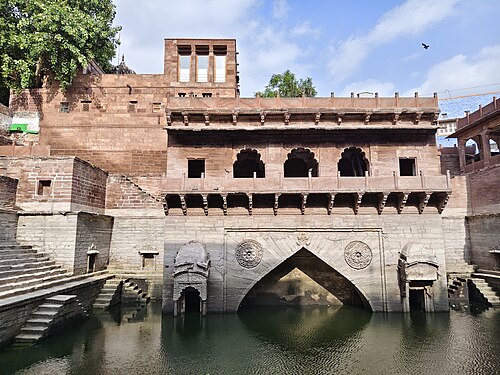
As you proceed further into the shrine complex toward the inner realm of worship, you will encounter the remarkable water reservoir known as the Ganga Bawari, located directly near the sacred Shivling inside the shrine. In the local terminology of Rajasthan, the word Bawari refers to a traditional water tank or reservoir, and within the Achal Nath Shivalaya, this large structure was specifically established as a dedicated drinking water tank for priests, visiting devotees, and pilgrims. …
04 Mandap Bhavan
Leaving behind the quiet waters of the Ganga Bawari, your path leads you into the Mandap Bhavan, one of the primary separate halls within the Achal Nath Shivalaya complex. Designed with clear functional layout characteristic of traditional Rajasthani temple architecture, the Mandap Bhavan forms a dedicated prayer hall where the temple priest offers his regular prayers in honor of Lord Shiva. …
05 Kirtan Bhawan
Moving forward from the quiet prayer hall of the Mandap Bhavan, your tour brings you into the radiant space of the Kirtan Bhawan, an expressive assembly hall dedicated to communal devotion and holy music. Within the Achal Nath Shivalaya complex, the Kirtan Bhawan serves as a congregational hall wherein the devotees assemble and participate in Kirtans, which are songs dedicated to Gods and goddesses, while seeking the divine blessings of Lord Shiva. …
06 Garbha Griha Inner Sanctum
You now stand before the Garbha Griha, the inner sanctum and spiritual heart of the Achal Nath Shivalaya Temple. In Hindu temple architecture, the Garbha Griha forms the inner sanctum that houses the Shiva Linga, representing the ultimate holy center where the primary deity resides. Within this sanctuary, the divine presence of Lord Shiva, Mahadev, is enshrined in an environment crafted to reduce outer distractions and foster deep spiritual contemplation. …
07 Chhitar Stone Art & Sunlit Courtyard
Stepping out from the inner halls into the sunlit temple courtyard, you are presented with an exceptional vantage point to admire the overall architectural elegance of the Achal Nath Shivalaya. Every main section within this sacred complex, including the inner sanctum Garbha Griha, the prayer hall Mandap Bhavan, and the assembly hall Kirtan Bhawan, is masterfully constructed using Jodhpur's native yellow Chhitar stone. …
08 Closing
This concludes our audio guide tour of the historic Achal Nath Shivalaya Temple in Jodhpur. From the welcoming entrance along Sodagaran Mohalla to the sacred drinking water reservoir of the Ganga Bawari, the quiet prayer space of the Mandap Bhavan, the carved musical hall of the Kirtan Bhawan, the solemn inner sanctum of the Garbha Griha housing the black Shivling idol, and the sunlit courtyard adorned with yellow Chhitar stone art, we hope this journey has provided you with a deep appreciation…