 Photo Wikimedia Commons
Contents
History & cultureBY TELLBY8 sections · numbered as on the map01 Orientation
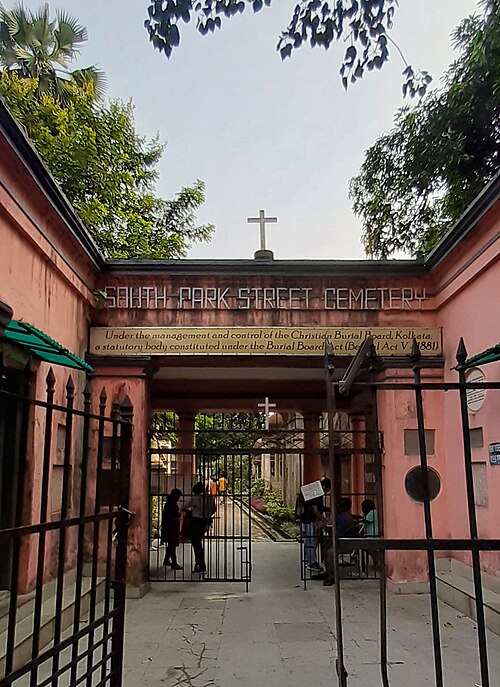
Welcome to the South Park Street Cemetery, a serene repository of eighteenth century history nestled in the heart of Kolkata. Standing here along Mother Teresa Sarani, historically known as Park Street, you are about to step into one of the most remarkable funerary landscapes in the world. As you walk beneath the thick canopy of tropical trees, the bustling sounds of the modern city gradually fade away, replaced by the somber elegance of grand stone monuments rising from the lush greenery. This cemetery was established in 1767 by the British East India Company. During that era, the old burial ground at Saint John Church inside Fort William had become severely overcrowded. The harsh tropical climate, combined with poor sanitation and unfamiliar diseases, led to a tragically high mortality rate among the European settlers, many of whom perished at a very young age. The frequent sight of funeral processions winding through the center of town severely depressed the morale of the living residents. Furthermore, establishing a new burial site within the town boundaries posed serious health hazards. Consequently, the Board of Governors selected a remote site located on the muddy, wooded outskirts of the settlement near Mr Vansittart's house. A new access road was constructed to transport coffins to this secluded location, appropriately named Burial Ground Road. This thoroughfare was later renamed Park Street after the private deer park established nearby by Chief Justice Sir Elijah Impey. Spanning roughly eight acres, the South Park Street Cemetery holds immense historic and architectural importance as one of the earliest non church graveyards in the world. It serves as the final resting place for over sixteen hundred souls, commemorated by an extraordinary collection of tombs constructed of bricks in lime surkhi mortar and finished with ornate stucco. The architecture here displays a captivating fusion of styles, ranging from Gothic spires and Egyptian obelisks to classical Roman and Greek Doric, Ionic, and Corinthian columns, as well as Indo Saracenic motifs. Architects ingeniously utilized squinches, spandrels, and recessed architraves decorated with beaded or ribbed patterns to reduce space and raise domes proportionately over raised brick plinths. Intriguingly, despite being a burial site for European Christians, you will not find a single Christian cross among the monuments. This absence reflects the prevailing Enlightenment philosophy and classical aesthetic tastes of the eighteenth century elite, who preferred urns, weeping figures, and poetic epitaphs over traditional religious symbols. As you wander along these peaceful pathways, allow yourself to step back in time and uncover the fascinating lives, tragic fates, and enduring legacies written upon these ancient stones.
02 Marble Plaque at the Gate
As you approach the main gate, your attention is immediately drawn to a prominent white marble plaque set firmly into the masonry structure. The inscription reads: South Park Street Cemetery, Opened 1767, Closed 1790. However, behind this simple historical label lies a fascinating historical reality, along with a vivid window into the atmospheric and ghostly funeral traditions of eighteenth century Kolkata. …
03 Obelisk of Sir William Jones
Directing your steps toward Sector 4, Grave 1517, you will encounter the most imposing and soaring monument in the entire cemetery. Standing at an astonishing height of thirty two feet, this majestic Corinthian style obelisk marks the final resting place of Sir William Jones, one of the most brilliant minds of the eighteenth century Enlightenment. …
04 Pancha-ratna Temple Tomb of Hindoo Stuart
As you walk into Sector 6, Grave 466, you will come across the most extraordinary and unexpected monument in the entire cemetery. Standing in stark contrast to the surrounding European architecture is the tomb of Major General Charles Stuart, a British officer fondly remembered by history as Hindoo Stuart. Born in 1758 and dying in 1828, Stuart was an eccentric Irishman who served in the East India Company army. …
05 Fluted Column of Rose Aylmer
Wandering further along the tranquil brick pathways, you will be drawn to a tall rounded column of exquisite elegance and tragic romance. This beautiful monument marks the grave of Rose Whitworth Aylmer, a young English noblewoman who died in Kolkata in the year 1800 at the fragile age of twenty. The tomb of Rose Aylmer is widely celebrated as one of the most artistically refined compositions in the entire cemetery. …
06 Pyramidal Vault of Elizabeth Barwell
As you navigate toward another prominent pathway in the cemetery, you will encounter a grand structural vault topped by a massive stone pyramid. This imposing square monument serves as the final resting place of Elizabeth Jane Barwell, who passed away in 1778 at the young age of twenty three. Among the eclectic assemblage of tombs in South Park Street Cemetery, this pyramidal vault stands out for its structural symmetry and towering presence. …
07 Grave of Henry Louis Vivian Derozio
Arriving at Sector 6, Grave 581A, you stand before a sacred pilgrimage site of modern Indian intellectual history. This modest tomb belongs to Henry Louis Vivian Derozio, an extraordinary educator, poet, and visionary thinker who ignited the flames of the Bengal Renaissance. Born in 1809 and passing away in 1831, Derozio's tomb structure is visually humble compared to the giant obelisks or temple vaults nearby. …
08 Closing
As our journey through the South Park Street Cemetery draws to a close, we reflect upon the remarkable preservation story that saved this unique historical treasure. Following the cessation of regular burials in the 1840s, the cemetery spent decades engulfed by dense tropical vegetation, exposed to heavy monsoon rains and structural decay. After Indian Independence in 1947, city authorities considered clearing colonial era graveyards. …