 Photo Wikimedia Commons
Contents
History & cultureBY TELLBY8 sections · numbered as on the map01 Orientation
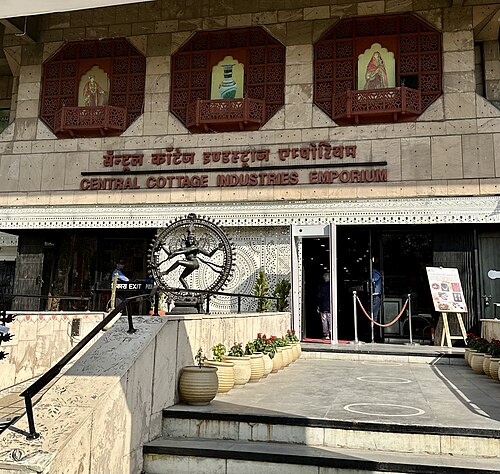
Welcome to the entrance of Jawahar Vyapar Bhawan along the historic Janpath avenue in New Delhi, home to the Central Cottage Industries Emporium, affectionately known around the globe simply as the Cottage. As you stand before the grand entrance archway looking toward the vibrant concourse, take a moment to appreciate the extraordinary history beneath your feet. During the era of British colonial rule, this grand boulevard was titled Queensway in honor of the British Crown. Following independence in 1947, the newly sovereign nation renamed it Janpath, a Hindi term translating directly as the way of the people. This spatial redefinition reflected a profound philosophical transformation, reclaiming a former corridor of imperial authority and transforming it into a public sanctuary dedicated to the citizens, weavers, and traditional artisans of India. Before stepping inside, look closely at the emporium emblem displayed prominently at the entrance, the celebrated Bankura horse. Traditionally sculpted from terra cotta clay in the rural villages of West Bengal, this iconic figure is reimagined here in polished cast brass, symbolizing the eternal strength, resilience, and refined aesthetic durability of Indian indigenous craft traditions. Shortly after its inception, Prime Minister Jawaharlal Nehru famously hailed the Cottage as a modern monument of Delhi, explicitly comparing its cultural importance in post independence India to historic architectural wonders of the past, such as the ancient Qutub Minar. At the dawn of independence, India navigated a intense national debate between Mahatma Gandhi vision of village self reliance, known as Swadeshi, and Nehru ambitious push toward rapid industrial modernization. The Cottage emerged as the perfect synthesis of these two ideals, functioning not merely as a flagship government enterprise, but as a vital cultural institution fulfilling a dual national mission. On one hand, it actively rescues delicate craft techniques from the brink of extinction amidst global mass production. On the other hand, it provides stable and dignified economic livelihoods for millions of skilled artisans, who constitute the second largest working demographic in India after agricultural farmers. By gathering rare handlooms, master metalwork, and exquisite regional decorative arts under a single protective roof, the emporium establishes an enduring bridge between isolated rural craft clusters and urban appreciators of culture. As you step across the threshold into the ground floor atrium, prepare to immerse yourself in an extraordinary story of human skill, historical resilience, and national identity.
02 Founding History: Kamaladevi Chattopadhyay and the ICU
As you walk into the central exhibition hall on the ground floor, you enter the historic founding space of the Cottage Emporium, where the visionary spirit of post independence India was born. To understand the remarkable origins of this institution, we must return to 1948, just one year after India achieved independence from British colonial rule. …
03 Refugee Handicrafts: Post-Partition Women's Empowerment
As you proceed into the western gallery of the ground floor, you enter a space dedicated to one of the most poignant chapters in modern South Asian history, the post Partition rehabilitation of displaced women. The evolution of the Cottage Emporium is fundamentally bound to the tragic events following the 1947 Partition of India. …
04 Diplomatic Legacy: Royal Visits and Global Exhibitions
As you walk toward the central diplomatic showcase and archival photograph gallery, you step into the world stage where the Cottage Emporium established India global cultural reputation. Throughout the nineteen fifties and sixties, the emporium functioned as an essential venue on the official itinerary for visiting foreign heads of state, international royal figures, and foreign diplomats. …
05 The Textile Realm: Handlooms, Silks, and Pashmina
Ascending the central staircase or taking the elevator to the dedicated upper level textile wing, you enter the artistic heart of the emporium, where the living textile traditions of India are grandly presented. In Indian culture, handloom weaving is not merely an economic industry, but a sacred craft deeply woven into regional geography, oral mythology, and daily spiritual life. Here under one vast roof, the emporium displays an astounding panorama of regional weaving techniques. …
06 Master Handicrafts: Wood, Metal, Ceramics, and Paintings
As you move into the adjacent master handicrafts gallery, you are surrounded by a spectacular showcase of three dimensional art forms hailing from every region of India. The remarkable variety of raw materials, sculpting traditions, and decorative metalwork on display offers a breathtaking journey through the nation artistic geography. …
07 Modern Atelier and Digital Initiatives: ODOP and GeM AABHAR
As you walk into the modern design pavilion and interactive display gallery, you discover how the Central Cottage Industries Emporium continuously reinvents itself, marrying traditional heritage with contemporary fashion and digital ecommerce platforms. A paramount illustration of this innovative vision is the Designer Atelier Exhibition cum Sale, hosted at Jawahar Vyapar Bhawan from September 12 to October 1, 2026. …
08 Closing
As our audio tour comes to a gentle conclusion here in the quiet courtyard near the exit of Jawahar Vyapar Bhawan, take a peaceful moment to reflect upon the remarkable narrative journey you have experienced. The Central Cottage Industries Emporium stands as far more than a government commercial establishment. It endures as a living microcosm of traditional India, where centuries of artistic mastery, spiritual symbolism, and regional identity converge under a single roof. …