 Photo Wikimedia Commons
Contents
History & cultureBY TELLBY8 sections · numbered as on the map01 Orientation
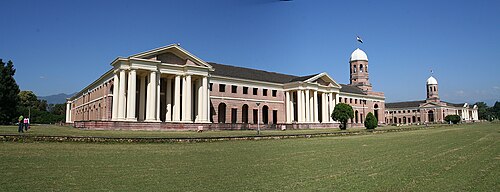
Welcome to the historic Forest Research Institute Museum, beautifully situated in the Doon Valley of Dehradun, Uttarakhand, set against the breathtaking backdrop of the Outer Himalayas. As you stand before this iconic landmark, you are entering one of the oldest and most prestigious institutions dedicated to scientific forestry research and education in the world. The expansive campus, officially known as the New Forest estate, covers an immense area of approximately four hundred and fifty to five hundred hectares, encompassing over eleven hundred acres of sylvan surroundings, manicured lawns, arboreta, and specialized research facilities. The origins of this monumental institution trace back to eighteen sixty-four, when a forest rangers school was first initiated in Dehradun under the guidance of visionary figures, most notably the eminent German-British forest botanist Dr. Dietrich Brandis. In eighteen seventy-eight, it was formally established as the Forest School of Dehradun, which was subsequently taken over by the central government in eighteen eighty-four and renamed the Imperial Forest School. On June fifth, nineteen hundred and six, the organization was reestablished on a much grander scale as the Imperial Forest Research Institute, initially operating with six colonial officers. During its earliest years from nineteen hundred and six to nineteen twenty-three, the institute conducted its pioneer work from a site in the Chandbagh area of Dehradun on Mall Road, which later became the grounds of the famous Doon School. Seeking broader space for scientific field trials and expanding educational programs, a much larger campus at the present site was acquired in nineteen twenty-three, initiating a transformative era of forestry development. The institute was established with a vital dual mission: advancing cutting-edge scientific research in natural resource management, silviculture, and forest utilization, while simultaneously providing rigorous academic and professional training for Indian Forest Service officers and state forest rangers across the Indian subcontinent. In December nineteen ninety-one, upon the recommendation of the University Grants Commission, the institute was conferred the prestigious status of a deemed university. Today, its academic division offers specialized Master of Science and doctoral degree programs in forestry, environmental management, wood science and technology, and cellulose and paper technology. The sprawling estate also accommodates premier national training institutions, including the Indira Gandhi National Forest Academy and the Central Academy for State Forest Services. As you navigate across the central lawn toward the monumental main building, you will prepare to explore five distinct interior museum galleries dedicated to silviculture, timber science, forest pathology, entomology, and non-wood forest products alongside social forestry. Please take a moment to savor the serene Himalayan atmosphere as we embark on this educational journey through forestry heritage.
02 Section 1
Standing grandly across the sweeping central lawn, the main building of the Forest Research Institute is an iconic visual symbol of Dehradun and a proudly recognized National Heritage site of India. Constructed between nineteen twenty-three and nineteen twenty-nine, this architectural masterpiece was designed by the distinguished British chief architect C. G. Blomfield, who is also celebrated for designing the historic Jaipur House located in Lutyens Delhi. …
03 Section 2
Stepping inside the museum section of the main building, our first major gallery is the Silviculture Museum, an advanced educational exhibition space dedicated to the science of forest establishment, tree cultivation, and sustainable ecosystem management. This modern gallery underwent a comprehensive renovation and technological upgrade funded generously by the Ministry of Culture, Government of India. …
04 Section 3
We now enter the world renowned Timber Museum, a spectacular gallery dedicated to wood technology, structural timber engineering, and the commercial applications of forest timber across India. Displayed prominently along the extensive walls of this grand hall are polished timber planks representing one hundred and twenty-six commercially important Indian wood species. …
05 Section 4
Our tour continues into the Pathology Museum, a specialized scientific repository housing approximately nine hundred meticulously preserved physical exhibits dedicated to the study of tree diseases and timber decay. The extensive exhibits inside this gallery are systematically organized based on two broad botanical host categories: hardwoods and conifers. …
06 Section 5
Welcome to the Entomology Museum, one of the most dynamic and popular galleries within the institute, containing approximately three thousand individual scientific exhibits. This extensive collection illustrates the complete life cycles of various forest insect pests and details the precise nature of physical damage inflicted upon forest seeds, young nursery seedlings, standing mature trees, felled timber logs, harvested bamboo, and finished wood products. …
07 Section 6
Our next stop brings us to two interconnected exhibition spaces: the Non-Wood Forest Products Museum and the Social Forestry Museum. The Non-Wood Forest Products, or NWFP Museum, highlights the incredible variety of natural economic resources supplied by forest ecosystems beyond traditional industrial timber. One of its standout technical exhibits compares conventional resin tapping techniques with the modern, highly efficient rill method used for harvesting pine resin. …
08 Closing
As we conclude our tour of the indoor museums and step outside into the fresh air of the campus, you are invited to explore the institute's magnificent outdoor botanical spaces. Surrounding the main building is the sprawling thirty-hectare Arboretum, which houses hundreds of rare species of trees, shrubs, and climbing plants native to the Himalayan foothills and beyond. …