Contents
History & cultureBY TELLBY8 sections · numbered as on the map01 Orientation
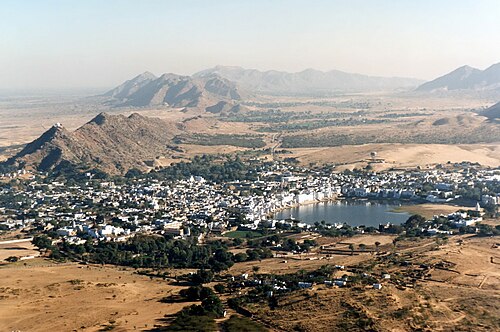
Welcome to the Pushkar Lake Sacred Heritage Walk. I am delighted to guide you through one of the most revered and spiritually significant destinations in all of India. Located approximately twelve to fourteen kilometers northwest of Ajmer city in the state of Rajasthan, Pushkar Sarovar rests at an elevation of five hundred thirty meters above sea level. Nestled along the eastern edge of the Thar Desert, the town and its holy lake lie in a scenic valley formed between two parallel ranges of the ancient Aravalli Mountains. These surrounding hills, stretching from the southwest to the northeast, reach impressive heights ranging between six hundred fifty and eight hundred fifty-six meters, wrapping the lake in a dramatic natural amphitheater. The mountain range known as Nag Parbat, or Snake Mountain, forms a formidable natural barrier separating Pushkar from the neighboring city of Ajmer.
According to the sacred Hindu scripture known as the Padma Purana, the origin of this lake is deeply bound to Lord Brahma, the creator god in Hinduism. Mythological accounts tell of a fierce confrontation where Lord Brahma unleashed his divine weapon, a lotus flower, to slay the demon Vajranabha who was tormenting his children and causing chaos throughout the earth. As the lotus struck the demon, its petals fell to the ground at three distinct places, causing three holy water bodies to spring forth. These became known as Jyeshta Pushkar, or the greatest Pushkar, Madya Pushkar, or the middle Pushkar, and Kanishta Pushkar, or the youngest Pushkar. Lord Brahma named this sacred land Pushkar by combining two Sanskrit words, pushpa meaning flower and kar meaning hand, signifying the divine flower that fell directly from his hand. Furthermore, legend holds that the holy Sarasvati River manifested at this sacred spot as five distinct streams. Consequently, Pushkar Lake has been exalted for millennia as Tirtha Guru or Tirtha Raj, the supreme guide and king among all water-based pilgrimage destinations in India. Historical records and archaeological numismatics show that coins dating from the fourth century BC, as well as ancient inscriptions at Sanchi from the second century BC, confirm Pushkar's role as a major pilgrimage center since antiquity.
Hydrologically, Pushkar Lake drains an extensive catchment area of twenty-two square kilometers across the Aravalli hills and possesses a water surface area of twenty-two hectares. Being a perennial body of water replenished by monsoon rainfalls, its depth fluctuates seasonally between eight and ten meters, holding a total water volume of approximately seven hundred ninety thousand cubic meters. The perimeter of the lake is encircled by fifty-two bathing stairs known as ghats, flanked by over five hundred historic Hindu temples. At the southern end of the lake, a footbridge measuring one hundred ten meters in length features a series of arches beneath it, which channels incoming surface runoff and allows pilgrims to comfortably perform parikrama, the sacred ritual circumambulation of the lake and its fifty-two ghats.
As we gaze across the shimmering water, we must also appreciate the delicate balance between the lake's spiritual purity and its physical vulnerability. Scientific studies on the limnological characteristics of Pushkar Lake reveal an ecosystem under considerable environmental strain. Physico-chemical analyses show that the lake water is slightly alkaline, with pH values ranging from seven point one six to seven point six three. The Total Dissolved Solids, or TDS, range between three hundred thirty-two ppm and four hundred sixty-two point three seven ppm. The Biochemical Oxygen Demand, or BOD, shows elevated levels ranging from twenty point three seven milligrams per liter to twenty-six point two three milligrams per liter. This high oxygen demand is driven by the daily accumulation of organic offerings such as flowers, sacred ashes, animal feeding, and mass bathing rituals. Additionally, surface runoff during rainy seasons introduces calcium and magnesium, bringing the total water hardness between one hundred eighty-five point seven five milligrams per liter and two hundred sixty-three point seven five milligrams per liter. With a Water Quality Index ranging from ninety-four point six seven to one hundred twenty-four point zero one and averaging one hundred seven point two one, scientific findings indicate that the lake water requires proper treatment to be safe for human consumption. As we begin our journey, keep in mind both the profound spiritual heritage and the ecological vulnerability of this sacred sanctuary.
02 Mahal Badshahi: Mughal Heritage on the Lakefront
Please pause here and take a look at Mahal Badshahi, our first official architectural stop along this heritage walk. Dominating the waterfront with its imposing presence, this historic complex was constructed in 1613 CE by the fourth Mughal Emperor, Jahangir. The emperor commissioned this magnificent palace structure to commemorate his military victory over the Maharajas of Mewar, who were the proud Rajput Ranas of the region. …
03 Mukhya Brahma Ghat and the Sacred Temple
As you follow the stone pathway along the water, you arrive at Mukhya Brahma Ghat and the nearby Brahma Temple, which together form the sacred beating heart of Pushkar. Constructed during the eighteenth and nineteenth centuries CE, Mukhya Brahma Ghat is revered as the most spiritually significant among all fifty-two ghats surrounding the lake. It serves as the primary gathering place where pilgrims perform solemn Vedic rituals, ancestor worship ceremonies, and purifying holy baths. …
04 Bade Ganesha Temple and the Heritage Flavors of Malpua Gali
Now, let us step slightly away from the immediate waterfront and enter the historic street network to explore two complementary cultural treasures: Bade Ganesha Ji Ka Mandir and the bustling alley known as Malpua Gali. First, examine the refined structure of Bade Ganesha Ji Ka Mandir, a historic temple constructed in the nineteenth century CE. …
05 Varaha Temple: Ancient Faith and Historical Resilience
Our route now leads us to the Varaha Temple, one of the oldest, largest, and most historically resilient sacred shrines in all of Pushkar. Dedicated to Varaha, the boar avatar of Lord Vishnu who rescued the Earth goddess Bhudevi from the depths of the cosmic ocean, this monumental temple complex stands as an enduring testament to ancient devotion and historical endurance. …
06 Rangji Temples: Fusion of North and South Indian Architecture
Our heritage walk now brings us to an extraordinary pair of religious sites: the Rangji Temple complex, comprising both the Old Rangji Temple and the New Rangji Temple. Together, these two structures illustrate a fascinating stylistic fusion of North and South Indian architectural traditions and highlight the significant role of merchant patronage across different centuries. …
07 Jaipur Ghat: Tranquility at Sunset
We have now returned to the waterfront at Jaipur Ghat, the breathtaking final destination on our historic walk around Pushkar Lake. Positioned along the southern curve of the shoreline, Jaipur Ghat was originally constructed between the eighteenth and nineteenth centuries CE. In 1956, the Maharaja of Jaipur formally gifted this entire ghat, along with the grand Main Palace situated directly upon it, to the town to foster religious life and preserve the sacred lakefront. …
08 Closing
As our heritage walk around Pushkar Lake comes to its quiet close, we reflect upon the deep spiritual memories and historical insights gathered along the way. Many pilgrims visiting these ghats receive a sacred red thread tied around their wrist by local priests in exchange for dakshina, a traditional voluntary offering. …