Contents
History & cultureBY TELLBY2 sections · numbered as on the map01 Sanctuaries of Memory: A Curator's Guide to Buenos Aires
Morning over the Río de la Plata arrives not with a sudden flash of gold, but as a slow unfolding of slate gray and pale rose across the granite pavers of Buenos Aires. As a curator of urban memory, I have long observed how cities reveal their deepest character not through pristine solitude, but through the accumulated weight of their civic spaces. Before you step into the avenues of this capital, take a moment to listen to the atmosphere itself. Here, architecture is never merely stone, iron, and mortar; it is a repository of political passions, artistic ambition, and national drama. Every portico and facade carries the invisible residue of public assemblies, presidential decrees, and cultural aspirations that have shaped Argentina across more than four centuries.
Consider the underlying pattern of this urban landscape. Founded originally in 1580 by Juan de Garay, who staked out a central square along the dusty banks of the river, Buenos Aires was built upon a grid designed to project order onto an endless horizon. Yet behind that geometric symmetry lies a history marked by dramatic transformations and fierce ideological debates. The monuments standing today are not static artifacts freeze-framed in time; they are living witnesses that have been altered, painted, demolished, and reborn to reflect the evolving identity of a nation continuously redefining itself.
Strata of Power and Memory
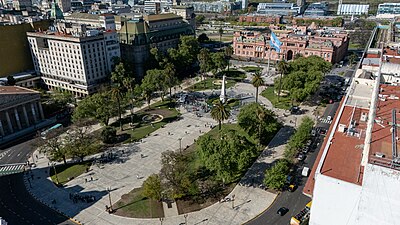
Nowhere is this dynamic layering more evident than in the heart of the city at Plaza de Mayo. In the nineteenth century, President Domingo Faustino Sarmiento sought to soften the grim profile of the executive headquarters by landscaping its grounds and ordering its exterior painted a soft pink. Tradition holds that this distinctive tint was chosen to defuse bitter partisan divisions by blending the Federalist red with the Unitarian white, though architectural archives also note that builders mixed cow blood into the whitewash to seal the masonry against the damp river air. Decades later, that same square became the stage where the Mothers of the Plaza de Mayo gathered during the Dirty War, wearing white scarves and bearing photographs of their missing children to challenge silent authority with peaceful persistence.
Further along the cultural axis stands the Teatro Colón, a masterwork of acoustic engineering and decorative splendor whose history reflects the resilience of the city. When French statesman Georges Clemenceau visited Buenos Aires during the 1910 Centennial, an anarchist bomb detonated inside the theater during an opera performance. Clemenceau recorded his astonishment not only at the violence, but at the quiet fortitude of the citizens, noting that on the very next evening, society ladies returned to fill every seat in the hall without hesitation. It is this profound composure in the face of history that defines the soul of Buenos Aires.
The Living Collection
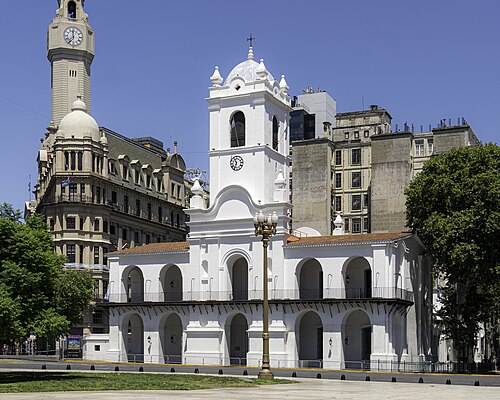
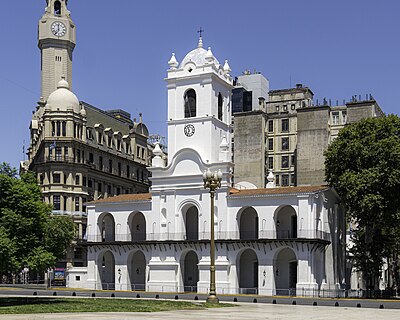
As you prepare to explore these places on foot, remember that a city is best understood as a collection of threshold objects. From the colonial arches of the Cabildo to the rotating steel needle of the Puente de la Mujer spanning the modern docks, each landmark invites you to step across time. Look past the surface polish and pay attention to the subtle textures: the weathered brick buried beneath layers of plaster, the echo of footsteps across marble foyers, and the deliberate geometry of wide avenues carved through older neighborhoods. These physical details tell the story of a metropolis that has continuously curated its past while marching toward the future.
02 The Epicenter of Civic Memory
Standing at the center of Plaza de Mayo, you occupy the focal point of Argentine history. It was here in 1580 that Juan de Garay established the city's foundation, laying out a central plaza that would witness every momentous transformation of the republic. The modern unified square took shape in 1884 under Mayor Torcuato de Alvear, who demolished the central Recova colonnade that had long divided the Plaza de la Victoria from the Plaza de Armas. …