Standing on a cobblestone threshold above the Golden Horn, one feels the quiet weight of centuries settling like dust over marble lintels and ancient brickwork. Istanbul does not reveal its deeper memory to the hurried traveler. It discloses itself slowly through forgotten archways, narrow alleys where Ottoman wooden bay windows lean gently toward one another, and small quiet courtyards preserved against the roar of the modern metropolis. To wander these historic quarters is to step into an open air archive where Byzantine stone rests beneath Ottoman timber, and where every winding alleyway holds the whisper of scholars, imperial edicts, and quiet domestic rituals. As a museum curator examines a precious artifact in a quiet gallery, we must look beyond the immediate exterior facade to discern the subtle layers of time embedded within the city living fabric.
The true essence of Istanbul hidden quarters lies not in grand monumentality, but in quiet survival. While imperial mosques define the distant skyline, the intimate history of the city unfolded in the tucked away residential streets of Fener, Balat, Kuzguncuk, and along the historic shores of the Bosphorus. Here, communities of Greeks, Armenians, Jews, and Turks constructed neighborhoods defined by shared bakeries, stone step lanes, and places of worship standing side by side. To walk these streets in the early morning before the city fully awakens is to listen to an acoustic environment where footsteps echo against ancient stone walls and the breeze off the Golden Horn carries the faint scent of roasting coffee and sea salt. It is an invitation to observe understated details, such as a carved wooden bracket supporting an upper floor, a Byzantine cross etched into a lintel, or a faded Ottoman inscription above a neighborhood fountain.
The Living Archives of the Golden Horn and Bosphorus
Consider the historical narratives preserved in these stone walls. In the narrow sloping lanes of Fener, the imposing red brick facade of the Phanar Greek Orthodox College rises like a scholastic fortress over the water. Here in the seventeenth century, the scholar and prince Dimitri Cantemir studied classic texts, absorbing the multilingual erudition of Ottoman Constantinople before authoring influential histories of the empire. A short distance away stands the Church of Saint Mary of the Mongols, an architectural marvel that was never converted into a mosque following the conquest of 1453. Its survival was secured when the architect Atik Sinan persuaded Sultan Mehmet the Second to grant a formal imperial edict protecting the sanctuary for its congregation, a decree that remains preserved inside the church to this day.
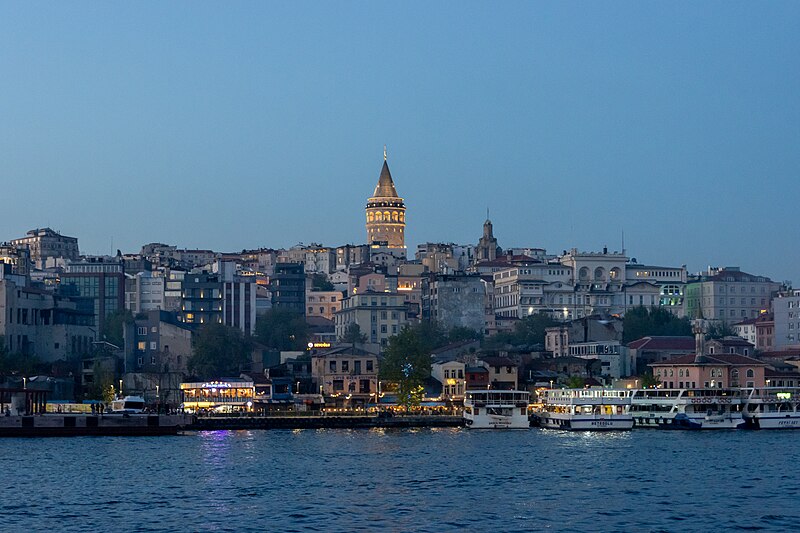
Further along the historic contours of the city, at the base of Galata Tower, another narrative of preservation unfolds. When Sultan Mehmed the Second assumed control of Galata in 1453, he specifically issued an imperial decree to halt the destruction of the Genoese watchtower, recognizing its immense architectural significance and ordering its restoration rather than its demise. Across the Bosphorus in Kuzguncuk, quiet wooden mansions provided sanctuary for twentieth century literary figures such as the poet Can Yücel and the writer Oktay Rıfat Horozcu, who drew deep inspiration from the serene valley and its peaceful multi-faith heritage.
A Quiet Reflection Before the Journey
As you prepare to embark on this walking journey across the city historic topography, allow your focus to shift from mere sightseeing to thoughtful observation. Listen to the subtle rhythms of these historic neighborhoods, notice the texture of worn granite pavers beneath your feet, and appreciate the enduring harmony between human lives and historic structures. Each place on this route offers a rare window into the authentic soul of Istanbul, where history is not confined behind museum glass but lived continuously every single day.
Want to walk it yourself? Plan a trip with these places
The walk
On site, play just that chapter
- 1 min · on site
The Citadel of Genoese and Ottoman Memory
Photo · Wikimedia Commons Standing beneath the formidable stone base of Galata Tower, look upward along its massive masonry walls to appreciate how this former Genoese watchtower has anchored Beyoglu since the fourteenth century. Following the conquest of Constantinople in May fourteen fifty three, Sultan Mehmed the Second recognized the strategic and architectural dignity of this citadel, issuing an imperial decree that halted its destruction and initiated immediate structural restoration. As you walk along Buyuk Hendek Street away from the noisy main avenue, pause to examine how the lower masonry layers merge seamlessly into Ottoman brickwork. Notice how the narrow side streets surrounding the tower slope steeply toward the Golden Horn, preserving the dense urban grid of the medieval Latin colony. Take a moment to rest at a quiet corner tea house near the base, watching how morning light reflects across the conical roof while savoring the quiet atmosphere.
From this historic height, follow the downward slope toward the shore and cross the Golden Horn to reach the ancient neighborhood of Fener.
- 1 min · on site
The Red Brick Sanctuaries of the Patriarchate
Stepping into the narrow lanes of Fener, you enter a quarter defined by centuries of Greek Orthodox heritage and diplomatic scholarship. Look toward the hillside to locate the magnificent red brick facade of the Phanar Greek Orthodox College, where seventeenth century scholar Dimitri Cantemir studied classic literature and historical philosophy. Walk further uphill to discover the Church of Saint Mary of the Mongols, famous as the sole Byzantine sanctuary that was never converted into a mosque, protected by the original edict granted by Sultan Mehmet the Second to the architect Atik Sinan. As you explore these quiet stone streets, observe the historic terraced houses featuring projecting wooden bay windows and carved lintels. Stand quietly near the entry gate of the Patriarchal compound to absorb the solemn acoustic atmosphere of Orthodox chanting carried on the coastal breeze while appreciating the neighborhood enduring historical weight.
Stroll westward along the historic waterfront lanes as they merge seamlessly into the vibrant district of Balat.
- 1 min · on site
The Winding Terraces and Domestic Palimpsests
Entering Balat, the urban scenery transforms into a vivid canvas of historic wooden homes and steep cobblestone staircases. Navigate toward Merdivenli Yokusu, where a line of painted nineteenth century terraced houses cascades gracefully down the hillside slope. This quarter welcomed Jewish families exiled from the Iberian peninsula in the late fifteenth century, creating a resilient neighborhood defined by shared courtyard domesticity and communal bakeries. Take a seat at a modest vintage cafe tucked into a quiet stone corner, ordering a cup of traditional Turkish tea served in a tulip glass while observing neighborhood life unfold around you. Look closely at the doorframes to spot vintage ironwork and subtle decorative flourishes preserved over generations. Walk early in the morning before tour groups arrive to appreciate the authentic residential rhythm and quiet domestic warmth of these sloping historic lanes.
Return to the Golden Horn promenade and head northward along the Bosphorus shoreline toward the historic pier of Arnavutkoy.
- 1 min · on site
The Wooden Waterfront Mansions of the Bosphorus
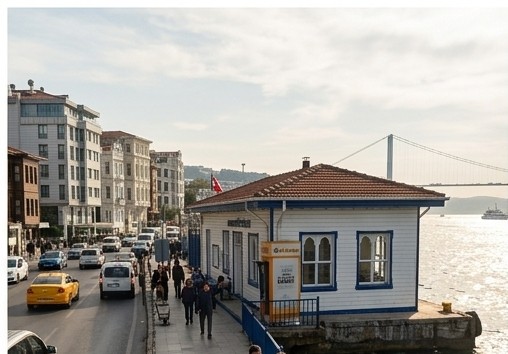
AI-generated image · may differ from the real place Arriving at Arnavutkoy Pier, pause along the granite promenade to behold one of the finest surviving stretches of Ottoman waterfront architecture. The multi-storied wooden mansions, known historically as yali, stand lined along the water with delicate fretwork eaves and pale timber facades reflecting in the swift currents of the strait. Walk slowly along the wooden boardwalk near the pier landing, observing how these historic residences were engineered to withstand the moisture and salt of the marine passage over generations. Visit during the late afternoon as the sun begins to dip, casting a warm golden light across the Bosphorus bridge and the historic boat docks. Sit on a bench near the edge of the pier to watch traditional wooden fishing boats bob quietly against the tide while breathing in the brisk sea air and contemplating the marine heritage.
Walk southward along the coastal road toward the lively waterside square of Ortakoy.
- 1 min · on site
Baroque Elegance Beside the Bosphorus Currents
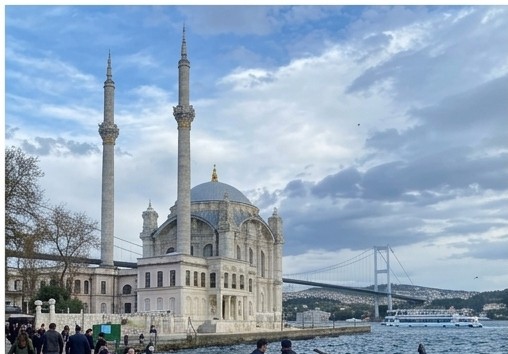
AI-generated image · may differ from the real place Reaching the open waterside square of Ortakoy Sahil, your eyes are immediately drawn to the majestic exterior of the Buyuk Mecidiye Mosque. Built in the nineteenth century, its ornate stone carvings and lofty twin minarets present a breathtaking fusion of European baroque ornamentation and traditional Ottoman mosque design right on the water edge. Walk along the cobbled plaza toward the pier, looking upward to admire how the massive Bosphorus Bridge frames the delicate stone arches of the historic mosque. Find a quiet spot along the stone embankment away from the busy food stalls to observe the swift marine traffic navigating the narrow strait. Notice how the changing sky casts soft reflections across the marble facade as evening approaches, offering a peaceful moment of historical contemplation while taking in the majestic coastal view.
Board a local ferry at the nearby terminal to cross the Bosphorus strait to the Asian neighborhood of Kuzguncuk.
- 1 min · on site
The Peaceful Sanctuary of Valleys and Verses
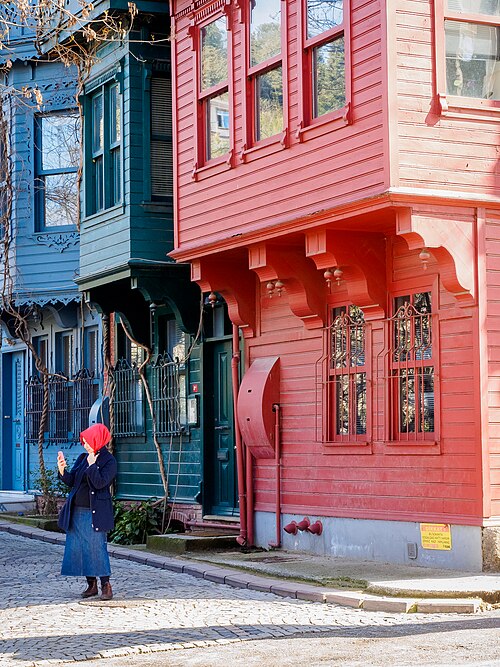
Photo: Esin Üstün from Istanbul, Turkey · CC BY 2.0 · Original file Disembarking on the Asian shore, walk into the verdant valley of Kuzguncuk, a neighborhood whose name recalls the holy figure Kuzgun Baba from the era of Sultan Mehmet the Second. Here, nineteenth century wooden Ottoman houses line peaceful cobblestone streets shaded by ancient plane trees, creating a serene village atmosphere within the metropolis. Walk along the main residential avenue to notice how Bet Yaakov Synagogue and Surp Krikor Lusavoric Armenian Church stand in harmonious proximity to the local mosque, reflecting centuries of peaceful multi-faith coexistence. Seek out the lush green clearing of Kuzguncuk Bostani, a historic community garden preserved by local residents against modern development. Sit on a shaded bench near the garden edge, reflecting on how poets like Can Yucel found creative refuge in these tranquil residential lanes and gentle valley breezes.

This journey through Istanbul hidden topography reveals that the city truest treasures reside in the quiet endurance of its historic fabric. By stepping off the beaten path, one discovers a living archive where every stone, courtyard, and timber bay window continues to tell an enduring story of human community and architectural memory.
Take it further
Open the tour in the appThe tour in the app
Curator Audio Walking Itinerary of Hidden QuartersThis immersive walking guide invites you across the historic contours of Istanbul, tracing ancient pathways from Genoese watchtowers down to Golden Horn sanctuaries and quiet Asian shoreline valleys. Experience centuries of architectural preservation, multi-faith heritage, and serene waterfront strolls at a reflective curator pace.
+ Add the tour to your planIf you have the app the tour opens right away; otherwise you go to the store.FAQ
- What is the best time of day to begin this walking tour?
- Starting in the early morning allows you to enjoy quiet cobblestone lanes and soft light before neighborhood activity picks up.
- How do we transition from the European shore to Kuzguncuk?
- Take a short public ferry from Ortakoy or Besiktas across the Bosphorus strait to Uskudar, then enjoy a scenic shoreline walk north.