As winter settles over Amsterdam, a quiet transformation alters the character of its historic inner rings. The low northern sun casts long, golden shadows across brick facades, while a fine mist rises from the Singel and Herengracht canals, softening the sharp contours of seventeenth-century gables. To walk through the city in this crisp season is to enter an open-air archive, where the cool air smells faintly of roasted chestnuts and damp oak, and the passage of centuries feels extraordinarily thin. Winter here is not merely a drop in temperature; it is a profound shift in urban tempo. The open plazas that served as bustling commercial hubs during the Golden Age take on a contemplative, almost sacred quiet before the evening lights illuminate the market stalls. As a museum curator, I habitually examine cities through the lens of material memory and historical evidence. Amsterdam presents a deeply fascinating study in how seasonal rituals preserve civic identity across time. The temporary wooden booths and glowing lanterns that appear each December are not modern inventions, but the living continuation of a tradition of open-air commerce that dates back over seven hundred years. Beneath the festive surface lies a rich stratigraphy of civic planning, commercial ambition, and architectural devotion, waiting to be deciphered by the attentive observer.
The Geometry of Winter Commerce
To understand the winter landscape of Amsterdam, one must examine the objects and urban decisions that reshaped its public spaces over centuries. Consider Dam Square, the original thirteenth-century embankment where fishermen once moored their vessels to unload the daily catch from the Amstel River. For generations, a massive seventeenth-century weigh house dominated the plaza, anchoring the city's maritime trade. Yet, in eighteen hundred and eight, King Louis Bonaparte took up residence in the newly converted Royal Palace and promptly ordered the historic weigh house to be demolished, simply because it obstructed his panoramic view across the square. That single royal impulse permanently altered the spatial hierarchy of the city center. A short walk to the east reveals another dramatic historical transformation at Rembrandtplein. Originally known as the Botermarkt, where regional farmers gathered each autumn to sell butter, cheese, and poultry, the square was transformed in eighteen fifty-two when sculptor Louis Royer unveiled a grand cast-iron statue of Rembrandt van Rijn. Cast in a single piece, it remains the city's oldest surviving public monument. In eighteen seventy-six, the statue was moved to the very center of the square, officially renaming the former butter market in honor of the master painter. These historical artifacts remind us that public spaces are dynamic canvases, constantly reinterpreted by human memory.
Artifacts of Light and Shadow
As night falls, the winter markets become living exhibitions of light and shadow, evoking the warm, intimate interiors captured by Dutch masters like Vermeer and Jan Steen. The spatial rhythm of Amsterdam—moving from quiet residential canal belts into glowing, crowded market squares—offers a profound reflection on human connection and urban design. We seek warmth not only in hot spiced drinks and traditional winter pastries, but in the collective gathering under cold open skies. The seasonal market is an ephemeral structure, erected for a few short weeks and then carefully dismantled, yet its emotional resonance lingers in civic memory throughout the year. As you begin your journey across these historic grounds, allow yourself to observe not just the surface displays, but the architectural framing, the weathered cobblestones underfoot, and the enduring spirit of a city that has long mastered the fine art of winter hospitality.
Want to walk it yourself? Plan a trip with these places
The walk
On site, play just that chapter
- 1 min · on site
The Northern Echoes of the Jordaan
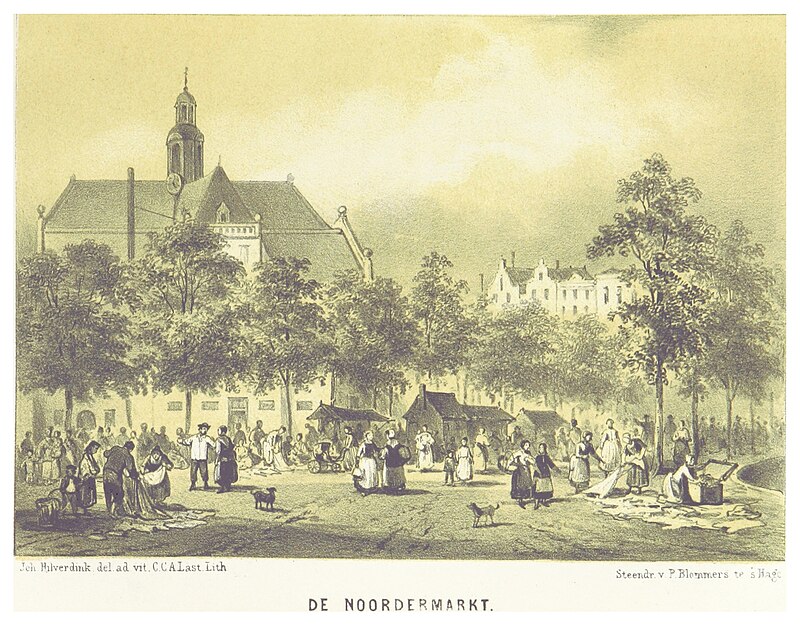
Photo · Wikimedia Commons Standing in the heart of the Jordaan at Noordermarkt, one immediately senses the historical weight of this seventeenth-century square. Framed by the stern facade of the Noorderkerk, completed in sixteen twenty-three, the market area originally served as a church graveyard. As you walk past the lively stalls, notice the bronze plaque affixed to the south face of the church, commemorating the courageous organizers of the February Strike of nineteen forty-one. To experience its distinctive ambiance, arrive early in the morning when stallholders unpack organic produce, vintage textiles, and antique prints under the crisp winter air. Stand near the corner of the church facing the Prinsengracht canal to observe how the market seamlessly blends neighborhood intimacy with historical reverence. Order a slice of warm Dutch apple pie at one of the surrounding traditional cafes while listening to the distant church bells.
From this quiet northern sanctuary, make your way southward along the canal side towards the monumental heart of the republic at Dam Square.
- 1 min · on site
The Civic Axis of Amstel
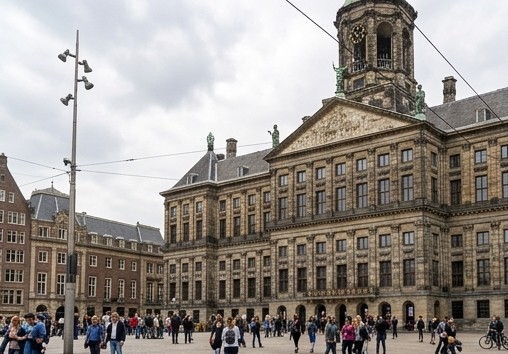
AI-generated image · may differ from the real place Arriving at Dam Square, you step onto the foundational soil of Amsterdam, where a thirteenth-century dam across the Amstel River first united its twin banks. Look toward the western side of the square at the neoclassical Royal Palace, constructed in sixteen fifty-five as the city hall, reflecting the immense pride of the Dutch Republic. Notice how the vast open expanse contrasts with the white stone column of the National Monument on the opposite side. To navigate the square effortlessly, combine your visit with a leisurely walk along the adjacent Kalverstraat shopping avenue. Stand near the center of the plaza to appreciate how King Louis Bonaparte reshaped this space in eighteen hundred and eight by removing the old weigh house to clear his sightlines. Take a moment to admire the massive holiday tree illuminating the palace facade.
Leave the grand civic plaza behind and wander south along the historic Singel canal towards the vibrant scents of the floating market.
- 1 min · on site
Botany upon the Waterway
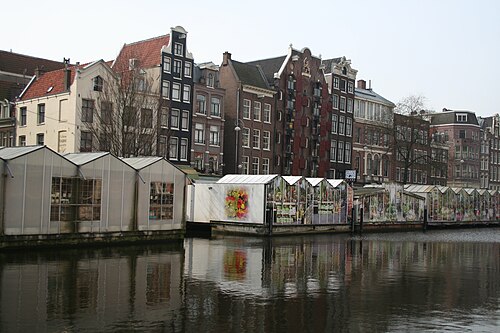
Photo: Massimo Catarinella · CC BY-SA 3.0 · Original file Positioned along the Singel canal between Muntplein and Koningsplein, the Bloemenmarkt represents the world's only floating flower market, established in eighteen sixty-two. Here, merchant stalls rest upon floating barges, a clever architectural response to the urban space constraints of the nineteenth-century canal belt. As you amble along the pedestrian edge of the canal, take time to compare the wooden display stalls before choosing seasonal tulip bulbs, potted amaryllis, or winter greenery. Look closely at the underside of the shops to discern the floating platforms beneath the timber structures. Notice how the vibrant colors of seasonal flora contrast against the dark winter waters of the Singel. Pick up a packet of traditional flower bulbs wrapped in burlap as a tangible memento of Dutch horticultural heritage.
Continue eastward past the Mint Tower toward the historic Jewish quarter to explore the antique treasures of Waterlooplein.
- 1 min · on site
Memories of the Old Vlooienburg
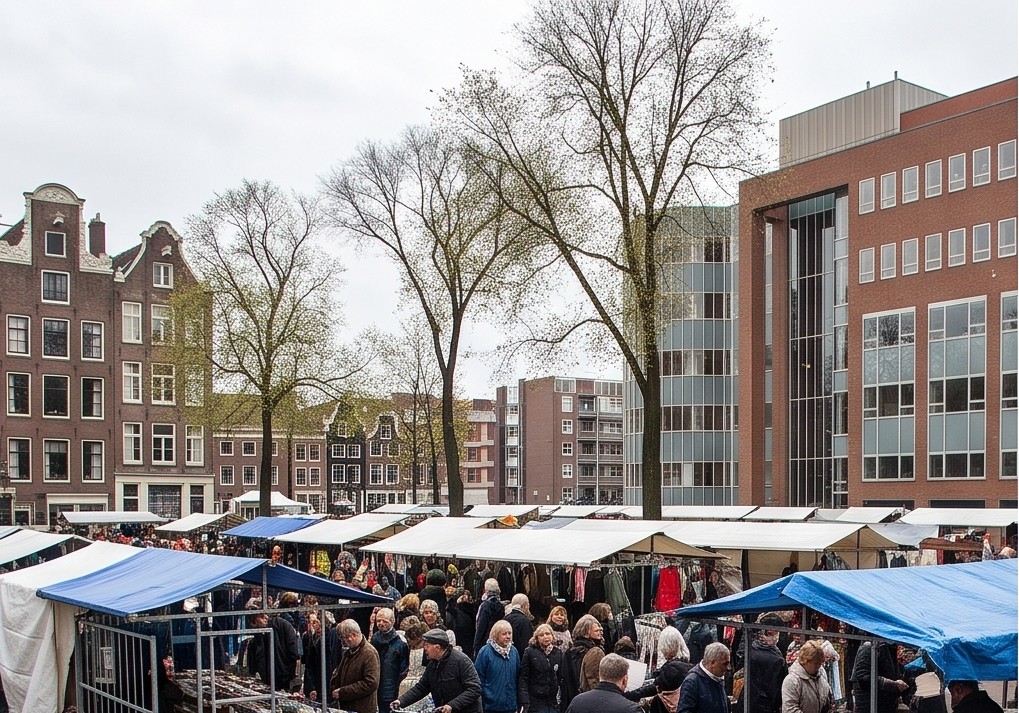
AI-generated image · may differ from the real place Waterlooplein stands upon the former artificial island of Vlooienburg, long the cultural heart of Amsterdam's historic Jewish quarter. Formed in eighteen eighty-two by filling in the historic Leprozengracht and Houtgracht canals, the square became the city's premier open-air market for street traders. Today, surrounded by the modern Stopera building, the market remains a treasure trove of vintage clothing, rare books, and secondhand curiosities. Walk slowly between the rows of stalls and haggle politely while inspecting unique vintage items and antique porcelain carefully. Look for the striking bronze monument of philosopher Baruch Spinoza near the canal edge, inscribed with his belief that the goal of the state is freedom. Pause beside the Mozes en Aäronkerk to reflect on the resilient spirit of this historic trading ground.
Cross back over the Amstel River via the Blue Bridge to enter the illuminated nightlife district of Rembrandtplein.
- 1 min · on site
The Bronze Night Watch and Butter Market
Photo · Wikimedia Commons Rembrandtplein originated as a medieval city gateway and later flourished as the seventeenth-century Botermarkt, where regional dairy farmers sold their butter. The square was renamed in eighteen seventy-six after the solid cast-iron statue of Rembrandt van Rijn, sculpted by Louis Royer in eighteen fifty-two, was moved to its center. In the evening, when the winter lights transform the surrounding terraces into glowing pavilions, walk around the central granite plaza to admire Rembrandt's bronze gaze. Look for the signature engraved on the granite base of Amsterdam's oldest public monument. Warm yourself at one of the winter café terraces under heated lamps while watching street performers and visitors gather around the square. Notice how the grand nineteen twenty-six building of The Bank bounds the eastern perimeter of the plaza.
Follow the western thoroughfare of Regulierbreestraat towards the theatrical energy and cultural venues of Leidseplein.
- 1 min · on site
The Modern Crossroads of Theater
Photo · Wikimedia Commons Leidseplein historically marked the end of the main highway from the city of Leiden, operating as a bustling parking area for horse-drawn carriages. Over the twentieth century, it transformed into Amsterdam's premier entertainment district, anchored by the magnificent red-brick Stadsschouwburg theater and the neighboring American Hotel. To reach the square easily without traffic hassle, take one of the historic tram lines that stop directly in the pedestrian square. Look up at the ornate nineteenth-century facade of the Stadsschouwburg to admire its intricate balconies and classical moldings. Take a seat inside a historic grand café nearby to order hot cocoa with whipped cream while listening to the hum of city life outside. Observe the lively street performers who bring energy to the square even during crisp winter evenings.
Walk south along the tree-lined avenue across the Singelgracht canal to conclude your journey at the grand ice rink of Museumplein.
- 1 min · on site
The Frozen Mirror of Art
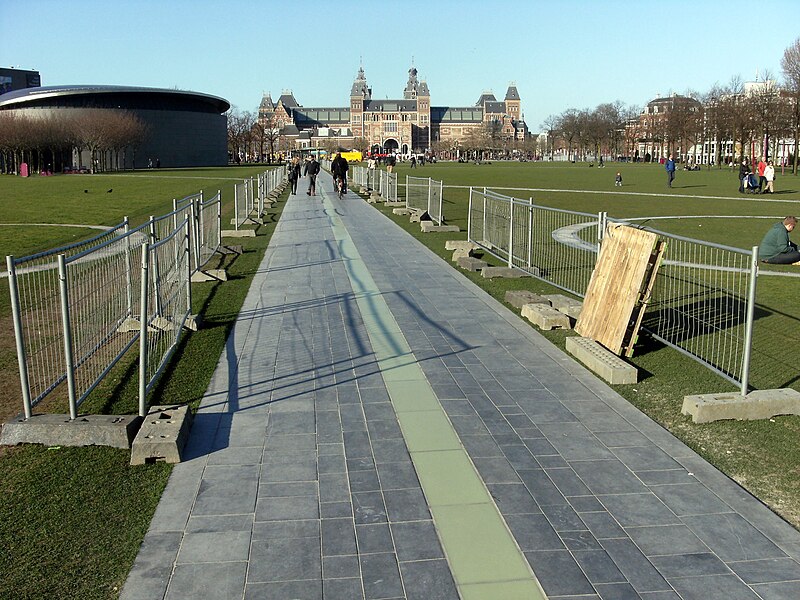
Photo · Wikimedia Commons Our journey reaches its grand finale at Museumplein, where the seasonal outdoor ice rink frames a magnificent view of the Rijksmuseum. Ice skating in Holland is more than a winter sport; it is an enduring cultural art form depicted in classic Golden Age paintings by Hendrick Avercamp. Before stepping onto the ice, bring warm gloves and check skate rental availability at the main wooden pavilion. Glide along the ice or stand on the timber viewing bridge to gaze at the reflection of the museum's neo-Gothic turrets shimmering across the frozen rink. Order a plate of freshly made poffertjes sprinkled with powdered sugar and a knob of melting butter from the traditional market stalls. Watch skaters of all ages circle the ice under suspended holiday lights, celebrating the timeless joy of an Amsterdam winter.

As you depart these historic squares, the memory of Amsterdam's winter landscape remains preserved in your mind like a cherished artifact. The city's masterly blend of spatial preservation and seasonal celebration reminds us that history is not merely preserved behind glass, but lived upon the open cobblestones every winter.
Take it further
Open the tour in the appThe tour in the app
Curator's Winter Walking Route through Historic MarketsThis expertly curated walking tour guides you through seven historic squares of Amsterdam, from the Jordaan district all the way to Museumplein. Experience seven centuries of Dutch market evolution, sacred architectural monuments, open-air ice skating, and vibrant seasonal gatherings while strolling along illuminated UNESCO World Heritage canals.
+ Add the tour to your planIf you have the app the tour opens right away; otherwise you go to the store.FAQ
- What is the historical significance of Dam Square in winter?
- Dam Square marks the original 13th-century dam across the Amstel River. In winter, its grand Christmas tree beside the Royal Palace highlights centuries of civic assembly.
- Why was Rembrandtplein originally named Botermarkt?
- Until 1876, the square served as Amsterdam's main butter and dairy market before Rembrandt's historic cast-iron statue was placed at its center.