There is a moment just after dawn along the sweeping crescent of Agadir when the Atlantic Ocean sheds its soft veil of sea mist and reveals itself in startling, crystalline brilliance. To stand upon this southern Moroccan shore, where the gentle arid foothills of the Anti-Atlas Mountains meet the sapphire swell of the open sea, is to understand why wanderers and chroniclers have long sought solace in its temperate, radiant light. The morning breeze carries a languid dialogue between the briny vastness of the Atlantic and the warm, spice-laden breath of the fertile Souss valley, producing an atmosphere of extraordinary clarity and stillness. Unlike the dense medieval alleyways of the northern imperial capitals, Agadir unfolds with generous boulevards and open terraces, breathing in effortless rhythm with the ocean tide. Here, urban geometry and maritime nature exist in harmonious concert, offering travelers an invitation to slow their stride and observe how the southern sun sculpts white lime, terracotta, and water into an expansive theater of contemplation.
Footsteps on the Maritime Frontier
Long before modern promenades welcomed travelers seeking winter warmth, these winds drew solitary figures whose journeys were measured in vast horizons and enduring silence. In the spring of 1884, the French explorer and ascetic Charles de Foucauld walked quietly along this coastline while traveling in disguise across the Moroccan south. Recording his passage in his volume Reconnaissance au Maroc, he described walking beside the Atlantic swell toward the rocky cape of Agadir Irir, noting the humble fishermen gathered in their huts at Founti beneath the white ramparts crowning the crest above. He observed the silent enclosure standing proud against the pale sky, a lonely citadel watching over an ocean expanse that seemed suspended outside the passage of centuries. Yet this coast was never truly isolated from the grand currents of history; it remained an elemental meeting point where continental earth, maritime voyages, and human resilience converged.
Decades later, around 1930, that same luminous coastal curve served as a vital haven for the pioneering aviators of the French airmail line, the legendary Aeropostale. Antoine de Saint-Exupery and his daring comrade Jean Mermoz landed their biplanes on these wind-swept sands, transforming Agadir into an essential resting place between the airfields of France and the hazardous desert routes across the Sahara toward Dakar. Resting beside these Atlantic breakers before flying into the immense desert solitude, Saint-Exupery absorbed the profound stillness and fragile dignity of human endeavor that would soon echo through his poetic literature. Decades further on, in the golden autumn of 1959, shipping magnate Aristotle Onassis sailed his storied yacht Christina into this quiet basin, accompanied by Winston Churchill, who spent quiet hours on deck sketching the sea and watching the ancient fortress ridge before devastating earthquakes reshaped the shoreline forever.
The Horizon as Sanctuary
When disaster leveled the historic quarters in 1960, visionary architects inspired by the principles of modern design rebuilt Agadir not as a monument to loss, but as a luminous city of parks, low white terraces, and open plazas facing the sea. To wander through Agadir today is to inherit this lineage of outward contemplation. Every vista, from the gleaming yacht basins and breezy waterfront dining terraces to the quiet shaded palm gardens and the bustling spice lanes of the great market, treats the ocean horizon not as an edge, but as an ever-shifting canvas. As you embark on this audio journey through its most evocative vantage points, let the cadence of the waves guide your steps, attuned to the quiet grace of a city that transformed the sea into its eternal sanctuary.
Want to walk it yourself? Plan a trip with these places
The walk
On site, play just that chapter
- 1 min · on site
Forest of White Masts at the Mountain Foot

Photo: AyourAchtouk · CC BY-SA 4.0 · Original file Begin your walking journey at the water edge where Agadir Marina cradles hundreds of white sloops and motor yachts within a sheltered Atlantic basin. To capture the most serene perspective without the passing harbor crowds, stroll past the quayside cafes directly to the outer seawall at the far western pier. Lean against the smooth stone balustrade and look across the turquoise basin back toward the towering headland. High upon the ridge stands the restored crenelated wall of the ancient Kasbah, bearing its monumental inscription in luminous letters against the ochre rock. Down here in the marina basin, the rigging clinks softly in the offshore breeze, mingling with the cries of circling yellow-legged gulls. It was into this very harbor that Aristotle Onassis guided his yacht in 1959, seeking quiet waters under the fortress ridge. Take a breath of the cool Atlantic salt air and notice how the morning light casts sharp geometric reflections across the hull lines.
When you are ready, follow the curving promenade southward along the golden sands toward the lively beachfront terraces.
- 1 min · on site
Golden Hour on the Open Promenade

Photo: Carlos ZGZ from Paris, France · CC0 · Original file As you proceed along the wide beachfront esplanade, make your way to the elevated open-air terrace of O Playa, positioned directly where the coastal promenade meets the sandy dunes. Secure a wooden table at the front railing, ideally arriving just as the late afternoon light softens the Atlantic surf into liquid brass. Order a pot of steaming mint tea or a freshly pressed orange juice, and gaze straight out over the rolling white rollers that break rhythmically against the wide shore. From this vantage point, you can watch local fishermen casting lines into the foamy shallows while long-distance boarders catch gentle swells drifting down from the northern points. The restaurant white linen and dark timber decking create a natural visual frame for the vast ocean horizon. Notice how the shifting colors of the southern sky transform the entire ten-kilometer bay into a luminous, pastel mirror before the sun descends into the Atlantic.
Turn inland from the ocean shore now and wander through the airy boulevards toward the tranquil enclave of New Talborjt.
- 1 min · on site
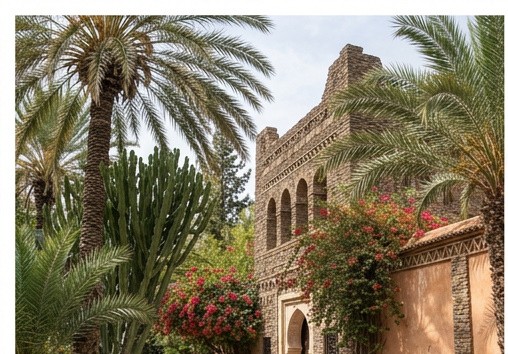
The Ochre Garden of Memory
AI-generated image · may differ from the real place Step off Avenue President Kennedy through the heavy carved portal of Jardin d Olhao, a secluded green sanctuary created to honor the enduring historic friendship between Agadir and its Portuguese sister city. Arrive in the stillness of early morning, when the pathways remain completely empty and the low sun slants through towering date palms and flowering jacarandas. Follow the meandering flagstone pathway toward the central ornamental pool, where the terracotta arcades and sculpted Moorish stone walls reflect peacefully upon the water surface. Take a quiet seat on one of the tiled benches beneath the eucalyptus trees, listening to the gentle murmur of trickling fountains amidst birdsong. Look closely at the earth-toned walls, crafted in traditional southern adobe techniques that evoke both Berber granaries and historic coastal ramparts. Here, away from the roaring Atlantic surf, the garden captures a contemplative stillness that honors the city past while offering a cool, verdant refuge from the southern sun.
Leave this walled oasis and stroll south along the leafy avenue toward Passage Ait Souss to discover the living heritage of the valley.
- 1 min · on site
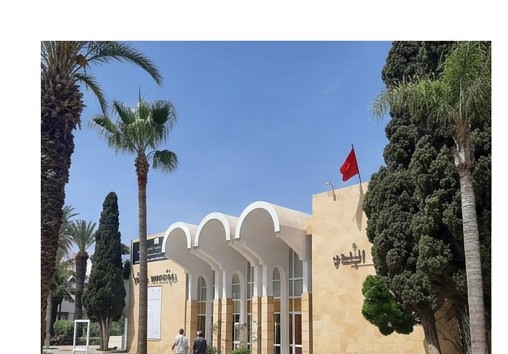
Silver Talismans and Woven Geometry
AI-generated image · may differ from the real place Pass beneath the shaded colonnades of Passage Ait Souss along Rue Hassan II to enter the cool, darkened halls of the Museum of Amazigh Culture. Before wandering through the glass cases, remember to check with the gallery curators regarding photography guidelines so you may observe the precious relics with care and respect. Direct your gaze toward the central display of antique Souss jewelry, where ornate fibulae of engraved silver, polished copal beads, and vibrant amber necklaces tell centuries of ancestral history. These adornments belonged to the resilient Berber communities whose trade caravans crossed the High Atlas and sustained Agadir through eras of siege and renaissance. Linger beside the monumental handwoven wool carpets, observing how the intricate diamond patterns and natural indigo dyes mirror the architectural motifs seen on southern granary citadels. The quiet exhibition rooms offer an illuminating study in indigenous craft, where every geometric line represents a sacred dialogue with landscape and spirit.
Step back into the sunlight and walk southeast along the bustling commercial avenues toward the towering red walls of the regional marketplace.
- 1 min · on site
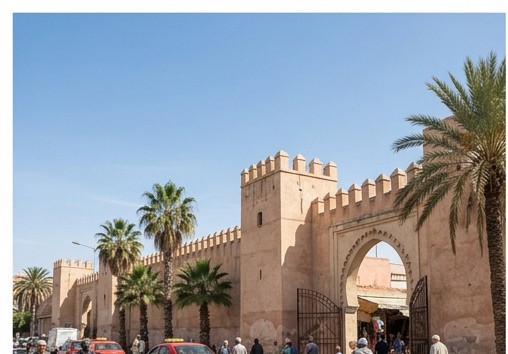
A Labyrinth of Spice Towers and Ochre Gates
AI-generated image · may differ from the real place Conclude your journey at the grand perimeter of Souk El Had along Rue 2 Mars, one of the most magnificent urban markets in North Africa, fortified by towering crenelated walls and thirteen grand gates. Before entering the crowded central aisles, ensure your bag is carried closely in front of you, and always remember to politely ask vendors for permission before taking photographs of their artisanal displays. Enter through Gate Six and navigate toward the spice quarter, where fragrant pyramids of ground cumin, vibrant golden turmeric, sweet paprika, and dried rosebuds form a visual feast of saturated color. Look upward to admire how sunlight filters through the timber-slatted roof, casting geometric beams across woven straw baskets, ceramic bowls, and stacks of handcrafted leather babouches. Pause beside a friendly merchant to sample a spoonful of pure regional orange blossom honey or fragrant culinary argan oil pressed from the foothills of the Souss. The sheer energy, sound, and sensory richness of these stalls provide the definitive portrait of contemporary Agadir life.


As the evening chill settles over the Atlantic and the lights of the renewed city begin to flicker against the darkened mountain slopes, one understands the enduring magic of Agadir. Here, between the memory of lost stones and the vast, unwritten expanse of the ocean, every view is an invitation to stand in quiet reverence of resilience and light.
Take it further
Open the tour in the appThe tour in the app
Atlantic Horizons: A Literary Walking Journey Through AgadirThis curated walking route links five iconic vantage points from the tranquil marina piers to the vibrant heart of Souk El Had. Along the way, immerse yourself in scenic ocean panoramas, tranquil walled gardens, indigenous craftsmanship, and the literary memories of travelers who fell under the Atlantic spell.
+ Add the tour to your planIf you have the app the tour opens right away; otherwise you go to the store.FAQ
- What is the best time of day to photograph the vantage points along this route?
- Early morning offers the clearest light and calmest waters around Agadir Marina and Jardin d Olhao, while late afternoon and golden hour provide warm, saturated tones over the beach terraces and the ocean horizon.
- What photographic etiquette should be observed in cultural spaces and markets?
- Always consult museum attendants regarding interior photography policies, and greet market stallholders politely to request their permission before framing portraits or close-up shots of their wares.
- How does the post-1960 architectural reconstruction shape the city viewpoints?
- The modern urban design prioritized low-rise plateaus, wide arterial boulevards, and expansive open coastal corridors, allowing unobstructed lines of sight between the Atlantic shoreline and the foothills of the Atlas.
This piece was newly written based on the Wikipedia articles ‘Agadir’ · CC BY-SA 4.0