I arrived in Agadir when the Atlantic was breathing a quiet winter mist across the shore, that peculiar coastal veil that softens the Moroccan sun into a pearl-colored haze. Most travelers imagine North Africa as an unbroken theatre of relentless desert heat, but here, perched precisely where the southern foothills of the Atlas Mountains tumble toward the ocean, the seasons arrive with an astonishing gentleness. January brings bright midday hours that hover comfortably around twenty degrees Celsius, warm enough to wander the wide coastal avenues in light linen, while the evening air carries the crisp salinity of the open sea. It is a city that taught me to understand time not as an abrupt succession of calendar pages, but as a slow, rhythmic tide of ocean light, coastal salt, and communal celebration.
Walking south from the sweeping curve of the bay toward the rebuilt residential quarters, you immediately sense how deeply Agadir has rewritten itself from the ground up. After the catastrophic earthquake of 1960 wiped away the historic kasbah and the bustling alleys of Old Talborjt in fifteen harrowing seconds, the city was resurrected on an entirely new orthogonal grid guided by modern master plans. Yet beneath this clean modernist geometry lies an ancient Amazigh soul that has inhabited the fertile Souss basin for centuries. The true calendar here does not belong to concrete or stone. It belongs to the cyclical pulse of coastal life, the arrival of sweet citrus harvests from the hinterland, the silver netting of sardines in the harbor basins, and the traditional gatherings that mark the turn of the sun.
Airmail Pioneers and the Winter Tide
Centuries of travelers and seekers have paused along this Atlantic shore, captivated by its paradoxical atmosphere of serene stillness and oceanic vastness. Around 1930, when the pioneering French airmail service Aeropostale charted daredevil flight paths down the West African coast, Agadir served as an indispensable outpost of the desert sky. Aviators like Antoine de Saint-Exupery and Jean Mermoz landed their rattling biplanes on these windswept sands, pausing between perilous Saharan flights to gaze at the high promontory of Cape Ighir. Decades later, in 1959, the Greek shipping magnate Aristotle Onassis sailed his grand private yacht into this very port, accompanied by his distinguished guest Winston Churchill, both seeking rest beneath the warm Moroccan winter sun that has comforted travelers across generations.
Whenever the seasons shift in Agadir, the neighborhoods erupt into living traditions that have outlasted empires and earthquakes alike. Every January, on the thirteenth day, the entire downtown transforms for the New Amazigh Year, filling the wide avenues with celebratory Berber songs, poetic recitations, and traditional shared feasts. In the warmth of July, the city hosts the renowned Timitar festival, where world melodies blend seamlessly with the vibrant string rhythms of Amazigh musical pillars such as Izenzaren and Oudaden. To walk through Agadir during these seasonal festivals is to understand that celebration is this city's most resilient and joyful act of remembrance.
The Lingering Scent of Argan and Salt
As the late afternoon shadows stretch long against the white modern facades, the sea breeze turns brisk, carrying the earthy fragrance of cold-pressed argan oil, roasted cumin, and ocean brine from the market gates. Agadir never demands that you rush through a frantic checklist of ancient monuments. Instead, it invites you to slow your breathing, to match your footsteps to the rolling rhythm of Atlantic breakers, and to listen to the gentle flow of conversations carried in Tachelhit and Moroccan Arabic. What remains with you long after you leave is this soothing continuity, an enduring assurance that even in the wake of silence and ruin, life returns with every winter tide, warm, luminous, and unbroken.
Want to walk it yourself? Plan a trip with these places
The walk
On site, play just that chapter
- 1 min · on site
Cumin, Citrus, and the Rhythm of the Gates
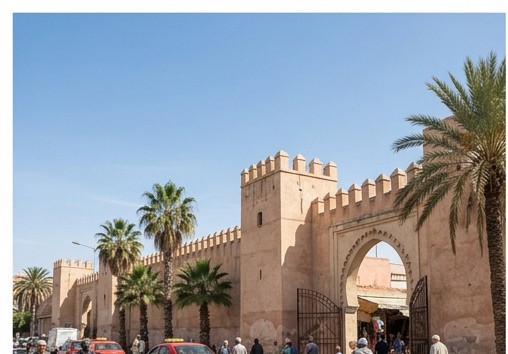
AI-generated image · may differ from the real place I always find my way back to Souk El Had when the morning sun begins to warm the high exterior walls. Entering through one of the thirteen grand gates, the sheer scale of Africa's largest urban market unfolds in an endless maze of fragrant stalls and shaded corridors. This is where Agadir's agricultural seasons arrive in vibrant abundance: wicker baskets brimming with winter clementines from the Souss valley, jars of fragrant orange blossom honey, and mounds of hand-ground cumin that perfume the warm air. Weaving through the quiet hum of conversation in Tachelhit, look closely at the craft stalls where artisans polish thuya wood and display handwoven Berber carpets. Keep small cash bills handy in your jacket pocket, and take time to exchange a warm greeting and agree gently on prices before purchasing a cone of freshly roasted almonds or a tin of pure argan oil.
Leaving behind the bustling corridors and sensory warmth of the market, walk northwest through the modern city grid toward the quiet sanctuary of the Complexe Culturel Mohamed Khair Eddin.
- 1 min · on site
Complexe Culturel Mohamed Khair Eddin
Echoes of Verse and Berber Modernity
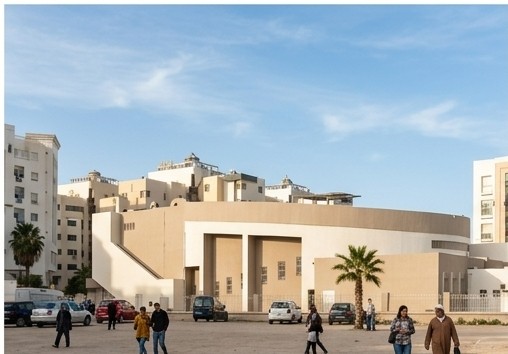
AI-generated image · may differ from the real place Stepping off the sunlit boulevard into the Complexe Culturel Mohamed Khair Eddin, the brisk coastal air gives way to contemplative silence. Named in honor of the legendary Moroccan author and poet who captured the fierce spirit of the southern mountains, this cultural center serves as an artistic haven for seasonal exhibitions, poetry readings, and Amazigh academic conferences. It was here that I first understood how the resilient creative energy of the Souss region found its voice after the great earthquake. Wander slowly through the gallery halls, where bold contemporary paintings share space with historical photographs and indigenous calligraphy. When you enter the central foyer, stop by the front reception desk to inquire about the current exhibition calendar, and pause near the courtyard to listen to the soft murmur of students discussing literature beneath the sheltering palm fronds.
From these serene halls of contemporary culture and spoken memory, follow the gentle downward slope of the avenue westward toward the gleaming waterfront of Agadir Marina.
- 1 min · on site
Golden Hour on the Atlantic Slipways

Photo: AyourAchtouk · CC BY-SA 4.0 · Original file Arriving at Agadir Marina in the late afternoon, the city reveals its most tranquil coastal face. White yachts and sailing boats rock gently against their berths while the golden hour light washes over the wide pedestrian promenade. Sitting at an outdoor terrace with a glass of fresh mint tea, I remembered how Aristotle Onassis and Winston Churchill sailed into these very waters aboard the yacht Christina in 1959, admiring the sheltered bay and the mountain ridge that rises behind the harbor. Look across the water toward the historic Kasbah hill, where the illuminated inscription of God, Country, and King begins to glow against the evening sky. Time your visit to catch the sun dipping into the Atlantic, watching the local fishing fleet return from sea while families stroll peacefully along the waterfront breeze.

Long after you leave Agadir, the memory of that gentle Atlantic light remains, an enduring reminder that every season here is an invitation to begin anew.
Take it further
Open the tour in the appThe tour in the app
A Seasonal Walk from Souk to SunsetThis leisurely walking journey traces Agadir's seasonal heartbeat, starting amid the vibrant citrus scents and artisanal craft stalls of Souk El Had. It winds through the quiet contemporary galleries of the Mohamed Khair Eddin Cultural Complex before concluding at Agadir Marina, where late afternoon sunlight warms the tranquil Atlantic waterfront.
+ Add the tour to your planIf you have the app the tour opens right away; otherwise you go to the store.FAQ
- What is the best time of year to experience Agadir's cultural festivals?
- January is especially vibrant with the New Amazigh Year celebrations downtown, while July brings the Timitar festival celebrating world and Amazigh music across open stages.
- How does the winter climate feel for travelers exploring on foot?
- Midday winter temperatures in January average around twenty degrees Celsius with mild sunshine, making it an ideal season for exploring markets and walking along the open promenades without intense desert heat.