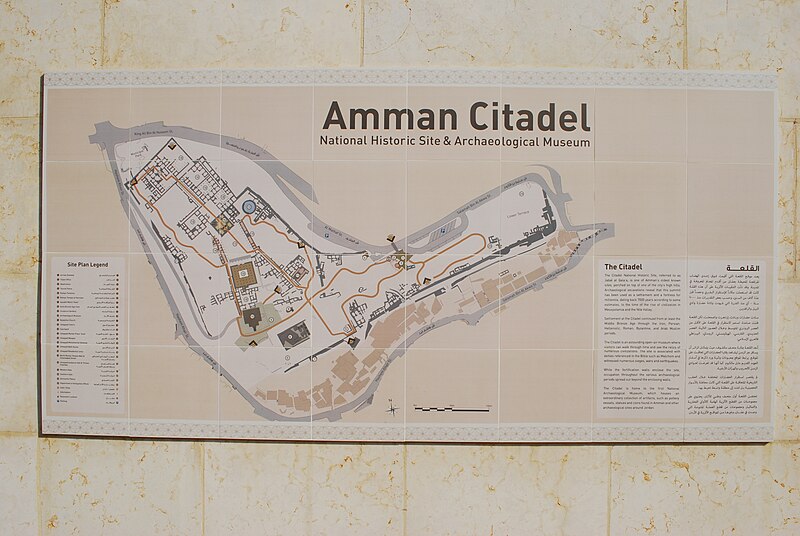
Amman is the ancient capital of Jordan, built across steep limestone ridges where Roman columns overlook lively modern neighborhoods.
I still remember the autumn wind sweeping across Citadel Hill during our very first evening walk together.
From that high summit, the pale limestone houses look like smooth pebbles scattered across seven golden hills.
A city shaped by steep slopes asks you to slow down your pace.
You cannot rush up these winding staircases or hurry through the quiet residential lanes.
Every stone corner opens to a sudden panorama of distant rooftops and pale sandstone terraces.
The cool evening breeze brings the aroma of dried mint and roasted coffee from the souks below.
As dusk settles, the evening call to prayer echoes across the valley.
One melodic voice rises from downtown, and another answers from a distant ridge.
The sky shifts from warm amber to deep violet above the quiet streets.
Up on the heights, the sun-baked stone pillars retain the warmth of the daylight.
Walking here hand in hand feels like stepping into a private world that belongs only to two people.
The Goddess and the Forgotten Basilica
The Amman Citadel on Citadel Hill preserves the layered ruins of civilizations that governed this desert plateau for thousands of years.
Greek architect and archaeologist Chrysanthos Kanellopoulos excavated the great Roman temple site here during the nineteen nineties.
For generations, travelers assumed that the gigantic marble hand lying in the dust belonged to the warrior hero Hercules.
Kanellopoulos examined the three surviving fingers and the carved elbow with meticulous care.
He noticed the slender fingernails and the delicate shape of the stone forearm.
He concluded that this colossal statue represented a protective goddess, perhaps Athena or Tyche, rather than a warrior hero.
His discovery matters because it reveals that ancient Amman honored a tender, watchful guardian rather than military conquest.
Roman governor Geminius Marcianus had commissioned this great sanctuary in the second century to impress visitors from across the Mediterranean.
Yet the stone hand resting in the grass speaks of quiet grace rather than imperial force.
Just steps away stand the stone foundations of a sixth-century Byzantine church.
British explorer C. R. Conder first excavated this basilica in eighteen eighty-one.
Conder cleared away centuries of earth to reveal vibrant mosaic floors resting beside ancient Roman pillars.
The colored floor tiles still catch the fading afternoon light, glowing like jewels set in dusty earth.
Courtyards Beneath the Night Sky
The Umayyad Palace crowns the northern crest of Citadel Hill, showcasing the early Islamic architecture of Jordan.
Umayyad Caliph Hisham ibn Abd al-Malik ordered the construction of this governor residence around the year seven thirty-five.
His master builders designed a central reception hall featuring four grand arched spaces known as iwans.
An iwan is a monumental vaulted hall that remains open on one side to a breezy courtyard.
The caliph borrowed this architectural concept from Persian royal palaces to welcome travelers into an airy, sheltered sanctuary.
That deep tradition of welcoming hospitality still defines the romantic quarters of Amman today.
Across the historic hills of Jabal Amman and Jabal al-Weibdeh, old stone villas now open their leafy gardens to visitors.
Couples gather at small iron tables beneath green fig trees and flowering jasmine vines.
They share warm flatbread, savory bean dips, and quiet conversation under strings of amber patio lamps.
Amman does not try to overwhelm you with soaring glass towers.
It invites you into a secluded courtyard, serves hot spiced tea, and lets the night linger without hurry.
Want to walk it yourself? Plan a trip with these places
The walk
On site, play just that chapter
- 1 min · on site
Sunset Above the White City
Photo · Wikimedia Commons The Amman Citadel is an ancient hilltop fortress on King Ali Ben Al-Hussein Street overlooking Downtown Amman. This archaeological site matters because human communities have lived on this high ground for thousands of years. To reach the quietest spots, visit in the late afternoon when tour buses depart and the desert light softens. Walk past the ancient watchtower toward the Temple of Hercules. Look down at the giant marble hand resting quietly beside the three standing Roman pillars. The surviving fingertips gleam against the golden evening sky. From the southern edge of the hill, you can see across the entire valley to the opposite ridge. The pale stone houses turn amber as the sun dips behind the distant hills. Standing here above the humming streets brings a calm that makes the bustling city feel far away.
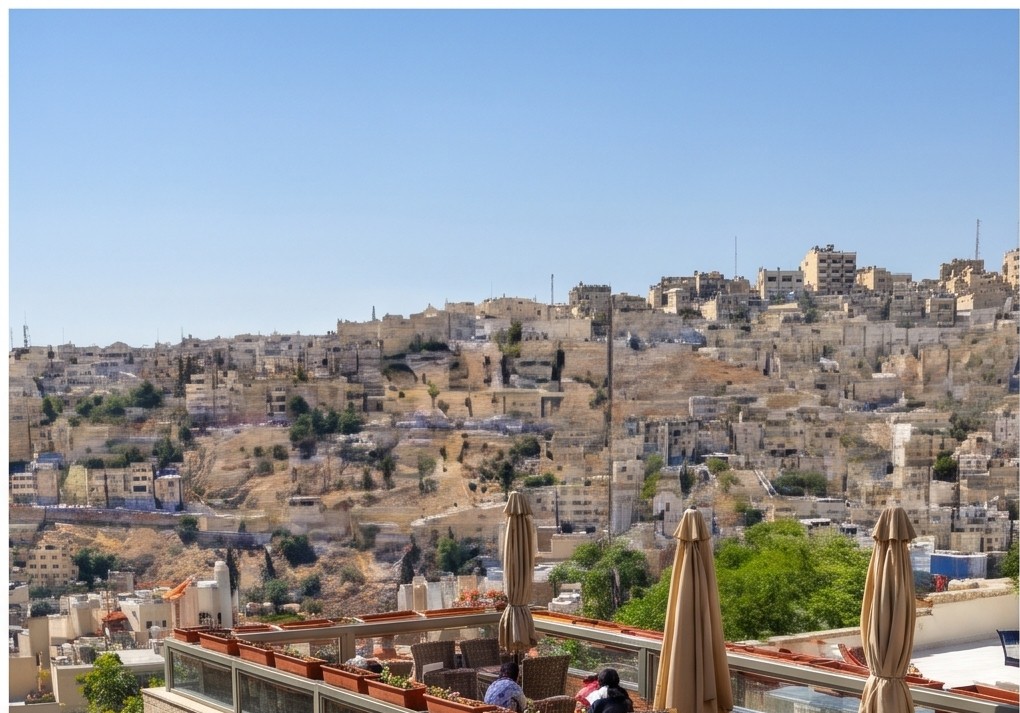
Walk down the hill and cross the valley to Umar Ibn Al Khattab street, where the cozy terrace of Old View awaits.
- 1 min · on site
Golden Hour Over the Valley
AI-generated image · may differ from the real place Old View is a relaxed rooftop cafe located on Umar Ibn Al Khattab street in the historic quarter of Jabal Amman. This scenic cafe matters because it provides one of the clearest panoramic sunset views in the entire city. Arrive shortly before dusk to secure a front table right against the terrace railing. Order a mug of warm, thick hot chocolate as the evening temperature drops over the hills. Look straight across the deep valley at the floodlit pillars of the Citadel standing against the darkening sky. Below you, rows of yellow taxi cabs drift along the curving streets like ribbons of light. The warm drink and cool evening breeze create an effortless intimacy between two people sharing a table. It is a simple place to pause before entering the lively evening promenade.
Walk five minutes down toward Rainbow Street, where the warm courtyard lanterns of Sufra Restaurant await your arrival.
- 1 min · on site
A Courtyard Dinner Under Lemon Trees
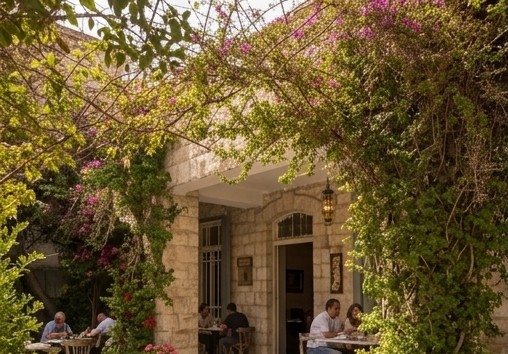
AI-generated image · may differ from the real place Sufra Restaurant is a traditional Jordanian dining house located in a restored stone villa at twenty-six Rainbow Street. This celebrated restaurant matters because it preserves cherished heritage recipes in an elegant domestic setting. When you enter through the front archway, ask the host for a secluded table in the garden courtyard. Green lemon trees and clay pots filled with red geraniums line the paved terrace. Order mansaf, the beloved national dish of tender lamb cooked in a savory fermented dried yogurt broth called jameed. The dish arrives over spiced yellow rice and thin flatbread, topped with toasted pine nuts and silvered almonds. Sharing this rich meal under the open night sky feels like being welcomed into a gracious Jordanian home. After your dinner, take a leisurely stroll past the art galleries and bookshops of Rainbow Street.
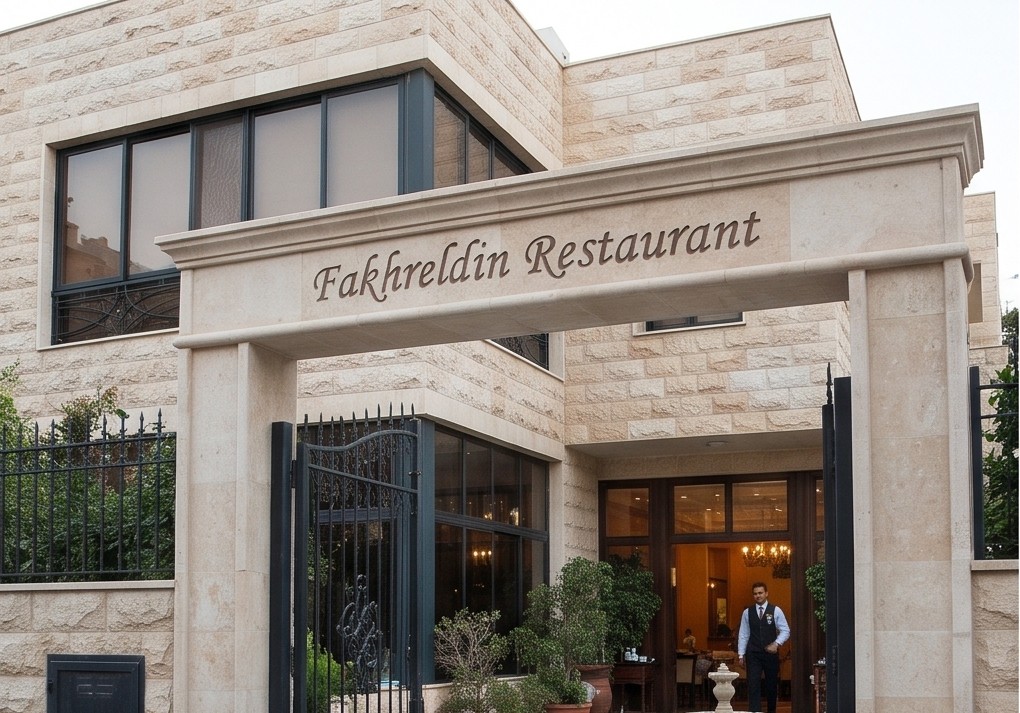
Follow the curving road west through the leafy embassy quarter to Taha Hussein Street, where Fakhreldin Restaurant sits secluded behind stone walls.
- 1 min · on site
Gentle Elegance in a Diplomatic Villa
AI-generated image · may differ from the real place Fakhreldin Restaurant is an upscale Levantine restaurant situated in a grand historic villa on Taha Hussein Street near the Second Circle. This iconic establishment matters because it has hosted diplomats, writers, and artists with legendary Lebanese culinary artistry for decades. Be sure to reserve a table in the garden courtyard in advance for a private and serene dining atmosphere. Tall palm trees and fragrant gardenias shade the manicured grounds from the city noise outside. Order a selection of cold and hot mezze, the traditional array of small sharing plates. Enjoy velvety chickpea hummus with warm bread, alongside charcoal-grilled lamb kebabs seasoned with fragrant sumac and ground herbs. Attentive servers replenish silver water carafes while soft classical violin melodies drift across the outdoor terrace. The timeless elegance of the villa makes any evening feel like a celebrated occasion.
Leave the garden and stroll into the artistic alleys of Jabal al-Weibdeh to find Chapters on Al-Shariaah College Street.
- 1 min · on site
Comfort Food in a Literary Quarter
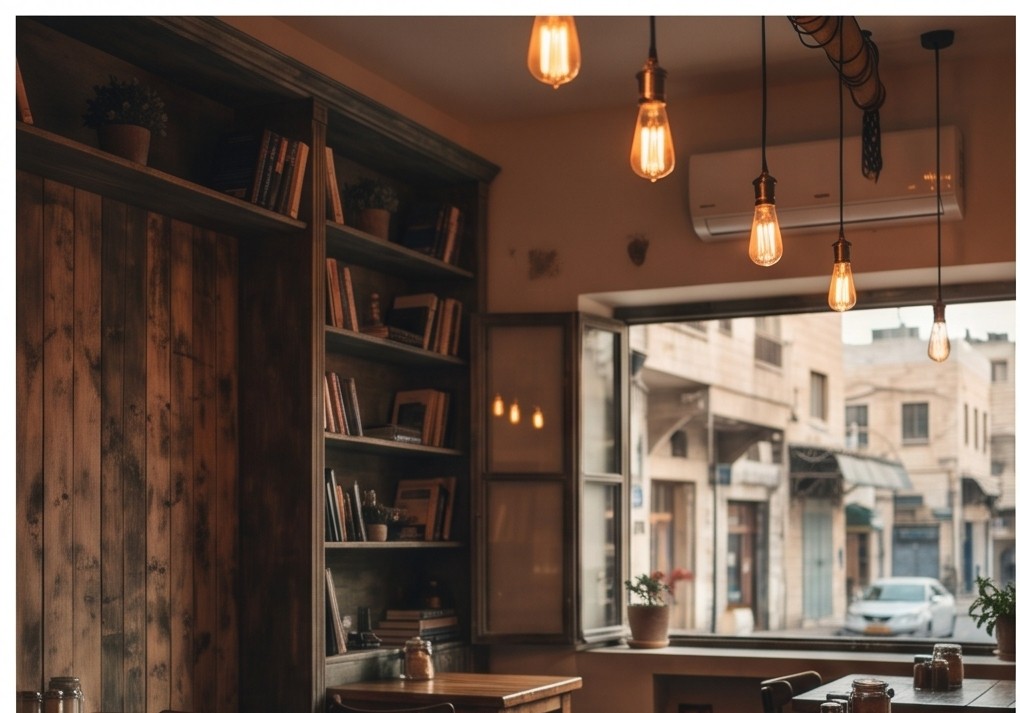
AI-generated image · may differ from the real place Chapters is a charming neighborhood bistro located at four Al-Shariaah College Street in the bohemian district of Jabal al-Weibdeh. This welcoming eatery matters because it creates inventive Mediterranean home cooking designed entirely for communal dining. Come with a healthy appetite so you can sample several shared dishes from their thoughtful seasonal menu. Always ask your server about the slow-cooked daily specials simmering in the open kitchen. Do not miss their signature fatteh, a warm comforting dish made with toasted flatbread, spiced chickpeas, and rich garlic yogurt. Melted clarified butter and toasted pine nuts sizzle over the top when it arrives at your table. Books and vintage prints decorate the sunny dining room, giving the space the relaxed feel of an artist home. It is an intimate place to linger over food and conversation.
Turn the corner onto Al-Baouneyah Street, where the glowing colored lamps of Rakwet Arab Restaurant mark the final stop of our walk.
- 1 min · on site
Starlight and Cardamom in Weibdeh
AI-generated image · may differ from the real place Rakwet Arab Restaurant is a beloved late-night cafe and restaurant located at eleven Al-Baouneyah Street in Jabal al-Weibdeh. This atmospheric gathering spot matters because it captures the true bohemian spirit and creative soul of night-time Amman. Stay late into the evening when the leafy courtyard fills with neighborhood artists, university students, and lively conversation. Find a small wooden table beneath the grape arbor and antique copper coffee pots hanging along the limestone walls. Order traditional Arabic coffee brewed in a small long-handled metal pot called a rakweh, infused with aromatic cardamom seeds. Pair the spiced coffee with a plate of grilled halloumi cheese, crisped golden on the outside with fresh mint leaves. Laughter and the strum of an oud lute drift through the night air as time slows to an easy pace. Sitting here together under the stars provides a gentle, unforgettable farewell to this timeless desert city.
As midnight settles over Amman, the dry desert wind cools the stone terraces and the seven hills fall into a quiet slumber. Traveling here as a couple is not about rushing between famous ruins, but about discovering those rare moments where ancient history provides a backdrop for quiet understanding. Whether watching the sun melt across Citadel Hill or sharing a pot of spiced coffee beneath climbing vines, this city grants you the luxury of unhurried time. Long after you leave, the pale limestone slopes and the warm scent of jasmine will linger in your thoughts like an unfinished song.
Take it further
Open the tour in the appThe tour in the app
A Romantic Evening Across Amman HillsThis walking tour begins atop the ancient Amman Citadel at golden hour, taking you across the valley to the sunset terraces and romantic dining courtyards of Jabal Amman, before finishing among the bohemian late-night cafes of Jabal al-Weibdeh. It is an intimate walk designed for unhurried conversation.
+ Add the tour to your planIf you have the app the tour opens right away; otherwise you go to the store.FAQ
- What makes walking between the hills of Amman romantic?
- The steep limestone staircases and high ridges offer sudden panoramic views over the city, while historic residential villas open peaceful garden courtyards where couples can dine away from street noise.
- What is the best time of day to follow this route?
- Start in the late afternoon around four o'clock to enjoy softer light on the Citadel, catch the sunset from Old View, and linger over dinner and coffee late into the evening.
This piece was newly written based on the Wikipedia articles ‘Amman Citadel’ · CC BY-SA 4.0