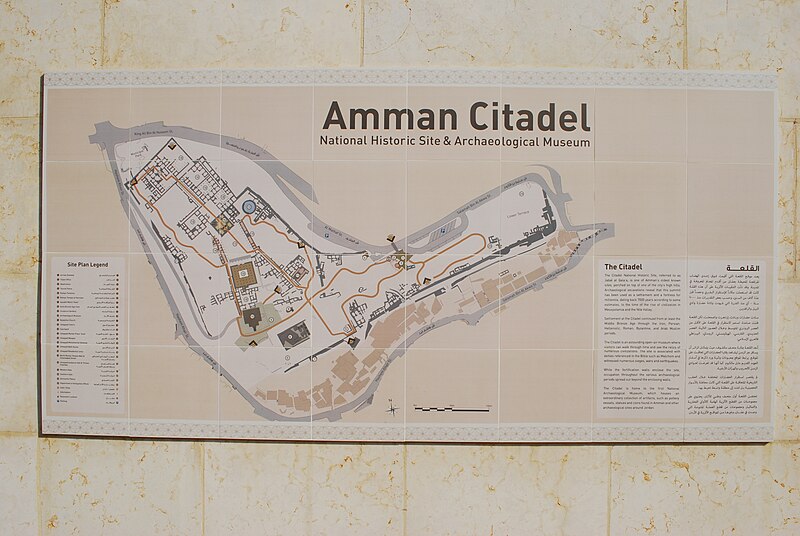
Amman is the capital city of Jordan, built across steep hills that shelter thousands of years of human settlement. The city matters because it is one of the oldest continuously inhabited places on earth. I evaluate a city the same way I judge an open kitchen. I look for raw ingredients, honest fire, and the honest marks of human labor. As morning breaks, the pale limestone buildings reflect a sharp, dry glare. The scent of crushed sumac and toasted sesame drifts upward from the street stalls below. In the distance, the morning call to prayer reverberates against sheer chalk cliffs. The sound carries a clean, resonant weight through the thin morning air. Dust rises from the downtown streets as shopkeepers sweep their stone doorsteps. From this vantage point, you can see how Amman grew over four thousand years. The city is not a sterile museum piece preserved under glass. It is a working kitchen that has fed countless dynasties without a single pause.
The Masons of the Acropolis
Citadel Hill rises in the center of Amman as an acropolis, which means a fortified high city. This limestone ridge matters because every major ruling power from the Bronze Age to the Islamic era left its mark here. A great cook understands that true flavor comes from reduction and slow heat. On the high summit, Roman stonecutters dressed massive columns for the Great Temple of Amman. In the second century, Roman provincial governor Geminius Marcianus ordered the construction of this grand sanctuary. His bold undertaking gave the Roman province of Arabia its most impressive public statement. Masons quarried the surrounding hills and carved towering pillars that measured over thirteen meters high. They set these giant drums atop a raised stone platform that commanded the entire valley. Centuries later, Christian masons built a basilica on the adjacent ground. In 1881, British explorer C. R. Conder excavated the ruined sixth-century church. He discovered that the Christian builders took Corinthian capitals directly from the Roman temple. They carved acanthus leaves into the nave, which is the central hallway of a church. The builders did not discard older stone. They folded older classical spices directly into their new Christian liturgy.
A Thousand Years of Seasoning
The Umayyad Palace complex occupies the northern terrace of Citadel Hill as an eighth-century administrative center. This monument matters because it demonstrates how Islamic rulers merged Persian architecture with local desert stone. Around the year 735, Umayyad caliph Hisham ibn Abd al-Malik commissioned this governor residence. The royal builders created an audience hall shaped with four iwans, which are vaulted halls opening onto a central court. They decorated the limestone walls with delicate rosettes and palmettes influenced by artisans from ancient Iraq. East of the hall, engineers carved a circular cistern sixteen meters wide to catch rainfall for royal baths. Greek archaeologist Chrysanthos Kanellopoulos studied this high terrace during major excavations in the 1990s. He examined three colossal marble fingers and a massive elbow found near the Roman temple. Earlier excavators assumed the giant statue represented Hercules. However, Kanellopoulos identified slender fingernails and smooth muscle contours on the carved fragments. He showed that the colossal statue depicted a supreme goddess such as Athena or Astarte rather than a male warrior. History in Amman is never a simple recipe with a single ingredient. Ayyubid soldiers later added a watchtower in 1220, recycling Roman column drums into the defensive masonry. Each empire seasoned the stone to its own taste, leaving behind a feast of chiseled limestone for the curious traveler.
Want to walk it yourself? Plan a trip with these places
The walk
On site, play just that chapter
- 1 min · on site
Limestone Columns on the High Acropolis
Photo · Wikimedia Commons The Amman Citadel is an ancient ruined fortress on Citadel Hill in central Amman, Jordan. This archaeological site matters because it preserves the remains of Roman temples and Umayyad palaces in one place. As a culinary critic, I inspect how the stone blocks fit together like well-cut pastry. Wear sturdy walking shoes here because the paths are uneven and climb over rough bedrock. Walk past the entrance gate toward the southern terrace to find the Great Temple of Amman. Look up at the two remaining Roman columns that rise over thirteen meters high. Near their base lie three colossal marble fingers and a stone elbow. Greek archaeologist Chrysanthos Kanellopoulos deduced that these delicate fingernails belonged to a supreme goddess. Continue north along the gravel path to reach the domed Umayyad audience hall. Notice the four vaulted alcoves called iwans. The cool shade inside feels as refreshing as cold well water.
From the southern lookout of the hill, take the stone steps leading down into the bustling downtown valley toward the Roman Theatre.
- 1 min · on site
Acoustic Precision in the Downtown Bowl
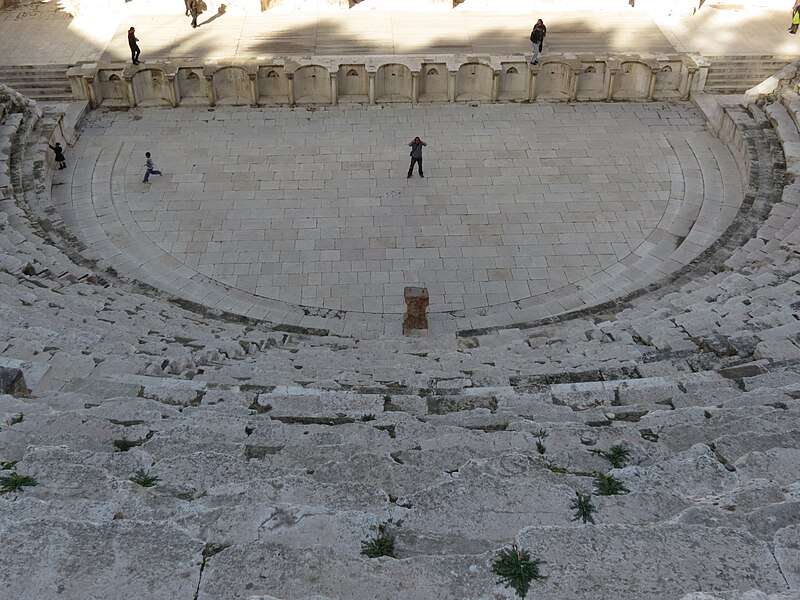
Photo · Wikimedia Commons The Roman Theatre is a restored second-century amphitheater located on Al-Hashemi Street in downtown Amman. This monument matters because it seated six thousand spectators and anchored the public life of ancient Philadelphia. Good cooking relies on precise acoustics, just like sizzling oil tells a chef when heat is right. Roman provincial governor Geminius Marcianus built this auditorium into a steep northern hillside to shield audiences from the sun. Step onto the stone stage and whisper toward the tiers of limestone benches. The sound travels crisply all the way to the top tier without any amplification. Climb the steep limestone steps to the uppermost tier of seats. The incline is demanding, so hold the stone edges for balance. From the top row, look across the open plaza toward Citadel Hill rising above the rooftops. You can see how the entire city gathers around this monumental bowl like guests around a banquet table.
Walk east across the flat paving stones of Hashemite Plaza toward the smaller curved facade of the Odeon Theater.
- 1 min · on site
The Intimate Recital Counter
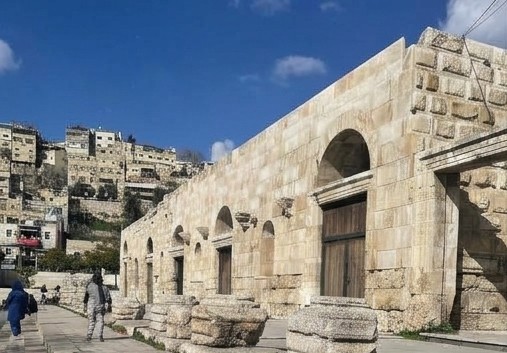
AI-generated image · may differ from the real place The Odeon Theater is a compact Roman music hall located on Al-Hashemi Street next to Hashemite Plaza. This intimate venue matters because it hosted poetry recitals and city council debates away from the roaring amphitheater crowds. In the culinary world, an intimate tasting counter offers a far sharper focus than a banqueting hall. The Odeon held only five hundred spectators under what was originally a timber roof. Walk out into the open plaza in front of the theater for the clearest view of its curved facade. Notice how the smoothly dressed limestone blocks interlock without modern mortar. Step through the arched entrance and sit on the low stone benches near the orchestra floor. Here, the city street traffic fades into a quiet hum behind the thick boundary walls. You can hear the dry wind brush across the carved cornice stones. It leaves a lasting impression of Roman architectural discipline.
Amman proves that time does not diminish great craftsmanship. From the colossal temple columns above to the curved stone theaters below, the city was built with patience, weight, and discipline. When you leave these ancient stones and head into the vibrant downtown markets, carry this culinary lesson with you. The finest creations in stone and bread always demand unyielding devotion to the raw ingredients.
Take it further
Open the tour in the appThe tour in the app
Amman Historic Citadel and Downtown Theatres WalkThis walking route begins on Citadel Hill among the Roman columns and Umayyad ruins. Descend the pedestrian stairs into the downtown valley to explore the monumental Roman Theatre. Finish on the flat flagstones of Hashemite Plaza inside the intimate Odeon Theater.
+ Add the tour to your planIf you have the app the tour opens right away; otherwise you go to the store.FAQ
- What is the best way to walk between Citadel Hill and the Roman Theatre?
- Descend using the marked public stairway on the southern slope of Citadel Hill. The path leads directly into downtown Amman near Hashemite Plaza in about fifteen minutes.
- Why were the Roman theaters in Amman built facing north?
- Roman architects positioned both the Roman Theatre and the Odeon against northern hillsides so spectators would never face the blinding Mediterranean sun during daytime performances.
This piece was newly written based on the Wikipedia articles ‘Amman Citadel’ · CC BY-SA 4.0