Whenever autumn returns, my thoughts inevitably drift back to that first pale dawn I walked along the banks of the Arno, watching the amber river mist curl around the weathered stone piers of Florence. The city was still half asleep, bathed in that tender gray light unique to Tuscany, and the paving stones under my boots felt slick with morning moisture. In that solitary hour, before church bells began their daily clamor from the high belfries, Florence did not feel like an open-air museum or an obligatory stop on a grand itinerary. It felt intensely alive, a wounded survivor of its own tempestuous genius. We often arrive here expecting serene geometry and polite harmony, having read about Renaissance humanism in tranquil libraries. Yet the stone truth of Florence is far more raw and dramatic. It was a republic forged in stubborn fury, ruthless exile, and artists who wagered their sanity and their lives upon the things they made with their hands.
I remember standing beneath the rough sandstone facades, feeling the chill that lingers in the narrow medieval alleys even at midday. Florence never sought to soothe its visitors. It confronted them with monumental ambition, demanding that every citizen, merchant, and ruler measure their fragile existence against eternity. Here, beauty was weaponized as statecraft, and political rivalry burned as intensely as religious faith.
Furnaces, Wax, and the Scent of River Stone
To understand this city, one must picture the sheer desperation that accompanied its greatest wonders. When Benvenuto Cellini cast his bronze Perseus, the metal began to curdle in an overheated furnace. Shivering from a sudden violent fever that had nearly driven him to his deathbed, the sculptor leapt up, cursing his terrified assistants, and ordered every scrap of dry household furniture thrown into the blaze. When even the oak tables were consumed, he hurled two hundred pewter dishes and platters from his kitchen into the roaring fire to force the molten bronze to flow into the mold. Only then did the liquid metal surge into the hollow limbs of the hero holding Medusa's severed head.
Across the piazza, inside the vast hall of the town palace, Leonardo da Vinci attempted to paint a monumental battle scene on plaster. Ever the relentless experimenter, Leonardo mixed beeswax into his pigments, but when the surface failed to dry, he ordered braziers stoked with red-hot coals brought into the hall. Horrified officials watched the heat liquefy the wax, sending dark trickles of pigment running down the damp wall. Meanwhile, on the opposite wall, Michelangelo had prepared magnificent full-scale sketches of soldiers, only for eager young artists to crowd the chamber, tearing the paper into fragments and carrying away the scraps like sacred relics.
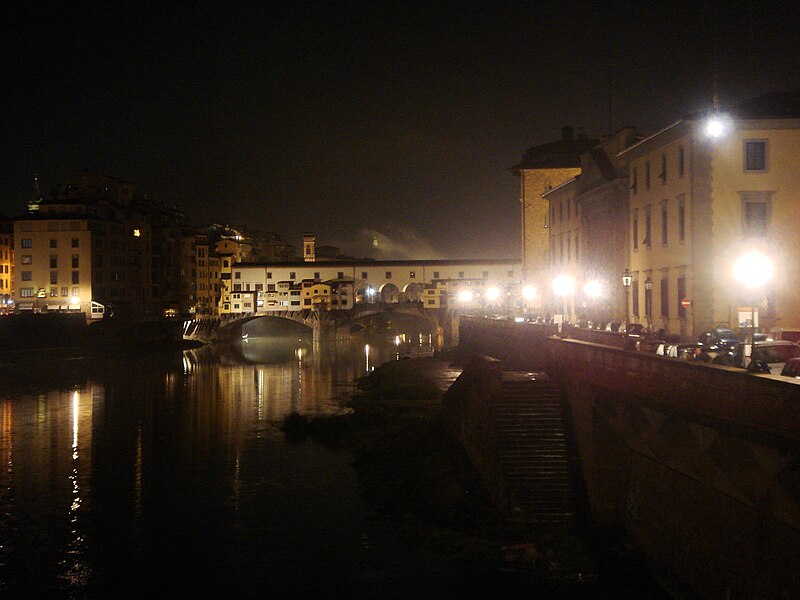
Even the everyday life of the city was governed by this ruthless pursuit of power. In 1565, when Duke Cosimo de Medici had Giorgio Vasari build an elevated walkway over Ponte Vecchio to connect his town hall with his palace across the river, he summarily banished the butchers who had monopolized the bridge for over a century. Their blood and rancid stench offended the duke as he walked overhead, so he replaced them by decree with goldsmiths whose lustrous wares would lend dignity to the Arno.
The Lingering Echo of the Square
As you listen to these words on your way into the historic core of Florence, look closely at the deep rusticated stones and shadowed recesses of the piazzas. Every archway preserves the memory of human hands pushing stubbornly against the physical limits of bronze, stone, and pigment. In this city, art was never a quiet luxury, it was an urgent struggle against oblivion. Keep your gaze attuned to the small scars in the stone, for it is in those imperfections that the true Florence still speaks.
Want to walk it yourself? Plan a trip with these places
The walk
On site, play just that chapter
- 1 min · on site
Galleria dell'Accademia di Firenze
The Awakening from Carrara Marble
Photo · Wikimedia Commons Stepping into the Tribuna of the Accademia on a crisp morning, the world outside falls silent. Before Michelangelo's David, what strikes me most is not just the towering height of the marble, but the pulsating tension carved into his right hand, the veins raised as if blood were actively surging beneath the polished stone. As you stand before him, walk slowly along the corridor leading to the rotunda and notice the unfinished Prisoners. Their rough, half-emerged forms seem to struggle desperately against the heavy stone, revealing the chisel marks of a young master who believed the sculpture was already trapped inside, waiting to be freed. Look closely at the slingshot resting casually across David's shoulder and the furrowed concentration in his brow, watching the distant giant before the strike. It is an overwhelming encounter with human vulnerability turned into divine resolve.
Step out into the bright light of Via Ricasoli and walk south towards the civic heart of the city until the grand open expanse of Piazza della Signoria opens before you.
- 1 min · on site
The Stone Stage of Ambition and Ashes
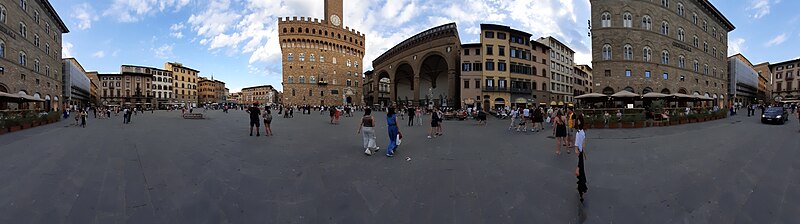
Photo · Wikimedia Commons Piazza della Signoria has always felt less like a public square and more like a theatrical amphitheater paved in sandstone. Standing near the splashing waters of Ammannati's Fountain of Neptune, look down at the paving stones just in front of the basin to find the small circular marble plaque embedded in the ground. It marks the exact, terrible spot where the fiery Dominican friar Girolamo Savonarola, who once burned cosmetics, mirrors, and poetry in the Bonfire of the Vanities, was hanged and burned to ashes in 1498. As you pivot to take in the surrounding facades, let your eyes sweep past the marble statues that line the promenade. From Donatello's bronze Judith to the colossal replica of David guarding the palace gate, every sculpture here was erected not merely for aesthetic wonder, but as an aggressive manifesto of republican liberty and Medici dominance.
Turn now toward the colossal rusticated fortress looming over the eastern edge of the square and cross the threshold into Palazzo Vecchio.
- 1 min · on site
Echoes in the Hall of the Five Hundred
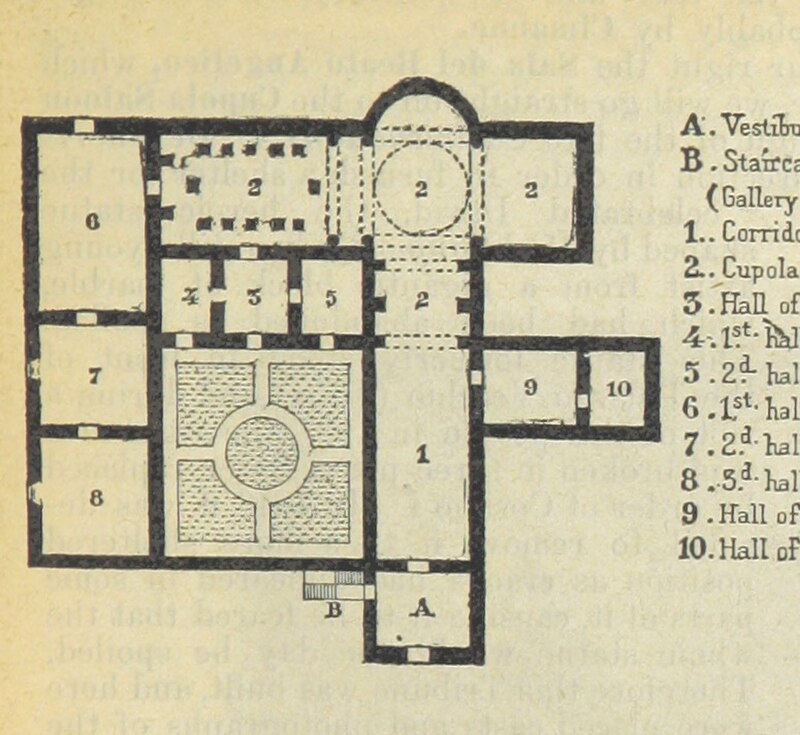
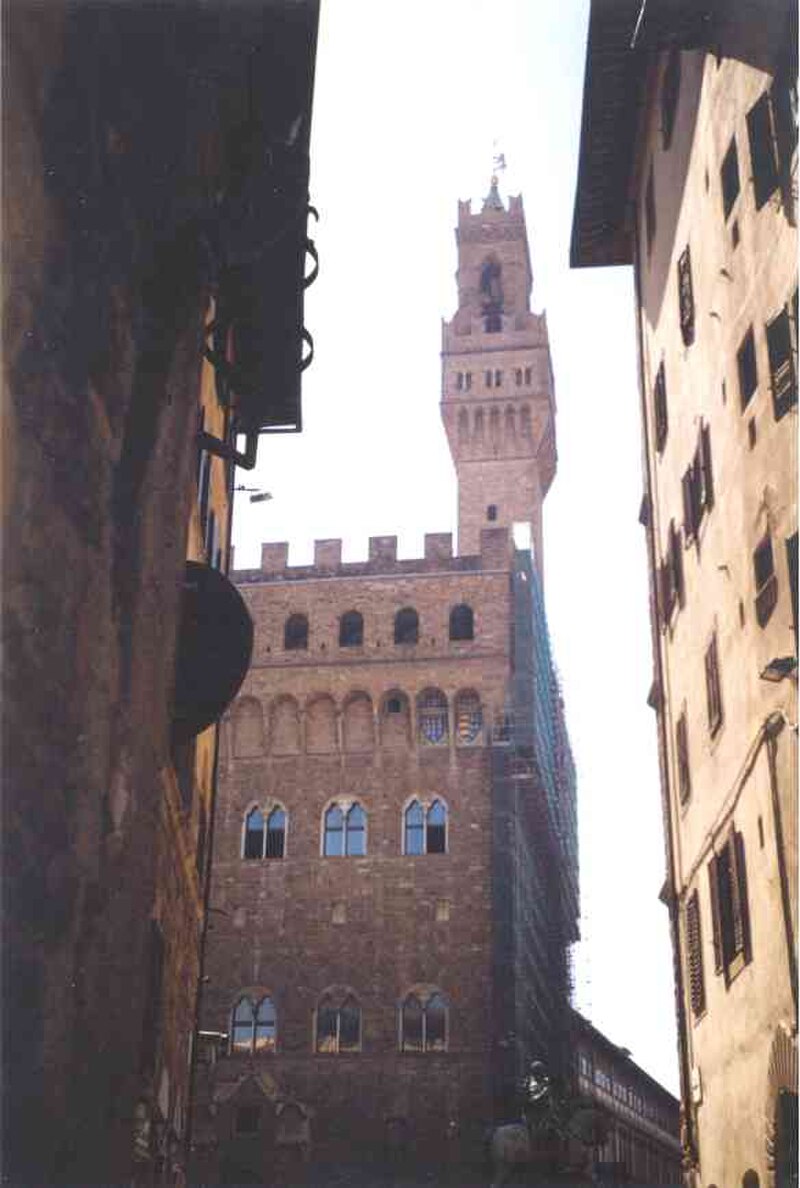
Photo · Wikimedia Commons Passing through the ornate entrance of Palazzo Vecchio beneath the golden monogram, the atmosphere thickens with the gravity of centuries. Climb the monumental stone staircase designed by Giorgio Vasari to enter the breathtaking Salone dei Cinquecento. This cavernous hall, fifty-two meters long, was built in 1494 under Savonarola's influence for the Grand Council of the Republic. Stand in the center and gaze upward at the thirty-nine gilded ceiling panels celebrating Duke Cosimo, then turn to the massive frescoed walls depicting Florence's fierce victories over Pisa and Siena. Look carefully toward the lower frescoes, remembering that beneath these very painted surfaces lies the lost ghost of Leonardo da Vinci's ill-fated battle mural, encased forever behind Vasari's plaster wall. Before you leave, step into the adjacent chancellery where Machiavelli penned his sharp analyses of human power.
Descend back into the sunlight of the piazza and make your way just a few steps south to the grand open arches of Loggia dei Lanzi.
- 1 min · on site
The Theater of Bronze and Marble
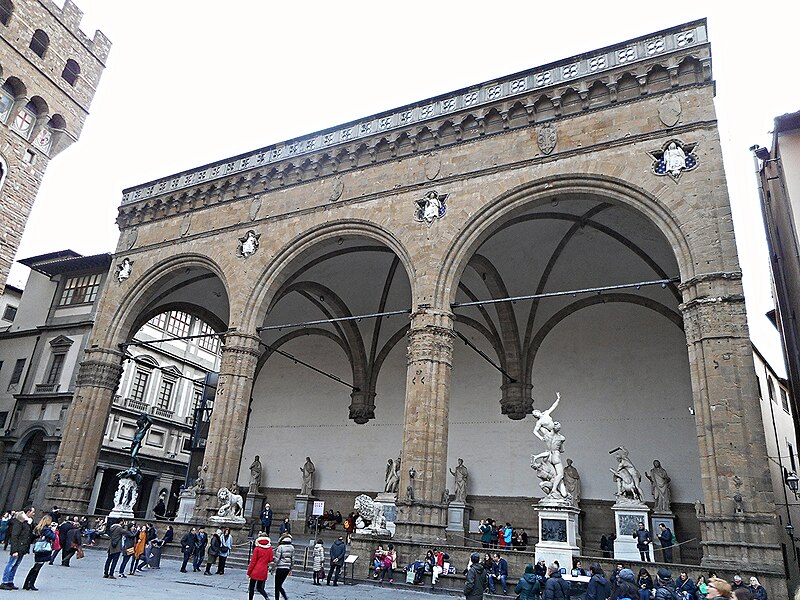
Photo · Wikimedia Commons Stepping under the wide, vaulted arches of the Loggia dei Lanzi offers a welcome respite in an open-air sculpture gallery of extraordinary power. Look up at the high cluster columns that inspired Michelangelo to suggest ringing the entire square with similar arcades. On the far left, Benvenuto Cellini's bronze Perseus holds the severed, bleeding head of Medusa high above his head. Walk close to the richly ornamented bronze pedestal and look into Perseus's face, you will notice not triumphal arrogance, but a contemplative, almost sorrowful exhaustion, reflecting the near-fatal fever and melted household pewter that brought him into being. To the right stands Giambologna's Rape of the Sabine Women, carved from a single flawed block of Carrara marble. Circle slowly around it to admire how the spiraling figures intertwine effortlessly, offering a breathtaking, dynamic composition from every single angle you choose to view.
Walk past the statues and follow the path leading down toward the riverbank until you reach the bustling cobblestones of Ponte Vecchio.
- 1 min · on site
The Golden Span over the Arno
Photo · Wikimedia Commons Stepping onto the cobblestones of Ponte Vecchio, the scent of the river mingles with the glint of gold in tiny shop windows. This medieval segmental arch bridge, rebuilt in 1345, is the only bridge in Florence spared from destruction by retreating German forces in 1944. Stand at the open central terrace where the bust of Benvenuto Cellini gazes toward the western hills, and look up above the rooftops of the jewellery shops. There runs the enclosed corridor that Vasari constructed in 1565 in just nine months, designed so the Medici dukes could cross the river unseen above common citizens. Notice how the bridge survived devastating Arno floods, maintaining its medieval spirit while trade shifted from smelly butcher stalls to master goldsmiths. In the soft light of dusk, the river glows amber below, reflecting centuries of resilient survival.
Cross the remainder of the bridge into the quieter streets of the Oltrarno and follow the gentle incline to the sweeping facade of Pitti Palace and Boboli Gardens.
- 1 min · on site
Pitti Palace and Boboli Gardens
Terraces of Stone and Green Sanctuary
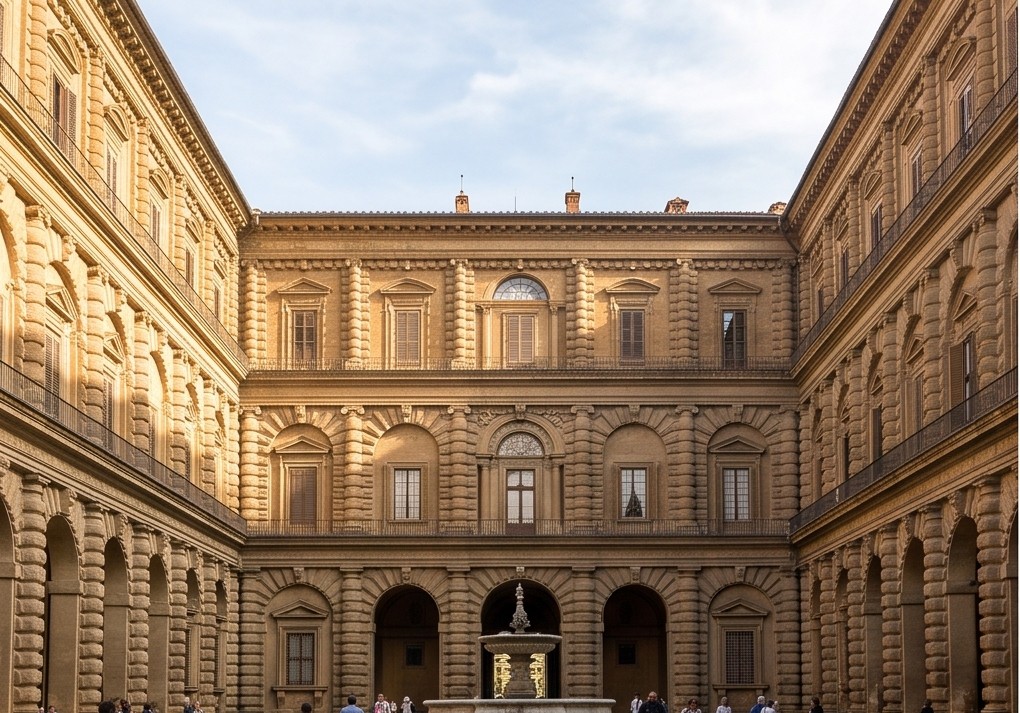
AI-generated image · may differ from the real place Arriving at the sweeping sloping piazza before Pitti Palace, the sheer immensity of the rusticated facade commands total attention. Once the grand ducal residence of Eleonora di Toledo and Cosimo I, this monumental estate opens out into the theatrical landscapes of the Boboli Gardens. Ascend the gravel path behind the palace courtyard, passing the ancient Egyptian obelisk rising from the amphitheater up toward Stoldo Lorenzi's Fountain of Neptune. As you reach the crest of the hill, pause to catch your breath and look back over the terracotta roofs of Florence. Before you leave, seek out Buontalenti's Large Grotto tucked near the palace entrance, where stalactites, whimsical mannerist frescoes, and replicas of Michelangelo's Prisoners once created an enchanting subterranean sanctuary. Here, amidst towering cypress trees and weathered garden statues, the frenetic ambition of Florence finally dissolves into contemplative peace.
Long after you leave Florence and the sound of your footsteps on its ancient stones fades into memory, the city lingers in the mind like the warm glow of dusk over the river. It teaches us that true greatness is never born of placid contentment, but forged through fierce devotion and the courage to leave an indelible mark upon the world. May your own journey forward carry a reflection of that unyielding Florentine spirit.
Take it further
Open the tour in the appThe tour in the app
The Historic Heart and River CrossingThis intimate walking itinerary begins at the Accademia before leading south across the historic stones of Piazza della Signoria and Palazzo Vecchio. After pausing beneath the sculptures of Loggia dei Lanzi, cross Ponte Vecchio over the Arno to conclude among the terraced green sanctuaries of the Boboli Gardens.
+ Add the tour to your planIf you have the app the tour opens right away; otherwise you go to the store.FAQ
- What is the best way to experience Michelangelo's sculptures along this walk?
- Begin early at the Accademia to observe both the finished poise of David and the rough chisel marks on the unfinished Prisoners, then contrast them with the expressive mannerism of the outdoor sculptures preserved in Piazza della Signoria and Loggia dei Lanzi.
- Why were the butcher shops removed from Ponte Vecchio?
- In 1565, Duke Cosimo I commissioned Giorgio Vasari to build an elevated enclosed corridor connecting Palazzo Vecchio with Pitti Palace. To eliminate the foul odors of meat and offal beneath the ducal walkway, the butchers were banished and replaced by goldsmiths.
- How can one locate the historic execution site of Savonarola?
- In Piazza della Signoria, walk directly in front of the marble basin of Bartolomeo Ammannati's Fountain of Neptune, where a circular marble plaque embedded in the ground marks the spot where Girolamo Savonarola was executed in 1498.
This piece was newly written based on the Wikipedia articles ‘Loggia dei Lanzi’, ‘Palazzo Vecchio’, ‘Ponte Vecchio’, ‘Piazza della Signoria’ · CC BY-SA 4.0