Picture stepping onto an asphalt pier where the subpolar wind feels like a brisk slap of glacial water, instantly sweeping the digital clutter from your brain. Low Arctic clouds graze the horizon across Faxaflói bay, Mount Esja looms in bruised violet gradients, and thin plumes of geothermal steam slip quietly from street vents beneath your feet. Reykjavik does not announce itself with dizzying high-rises or frantic commercial neon. Instead, it hits you as an intimate Nordic soundscape that somehow slipped off your favorite niche playlist and built itself out of volcanic rock, harbor steel, and sea mist. If your social feed has felt flooded lately with austere concrete spires, kaleidoscopic glass honeycombs, and panoramic sky decks overlooking the stormy Atlantic, there is a very real reason this windswept capital at sixty-four degrees north is having its definitive cultural moment.
Travel culture has shifted away from manufactured luxury toward places with genuine texture and architectural daring. Reykjavik offers exactly that unfiltered vitality. The capital of roughly one hundred forty thousand residents feels less like a conventional metropolis and more like an expansive laboratory where Nordic design philosophy collides head-on with untamed tectonic forces. Walking through its compact streets, you realize that every major structure is engaged in an ongoing, high-stakes dialogue with the elements, refusing to let dark winters and gale-force coastal winds stifle human imagination.
Foundational Drifts and Punk Governance
Reykjavik's aesthetic power lies in how casually it defies conventional urban sanity. This is a city founded on an ancient impulse of radical trust. Back in the year 874, the Norse chieftain Ingolfur Arnarson hurled his carved wooden high seat pillars into the freezing ocean waves, vowing to build his permanent homestead wherever the surf carried them ashore. His scouts searched the jagged coastline for three full years before discovering the pillars resting quietly in a mist-shrouded bay of bubbling hot springs, giving the future capital its enduring name, the Bay of Smoke. That foundational blend of elemental chance and stubborn persistence still pulses through every street corner.
Fast forward across more than eleven centuries, and that same irreverent energy keeps surfacing in the city's modern story. Consider the era when local comedian Jon Gnarr launched The Best Party as a surrealist political prank, casually won the mayoralty in 2010, and governed the municipality with playful authenticity while championing human rights and severing sister-city relations with Moscow over discriminatory anti-gay legislation. Reykjavik does not treat civic identity as a sacred, immovable monument. It treats it as an ongoing collaborative art installation where writers, musicians, and everyday citizens continuously reshape the narrative.
Monuments of Light and Resilient Geometry
Nowhere is that spirit more electric than in the architectural icons punctuating its skyline. When the devastating financial crisis struck in 2008 and halted nearly every commercial crane across the country, Iceland refused to surrender its vision for the dazzling geometric glass facade of Harpa. For several long years, that waterfront concert hall stood as the only active construction project in the entire nation, an audacious collective wager that culture, sound, and communal light would outlive fiscal ruin. Nearby, ancient water reservoirs on green volcanic hills have been reborn as glittering public domes, while towering basalt-inspired spires pierce the northern overcast.
As you listen to this guide while heading into the city center, tune your senses to that specific rhythm. The landmarks here are not cold tourist trophies built to dominate the landscape. They are warm, sculptural shelters engineered to capture shifting polar daylight, honor raw geological forces, and remind us that a community can craft world-class beauty out of volcanic basalt and pure human grit.
Want to walk it yourself? Plan a trip with these places
The walk
On site, play just that chapter
- 1 min · on site
The Tower of Stepped Basalt and Ringing Bronze
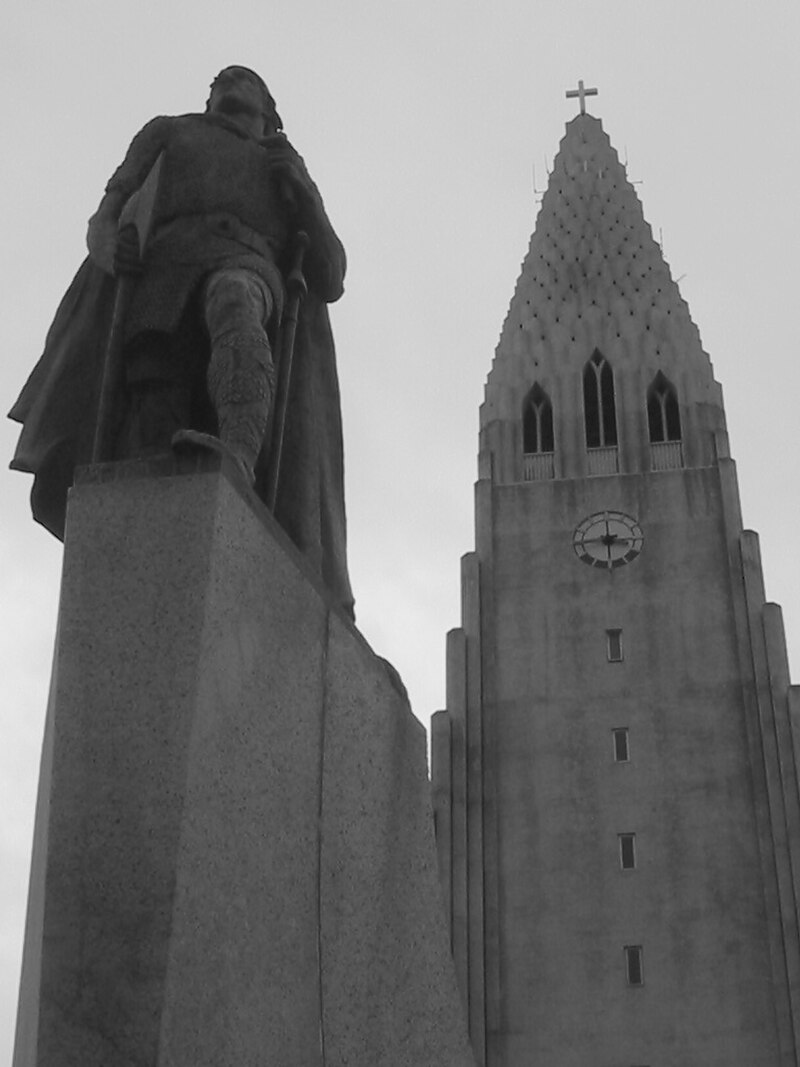
Photo · Wikimedia Commons Crowning the crest of Skolavorduholt hill, Hallgrimskirkja dominates the skyline with an unapologetic, geological drama. Designed by State Architect Gudjon Samuelsson in 1937, its stepping concrete wings mimic Iceland's hexagonal basalt columns, evoking natural wonders like Svartifoss waterfall. It took forty-one patient years to complete, rising seventy-four meters into the Arctic clouds as a monumental declaration of national identity. For the classic straight-on photo that captures its wings flanking the sky like an organ pipe mountain, pause halfway up Skolavordustigur before approaching the plaza. Notice Alexander Stirling Calder's imposing bronze statue of explorer Leif Erikson guarding the entrance, a millennial gift from the United States in 1930 that actually predates the church. Step through the entrance into the austere, light-flooded nave to admire the soaring fifty-foot mechanical organ crafted with over five thousand pipes. Then take the lift straight to the tower observation deck, where the colorful tin roofs and mountain silhouettes stretch out beneath your gaze.
Follow the vibrant storefronts of Skolavordustigur downhill toward the old harbor, where the waterfront mirrors the changing colors of the northern sky.
- 1 min · on site
Harpa Concert Hall and Conference Centre
A Crystalline Honeycomb on the Harbor Water
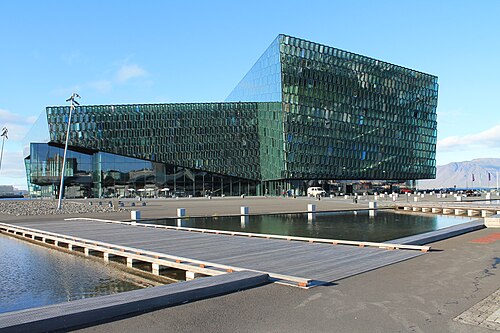
Photo · Wikimedia Commons Perched on the edge of the harbor, Harpa is an astonishing triumph of light and geometry designed by Henning Larsen Architects in collaboration with artist Olafur Eliasson. When the financial crisis froze the nation in 2008, Harpa became the sole ongoing construction project in all of Iceland, a glowing testament to the country's refusal to abandon the arts. Its exterior is clad in a modular steel framework holding geometric glass panels that shift from seafoam green to shimmering amber as clouds glide overhead. Step inside the warm lobby to see the facade light ripple across polished concrete floors and frame dramatic views across the water. Look outside toward the tide for the bronze sculpture of a cellist playing by Olof Palsdottir, modeled on musician Erling Blondal Bengtsson who played continuously for the artist while she sculpted. By evening, hundreds of custom LED light units turn the glass into an undulating kinetic canvas that once even hosted a citywide game of vintage Pong.
From the water's edge, head south across the city toward the pine-fringed slopes of Oskjuhlid hill, where steam once shaped the city's modern veins.
- 1 min · on site
The Geothermal Crown on Oskjuhlid Hill
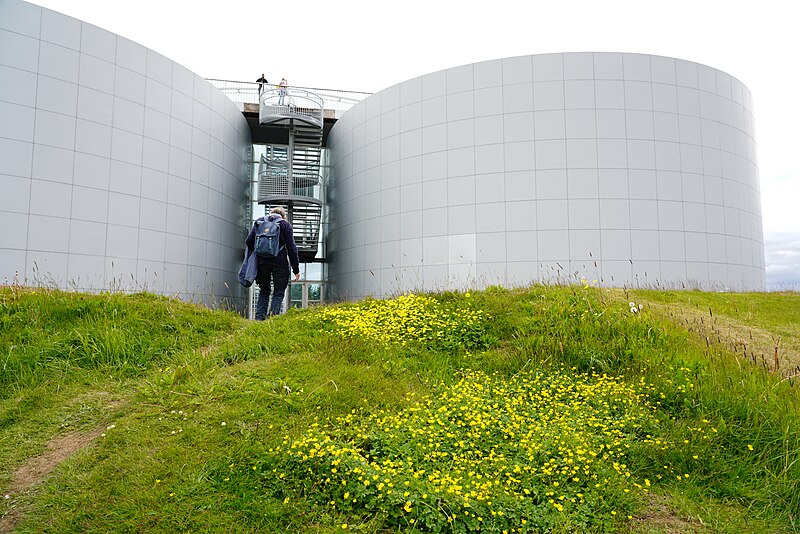
Photo · Wikimedia Commons Sitting majestically atop Oskjuhlid hill, Perlan resembles a futuristic observatory dropped into a subpolar woodland. Its gleaming glass dome rests directly on six massive municipal tanks that have stored geothermal hot water since the mid-twentieth century, an engineering feat pushed forward by visionary mayor David Oddsson and engineer Jon Bui Gudlaugsson. Four of those giant cylindrical tanks still supply heating across the city, while the others house an indoor ice cave sculpted from four hundred tons of snow and volcanic ash, alongside an Aurora planetarium. Head directly to the rooftop observation deck for sensational three-hundred-sixty-degree views spanning the colored districts of Reykjavik, the volcanic peaks of Bláfjöll, and the silver tides of Faxafloi bay. Sip a warm drink in the revolving cafe under the skylights while watching coastal gales race across the glass. Perlan is the ultimate embodiment of Icelandic ingenuity, transforming everyday infrastructure into an awe-inspiring civic crown.

Reykjavik's monuments teach us that iconic architecture does not have to distance itself from the ground it stands on. From volcanic basalt columns and crystalline harbor hives to steaming geothermal domes, each structure honors the raw northern wilderness while carving out an inspiring space for human warmth. As you wander these streets, let the shifting light and playful resilience of this remarkable capital accompany your journey.
Take it further
Open the tour in the appThe tour in the app
Reykjavik Architectural Odyssey: From Basalt Spire to Geothermal DomeTrace Reykjavik's defining design landmarks from the monumental columnar concrete of Hallgrimskirkja downhill to Harpa's shimmering harbor glass, finishing with panoramic vistas atop Perlan's geothermal dome. A walking and transit route celebrating subpolar light, innovative engineering, and cultural resilience.
+ Add the tour to your planIf you have the app the tour opens right away; otherwise you go to the store.FAQ
- What inspired the unique exterior design of Hallgrimskirkja?
- State Architect Gudjon Samuelsson designed the church to evoke Iceland's volcanic landscape, specifically the columnar basalt rock formations found at sites like Svartifoss waterfall, blended with expressionist Nordic architecture.
- Why was Harpa's construction considered such a historic turning point?
- During the 2008 financial crisis, commercial construction completely halted across Iceland. The government stepped in to fund Harpa, making it the only active building project in the nation and an enduring symbol of cultural determination.
- Are the water tanks beneath Perlan still actively used?
- Yes, four of the six massive tanks beneath Perlan still store millions of liters of geothermal hot water used to heat the buildings and snow-melting streets of Reykjavik, while two have been repurposed for exhibitions.