There is a particular kind of blue that takes over Dublin when the coastal mist lifts and the Victorian streetlamps ignite along the River Liffey. It is that cinematic, unscripted twilight when the tour buses vanish, the commuter rush evaporates into side lanes, and the capital finally exhales. If your social feed has conditioned you to think Dublin after dark is only about packed pub windows and spilled pints, consider this your official vibe check. The real Dublin does not wind down when the shops shutter. It shifts gears into an intoxicating, after-hours frequency where literature, politics, and art feel less like heritage and more like a nocturnal conversation that never stopped.
Walking these streets at night feels like sliding your headphones on and hitting play on an intricately layered track. Dublin is notoriously compact, an intimate grid where centuries-old stone facades lean inward over slick cobblestones, reflecting amber sodium glow and pale moonlight. There is an ambient hum in the damp Atlantic air, a blend of fiddle melodies leaking from doorways, the distant clatter of a late tram, and the sudden quiet that greets you when you step into an ancient Georgian square. It is a city that saves its best confessions for the hours when the shadows stretch long.
The Art of the Midnight Epiphany
What makes Dublin culture after dark so genuinely compelling right now is its refusal to treat history as a museum specimen behind velvet ropes. Here, the creative lore is messy, alive, and delightfully stubborn. In the late nineteenth century, a solitary and penniless Dublin youth named George Bernard Shaw spent his evenings escaping domestic gloom by haunting the quiet halls of the National Gallery of Ireland. Those wandering hours beneath the brushstrokes of old masters became his personal academy. Years later, after conquering the literary world and earning both an Oscar and the Nobel Prize, Shaw returned the favor in legendary fashion, bequeathing a full third of his lifetime royalties to the gallery in gratitude. That quiet nocturnal refuge literally funded the future of Irish art.
And the city never stopped generating those surreal, almost fictional discoveries. Consider the story of Caravaggio's long-lost masterpiece, The Taking of Christ. For generations, art historians believed the original Baroque canvas had vanished into private oblivion. In the nineteen nineties, senior gallery conservator Sergio Benedetti was invited into a Jesuit residence on Leeson Street to inspect several dusty paintings, only to find the priceless seventeenth-century canvas casually hanging above the communal dining table, quietly bearing witness to mundane evening suppers before being restored to global acclaim.
Where the Ghosts Talk Back
That same raw, defiant impulse echoes wherever you turn once darkness falls. When William Butler Yeats and Lady Gregory established the Abbey Theatre to reclaim Ireland's cultural voice, they were not looking for polite applause. When John Millington Synge staged The Playboy of the Western World in nineteen zero seven, Dubliners found the dialogue so provocatively authentic that the auditorium erupted into furious civil disturbances, turning opening week into an epic cultural clash. Even Temple Bar itself owes its survival to this nocturnal defiance. In the nineteen eighties, the district was slated for complete demolition to make way for a sprawling central bus depot. But while developers stalled, artists, printmakers, and musicians occupied the decaying brick warehouses at rock-bottom rents, staging exhibitions and late-night jam sessions that forged a bohemian quarter so vibrant the state had to cancel the bulldozers.
As you walk tonight from neoclassical galleries to candlelit castle courtyards, you are participating in a living ritual. Dublin after dark is not a retrospective. It is a shared frequency where yesterday's revolutionaries and tonight's dreamers cross paths on the very same stones.
Want to walk it yourself? Plan a trip with these places
The walk
On site, play just that chapter
- 1 min · on site
Shadows and Stolen Light at Merrion Square
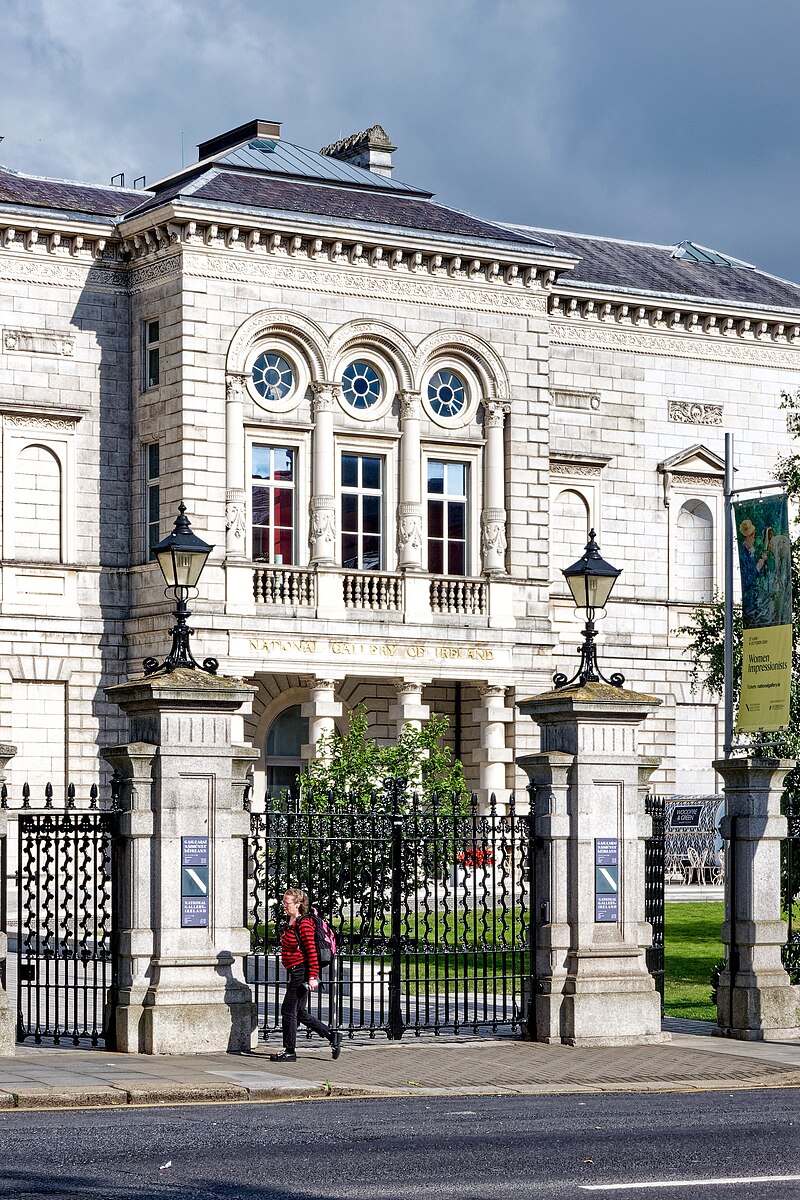
Photo · Wikimedia Commons Step past the grand Portland stone portico on Merrion Square West and let the high vaulted ceilings swallow the evening chill. The quiet here after dark is utterly cinematic. Walk straight toward the Irish rooms and pause before the canvases of Jack B. Yeats, where brushstrokes of Dublin street scenes pulse with an almost neon urgency. Then follow the dim gallery corridor down to the Italian Baroque room to find Caravaggio's The Taking of Christ. Notice how the dramatic chiaroscuro pulls you into the Judas kiss, illuminated by a single lantern against pitch darkness. It feels impossibly surreal to realize this very canvas spent decades hanging unassumingly in a Jesuit dining hall on Leeson Street, quietly absorbing dinner chatter before senior conservator Sergio Benedetti verified its authenticity in the nineteen nineties. Stand close enough to catch the reflection of the gallery lights on the varnished oils, feeling the warmth of Shaw's legacy lingering in the quiet marble halls.
Slip out through the Merrion Square exit and take a short three minute stroll around the corner to the historic iron gates of Kildare Street.
- 1 min · on site
National Museum of Ireland - Archaeology
Whispers from the Bog and Golden Relics
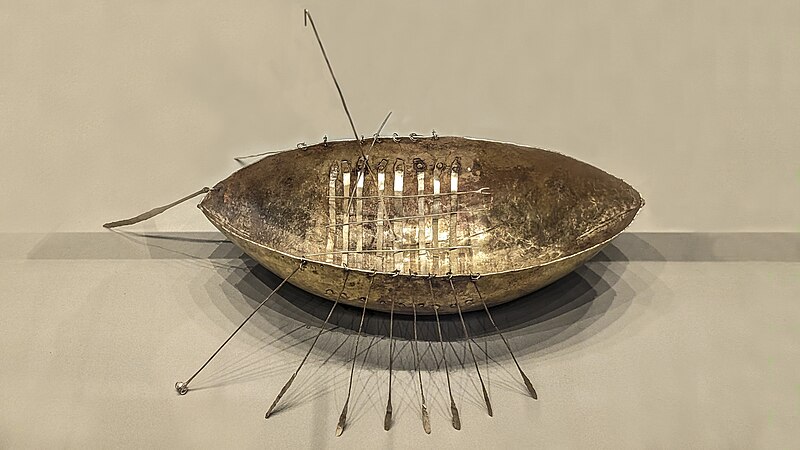
Photo · Wikimedia Commons Walk through the colonnaded Victorian rotunda on Kildare Street and step into a vault where Ireland keeps its deepest prehistoric memories. The atmosphere under the domed glass roof at night feels reverent and subterranean. Head directly upstairs to the Kingship and Sacrifice gallery, where you will find the preserved Iron Age bog bodies lying in climate controlled glass cases. Look closely at their fingernails and intricate hair knots, eerily intact after millennia submerged in peat moss. Downstairs in the Treasury, let your eyes adjust to the golden glow of the Ardagh Chalice and the ninth century Tara Brooch, masterpieces of Celtic metalwork discovered not by scholars, but by nineteenth century farm labourers cutting turf across freshly turned fields. Take a slow circuit around the darkened vitrines, taking note of how the ambient gallery downlights catch the filigree gold, turning ancient pagan rituals into an intimate late night encounter with Dublin's distant ancestry.
Leave Kildare Street behind and wander northward toward the illuminated campus of College Green just five minutes away.
- 1 min · on site
The Vault of Scribes and Rebel Alumni
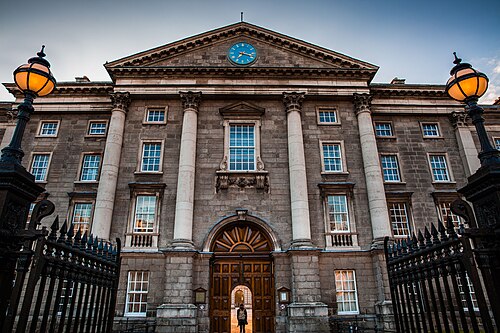
Photo: Stephen Bergin steve_ · CC0 · Original file Pass through the wooden gateway at Front Arch onto the cobblestones of Parliament Square, where oak setts absorb the evening silence. Look up at the neoclassical Examination Hall and the darkened Chapel before making your way to the towering Old Library. Within these hallowed walls rests the Book of Kells, an illuminated Celtic Gospel manuscript created around the year eight hundred and preserved here since the seventeenth century. Admire the astonishing interlaced spirals and vibrant vegetal pigments on the displayed vellum page. Nearby stands the medieval Trinity College harp, carved from willow and strung with brass, the very instrument that became Ireland's national emblem. As you stand beneath the high timber barrel ceiling of the Long Room, surrounded by busts of Jonathan Swift and Edmund Burke, listen to the profound hush. This is where generations of Irish wordsmiths, from Oscar Wilde to Sally Rooney, learned to turn quiet thought into cultural rebellion.
Head back through the archway onto Dame Street, continuing westward past the stately silhouette of City Hall.
- 1 min · on site
Courtyard Whispers and Fallen Empires
Photo · Wikimedia Commons Turn off Dame Street into the upper courtyard of Dublin Castle, where centuries of royal intrigue seem etched into the blackened paving stones. Stand in the center of the vast square and look toward the lone medieval Record Tower, the sole surviving turret of the Anglo Norman fortress that once guarded the Viking ridge. For more than seven hundred years, this complex was the nerve center of British colonial power in Ireland. Imagine the fateful night in January nineteen twenty-two, when revolutionary leader Michael Collins marched into these very state apartments to formally take possession on behalf of the newly independent provisional government. Glance up toward the glowing Georgian sash windows of the Chapel Royal and the State Apartments. The air here at night feels laden with drama and political catharsis, a former seat of empire that has gracefully transformed into a public stage for modern Irish democracy.
Descend the slope northward through Castle Street, slipping into the narrow brick alleys of Temple Bar.
- 1 min · on site
Cobblestones, Fiddles and Bohemian Survival
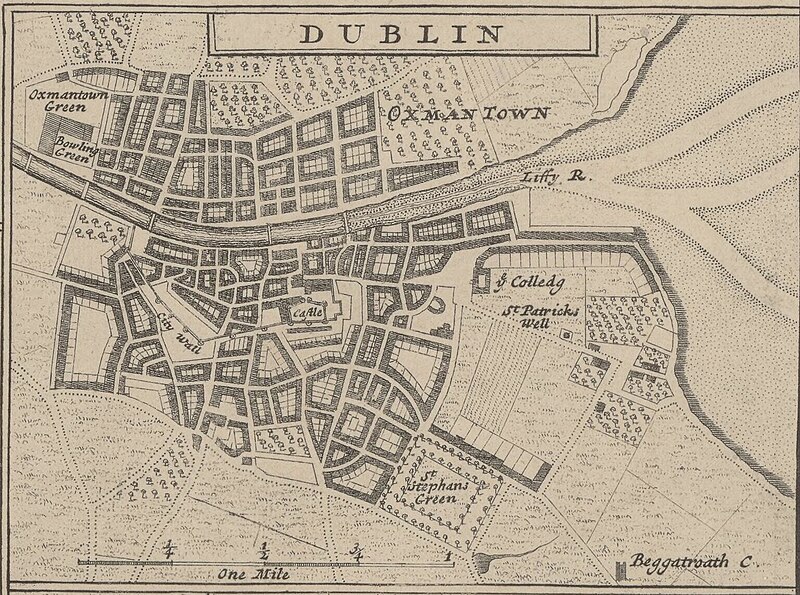
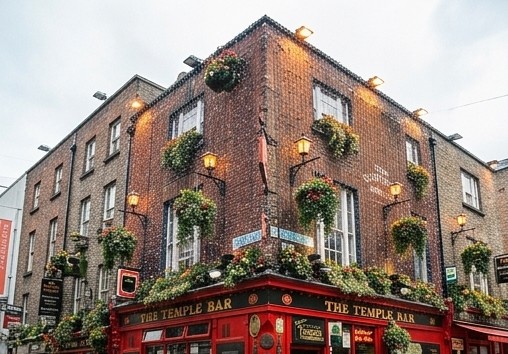
AI-generated image · may differ from the real place Wander past the glowing ruby facade of The Temple Bar pub onto the wet cobblestones where the rhythm of the city kicks into overdrive. Listen closely: beyond the clamour of pints, you can hear live fiddles, banjos, and bodhrans weaving traditional reels through open wooden tavern sash doors. Take a detour down Fishamble Street, where George Frideric Handel conducted the sensational world premiere of his Messiah in April seventeen forty-two. Walk onto Meeting House Square, framed by the contemporary arches of the Irish Film Institute and the Ark. In the nineteen eighties, this entire neighborhood was slated to be flattened for a gargantuan bus terminal. Instead, grassroots artists, independent galleries, and buskers colonized the cheap derelict rentals, creating a bohemian riot of creativity so beloved that city hall was forced to preserve it. Look down at the uneven flagstones: you are walking on land reclaimed from an eighteenth century river marsh.
Head toward the river quays and cross the Liffey over O'Connell Bridge to reach the northern theater district.
- 1 min · on site
Where Words Spark Riots on Lower Abbey Street
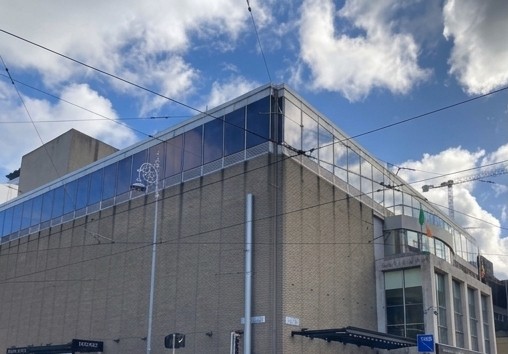
AI-generated image · may differ from the real place Cross the threshold of the Abbey Theatre on Lower Abbey Street, where the modern glass foyer reflects the moving lights of Dublin's red line tram. Since nineteen zero four, when William Butler Yeats, Lady Gregory, and patron Annie Horniman founded this national stage, these boards have existed to challenge the Irish soul. Step into the foyer and examine the black and white performance archives mounted along the walls. This is where audiences took drama so seriously that they literally rioted in nineteen zero seven over John Millington Synge's The Playboy of the Western World, appalled and electrified by its raw depiction of peasant life. Two years later, George Bernard Shaw's Blanco Posnet triggered another fierce battle over stage censorship. As the house lights dim and evening actors take the stage, you realize Dublin's nighttime culture is never about quiet escapism. It is a passionate, living dialogue that demands you feel every single word.

As the final curtain falls and the streetlights along the Liffey ripple across the dark water, Dublin reveals its truest secret. This city does not preserve culture to lock it away; it lives it in the dark, passing each verse and brushstroke down like a shared torch.
Take it further
Open the tour in the appThe tour in the app
The Midnight Promenade: From Georgian Canvases to Rebel StagesThis curated two-hour walking route threads through Dublin's most iconic nighttime cultural landmarks. Beginning at the National Gallery on Merrion Square, you will explore ancient gold relics, illuminated university courtyards, candlelit castle grounds, bohemian cobbled alleys, and the historic national theatre. Perfect for travellers who crave nocturnal history and vibrant local character.
+ Add the tour to your planIf you have the app the tour opens right away; otherwise you go to the store.FAQ
- How walkable is this nighttime route through central Dublin?
- The entire walk spans roughly two kilometres across mostly flat Georgian streets and pedestrianized zones, easily covered in ninety minutes of gentle walking with plenty of time to pause.
- Is Temple Bar worthwhile for culture seekers rather than just pub goers?
- Yes, while the main street is crowded with nightlife, side lanes like Meeting House Square and Fishamble Street house indie cinemas, photo galleries, and deep musical history dating back to Handel.
- Can you appreciate Trinity College and Dublin Castle from the outside at night?
- The historic exterior squares, illuminated neoclassical colonnades, and medieval towers offer a dramatic, atmospheric perspective that is far more peaceful after the daytime crowds have dispersed.
This piece was newly written based on the Wikipedia articles ‘National Gallery of Ireland’, ‘Abbey Theatre’ · CC BY-SA 4.0