I still remember the sudden, grateful hush that greeted me when I first pushed through the heavy glass doors on Boulevard Haussmann on a wet November morning years ago. Outside, the autumn rain had slicked the slate sidewalks into shimmering dark mirrors, and Paris was rushing past in an endless blur of damp woolen coats, glistening black umbrellas, and the impatient rumble of buses. Yet crossing that threshold was never merely taking shelter from the weather. It was stepping directly into an illuminated theater of glass, gilded ironwork, and warm perfume, where the air itself seemed spun from powdered iris, polished wood, and honeyed light. Standing beneath the sweeping galleries, completely overwhelmed by the dizzying verticality of the space, I looked up into a soaring stained-glass dome that felt less like a department store and more like a secular cathedral conceived for the secret longings of modern life. It was my first intimate initiation into the peculiar genius of Paris, a city that took the mundane necessity of commerce and turned it into an enduring art of contemplative wandering.
Before the nineteenth century, as historical memoirs remind us, shopping in the old European capitals was an austere and often claustrophobic affair. Goods were kept tucked away in dim, windowless backrooms, produced only when a customer made a deliberate inquiry, and every single transaction involved an exhausting, wary battle of bartering. It was here on the Right Bank of the Seine that this ancient order of trade was permanently dismantled. The great emporiums shattered the darkness with iron and glass, swept away the exhausting friction of haggling by introducing fixed prices, and invited the pedestrian to look, touch, and linger without any obligation to buy. Retailing was transformed into flânerie, a leisurely promenade where ordinary city dwellers could escape the mud and chaos of the streets to immerse themselves in an orchestrated spectacle of abundance. To walk these luminous corridors was to partake in a collective reverie, where every vitrine was a stage and every passerby an appreciative spectator.
The Theaters of Glass and Gilt
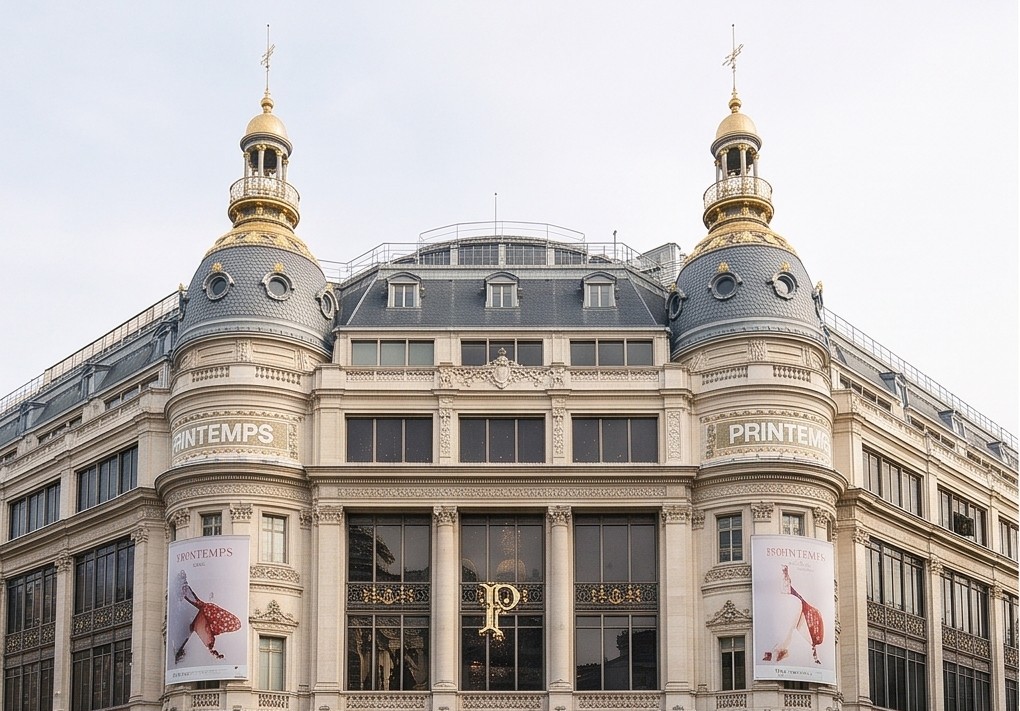
That intoxicating transformation was neither accidental nor purely commercial; it was shaped by dreamers who realized that retail required the emotional gravity of the theater. In 1865, when Jules Jaluzot founded Printemps, the ambitious venture was brought to life through the personal fortune and artistic sensibility of his wife, Augustine Jaluzot, a celebrated actress of the Comédie-Française. She infused the emporium with theatrical grandeur, establishing the delicate ritual of offering fresh bouquets of violets to visitors on the first day of spring to turn the commercial concourse into a seasonal festival. A few steps away, Théophile Bader and his cousin Alphonse Kahn expanded their modest novelty shop into Galeries Lafayette, crowning it with a forty-three-meter Neo-Byzantine dome that captured the changing Parisian sky. Their belief in pure spectacle ran so deep that in 1919 they invited the intrepid French aviator Jules Védrines to pilot his airplane straight onto the store's rooftop terrace, landing amid roaring cheers and proving that even the Parisian heavens belonged to the grand emporiums.
Echoes Across the Seine
Whenever I return to these boulevards and wander toward the river, I am reminded that shopping in Paris remains, at its core, an exercise in quiet remembrance. Whether standing beneath the gilded domes of Haussmann, sifting through the tactile history of vintage fabrics in the Marais, or inhaling the damp greenery of an island flower pavilion, the city persistently urges us to slow our stride. What we carry away is never simply an item wrapped in paper and ribbon. We walk away with a piece of Paris itself, an enduring memory of elegance that stays with us long after the twilight fades over the bridges.
Want to walk it yourself? Plan a trip with these places
The walk
On site, play just that chapter
- 1 min · on site
The Stained Glass of Spring
AI-generated image · may differ from the real place Whenever Boulevard Haussmann feels overwhelming, I slip in through the quieter side entrance on Rue de Caumartin to skip the heavy crowds. The sudden calm inside is an immediate relief, carrying the faint murmur of fine fragrances and polished stone. I always guide my feet straight toward the upper levels of the store, where the magnificent Art Nouveau glass cupola awaits. Looking up into its floral curves, I often think of nineteen thirty-nine, when artisans carefully dismantled this entire fragile dome, pane by pane, to store it safely in Clichy away from wartime bombs, before restoring it decades later. Take a quiet moment on the mezzanine to admire the delicate ironwork and let your gaze wander through the designer beauty halls below. There is an unmistakable theatrical grace here, as if Augustine Jaluzot herself were still watching over her beloved creation.
Step back out into the Parisian air and walk just a few paces east along Boulevard Haussmann to reach the golden threshold of Galeries Lafayette.
- 1 min · on site
A Cathedral Under the Sky

Photo: Moonik · CC BY-SA 3.0 · Original file I always enter through the central rotunda beneath the main dome first, knowing that to miss that initial upward glance is to miss the soul of the building. The forty-three-meter Neo-Byzantine stained-glass dome rises above like an immense jewel, filtering the northern light into shades of sapphire, rose, and amber. As you weave your way upward along the curving balustrades, look past the gleaming fashion displays and imagine Jules Védrines in nineteen nineteen, skimming the Parisian rooftops to land his wood-and-canvas plane directly on the open terrace above. Follow the escalators all the way to that very rooftop terrace, where the entire city suddenly unfurls before you. Stand at the balustrade and look across toward the ornate roof of Opera Garnier and the distant Eiffel Tower, catching the fresh breeze above the roaring boulevards.
Descend back to the boulevard and stroll southward past the Palais Garnier toward the river Seine until the glowing facade of La Samaritaine appears on Rue de Rivoli.
- 1 min · on site
The River's Golden Mirror
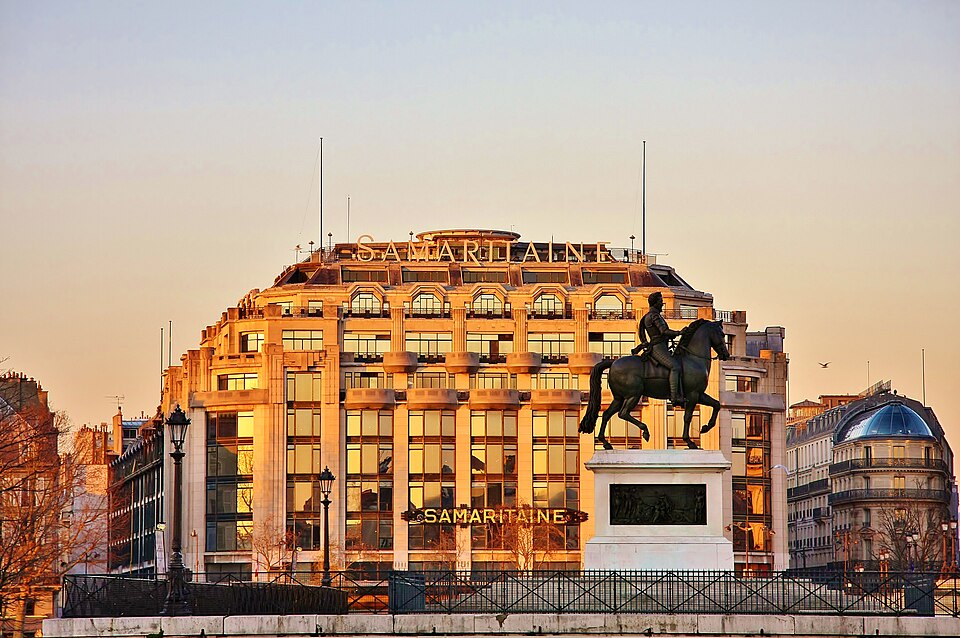
Photo: Adrian Scottow · CC BY-SA 2.0 · Original file Standing before La Samaritaine on Rue de Rivoli, I am always struck by how its yellow, white, and green enamel panels catch the afternoon light. Founded by Ernest Cognacq and Marie-Louise Jaÿ, and named after the historic water pump that once stood on Pont Neuf, this grand emporium has always belonged to the river. Step through the glass rotunda and look directly up at Frantz Jourdain's monumental staircase and the soaring glass-tiled light court that floods the interior with natural sun. Notice how the painted botanical motifs soften the stern lines of the structural iron, creating a harmony between industrial ambition and organic beauty. Take your time browsing through the riverside halls, listening to the gentle hum of conversations and footsteps echoing across the restored balconies before heading outside to the quays.
When you emerge onto Quai du Louvre, turn right and cross the ancient stone arches of Pont Neuf over the Seine onto the Île de la Cité.
- 1 min · on site
Marché aux Fleurs Reine Elizabeth II
Green Whispers on the Island
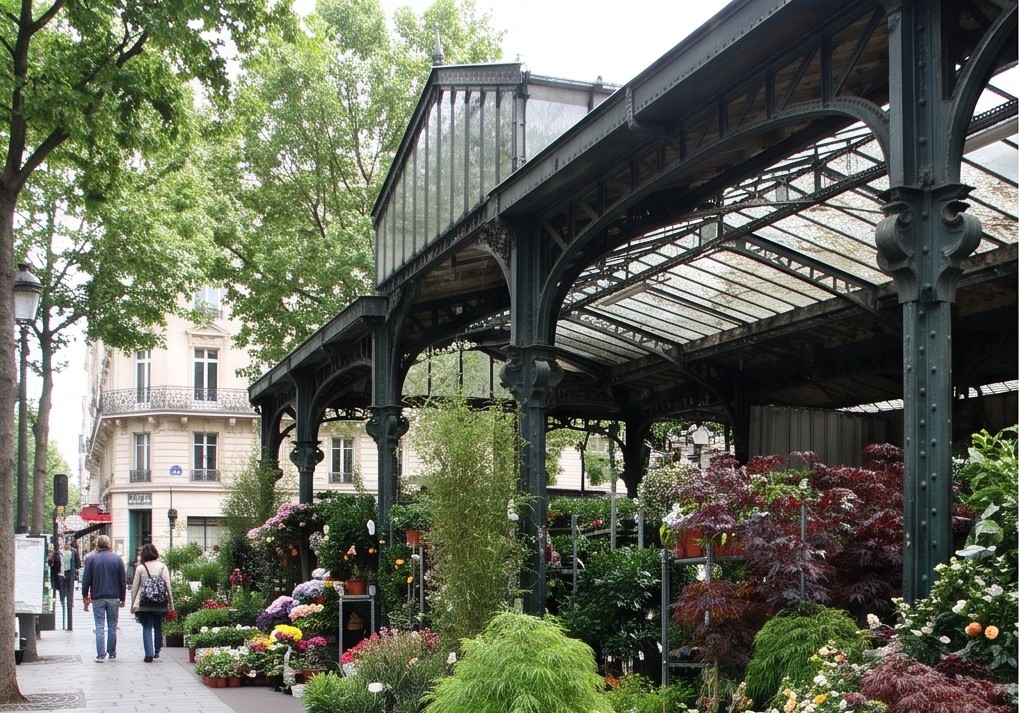
AI-generated image · may differ from the real place Tucked into Place Louis Lépine in the historic heart of the island, this tranquil pavilion has always been my favorite sanctuary after the grand department stores. Wander slowly down the central aisle beneath the dark green cast-iron canopies, where the sharp smell of damp potting soil, moss, and sweet eucalyptus fills the cool air. Browse carefully among all the small independent stalls before choosing, as each vendor cultivates a unique world of delicate orchids, seasonal cut blossoms, and rare potted herbs. I remember standing here and reflecting on its dedication to Queen Elizabeth II after her visit in twenty fourteen, marveling that a bustling world capital still preserves this peaceful enclave. Pause beside a stand of blossoming white cyclamens and simply listen to the soft clatter of watering cans against stone.
Cross the Pont d'Arcole to the Right Bank and walk up into the lively streets of Le Marais to find Rue de la Verrerie.
- 1 min · on site
The Weight of Memory
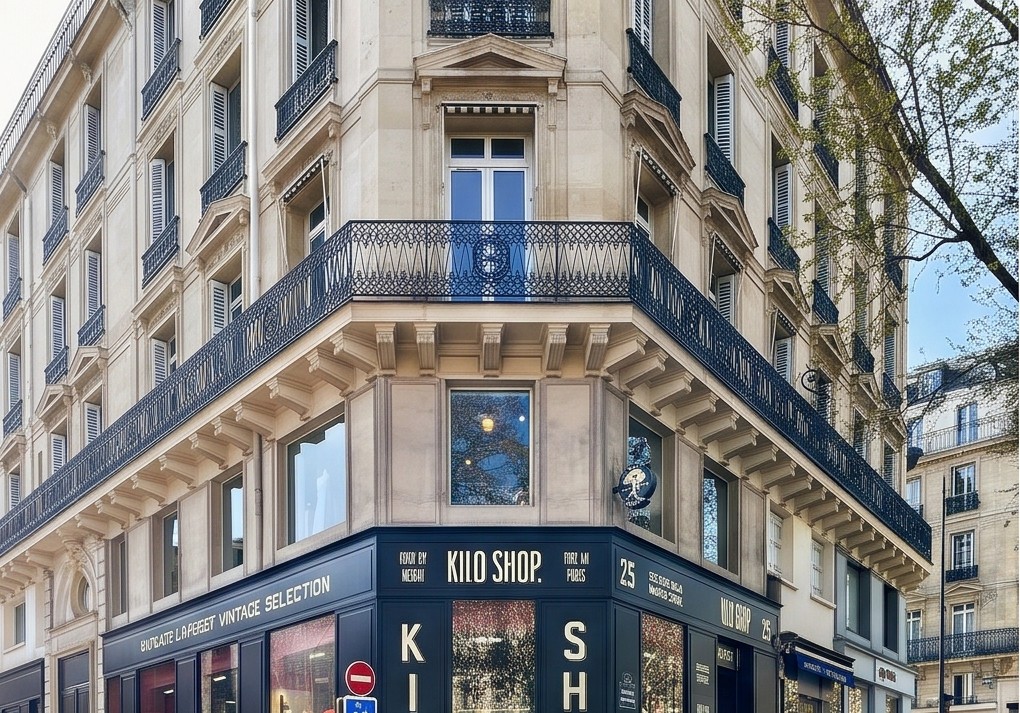
AI-generated image · may differ from the real place Entering this vibrant vintage haven on Rue de la Verrerie is like diving headlong into the living wardrobe of Europe's past decades. The racks are dense with velvet coats, weathered worker jackets, and silk scarves, each piece carrying the phantom silhouette of an unknown previous life. My habit here is intensely tactile: run your hands along the seams, check the inner labels carefully, and inspect the sturdy stitching, because vintage sizing never conforms to modern standards. There is an honest, unpretentious thrill in carrying your armful of treasures over to the round mechanical scales suspended from the ceiling to weigh your discovery. Here, fashion ceases to be an ephemeral luxury dictated by grand designers and becomes a personal, democratic excavation of textures and enduring street character that you can treasure.
Leave the lively buzz of the Marais behind and head eastward toward the twelfth arrondissement, where the historic square of Marché d'Aligre awaits.
- 1 min · on site
The Singing Square of Beauvau

Photo: Jesús Gorriti · CC BY-SA 2.0 · Original file Arriving at Place d'Aligre on a crisp morning, the vibrant energy of old working-class Paris rushes forward to greet you with unfiltered warmth. Be sure to bring a sturdy tote bag and keep small coins ready in your pocket for the cheerful independent vendors. Start beneath the soaring timber ceiling of the covered Halle Beauvau, designed in seventeen seventy-nine, where butchers and cheese mongers work under soft hanging lamps. Then step out into the semicircle of the open square, where second-hand dealers spread their curious wares across folding tables. I always pause here to look for the singer Moustique, a true neighborhood fixture whose stall of African artifacts embodies the market's generous spirit. Breathe in the rich aroma of ripe cheeses, roasted spices, and damp winter clementines as the market vendors call out their daily songs across the cobblestones.


As afternoon turns to dusk and the streetlamps along the boulevards flicker awake, I find myself holding a small bundle of lavender, a vintage silk scarf, and an overwhelming sense of gratitude. Paris teaches us that shopping is never merely an exchange of coins. It is an intimate communion with the craftsmen, dreamers, and wanderers who paved these stones before us.
Take it further
Open the tour in the appThe tour in the app
A Flâneur's Promenade Through Parisian CommerceThis curated walking journey traces the evolution of Parisian retail from the grand nineteenth-century department stores of Boulevard Haussmann down to the historic Seine riverbanks, crossing over to the serene island flower pavilions and concluding among the vibrant vintage racks and neighborhood stalls of the Right Bank.
+ Add the tour to your planIf you have the app the tour opens right away; otherwise you go to the store.FAQ
- What is the best way to avoid crowds when visiting the grand department stores?
- Slip through the discreet side entrances on quieter neighboring streets, such as Rue de Caumartin for Printemps, and begin your exploration at the upper dome and rooftop levels before wandering the bustling main ground floors.
- How should one prepare for exploring the open-air neighborhood markets like Aligre?
- Carry a lightweight reusable tote bag and keep small coins handy in your pockets, allowing you to easily purchase fresh produce, flowers, and vintage trinkets directly from independent stallholders.