Morning in Paris begins not with grand silhouettes, but with the immediate truth of textures. Sit at a small zinc-topped counter in the early hours while a child tears into a fresh croissant. Listen closely to the brittle fracture of laminated pastry crust collapsing beneath small fingertips, giving way to an elastic, butter-perfumed interior. A food critic knows that a child is the fiercest, most honest taster in the world. Unburdened by guidebooks or decorative reputations, a young mind registers the world through tactile resonance. If a brioche is dry or a sauce cloying, they reject it without polite hesitation. Exploring Paris alongside them demands that exact same uncompromising rigor. Far too many families are seduced into a frantic circuit of overcrowded monuments, dragging exhausted children through sterile corridors and souvenir traps that reduce the French capital to sugary confection. Yet real Paris is an artisan workshop, a living atelier where generations of master craftspeople have left their signatures in crushed limestone, iron trusses, espaliered pear branches, and deeply seasoned soil.
When you surrender adult itineraries and match your stride to a child's curiosity, the city opens up like a complex, slow-simmered reduction. Adults tend to look up at distant pediments, but children look downward and outward, discovering the crisp snap of park gravel underfoot, the cold smoothness of weathered bronze balustrades, and the lingering fragrance of cedar chips around a shaded playground. They remind us that travel, like dining well, is an act of pure physical immersion. A historic square is not merely an address on a map; it is a composition of air, temperature, sound, and material integrity. In an era dominated by polished screens and synthetic flavors, bringing a young traveler to this ancient capital offers an essential palate cleanser, restoring an unspoiled appetite for authentic physical reality.
The Geometry of Patient Craft
Look back through the centuries, and you realize that Paris has always rewarded those who demand substance over spectacle. In 1611, when Marie de' Medici found herself trapped in Parisian court etiquette, she longed passionately for the sensory warmth of her native Florence. Refusing to endure the bleak confines of royal halls, she acquired the Luxembourg estate and ordered the planting of two thousand elm trees, commissioning hydraulic master Tommaso Francini to sculpt a fountain evoking the grottoes of the Pitti Palace. She established parterres and a magnificent fruit orchard that still nurtures heritage apple and pear varieties today. Centuries later, it was along these exact perimeter gravel alleys that the novelist Patrick Modiano was strolling when his daughter rang his telephone to deliver the news that he had won the 2014 Nobel Prize in Literature. Great art and profound revelations do not announce themselves in crowded halls; they find you when you are quietly wandering beneath chestnut trees, watching model sailboats glide across an octagonal pond.
Follow the gentle curve of the Seine eastward toward the Jardin des Plantes, and you witness how natural science was forged by that same visceral patience. Here in the eighteenth century, the Comte de Buffon managed the royal grounds while tending his own iron foundry in Burgundy. He poured his own cast iron to crown the garden with the Gloriette, the oldest metal pavilion in the city, boldly engraving upon its bronze band that he counted only the hours without clouds. Nearby in that same reserve, Bernardin de Saint-Pierre rescued the abandoned animals of Versailles to found the menagerie, while chemist Eugène Chevreul spent decades unraveling the chemistry of fats and charting color harmonies, living vigorously until the age of one hundred and three. To walk these quiet grounds with a child is to offer an enduring apprenticeship in discernment. It trains their senses to recognize patient mastery, sharpening a palate that will demand truth for years to come.
Want to walk it yourself? Plan a trip with these places
The walk
On site, play just that chapter
- 1 min · on site
Tasting Art at Eye Level

Photo: Philippe Burjot · CC BY-SA 4.0 · Original file Turn into the narrow, cobblestoned corridor of Rue de l'Arbre Sec, just steps from the eastern colonnade of the Louvre. Here lies a museum that operates with the radical philosophy of a master chef who crafts a tasting menu exclusively for children. Founded in 1975 by Sylvie Girardet, Claire Merleau-Ponty, and Anne Tardy, this intimate space abandons the towering, intimidating pedestals of traditional galleries. Walk inside and notice how every single canvas, sculpture, and graphic installation is hung strictly at the eye level of a child. There are no velvet ropes or sterile warnings. The air carries the faint, nostalgic perfume of tempera paint, wood shavings, and damp paper pulp from the bustling studio tables in the back. Guide your young companion to the center of the exhibition room, encouraging them to run their eyes along the textured brushstrokes and playful compositions. By treating children as serious, observant critics rather than passive spectators, this little atelier proves that visual literacy begins with direct, unpretentious proximity.
Step back out into the Parisian light and walk west through the grand arches of the Louvre toward the gravel terraces of the Tuileries.
- 1 min · on site
Aire de jeux pour enfants des Tuileries
Kinetic Energy on Royal Ground
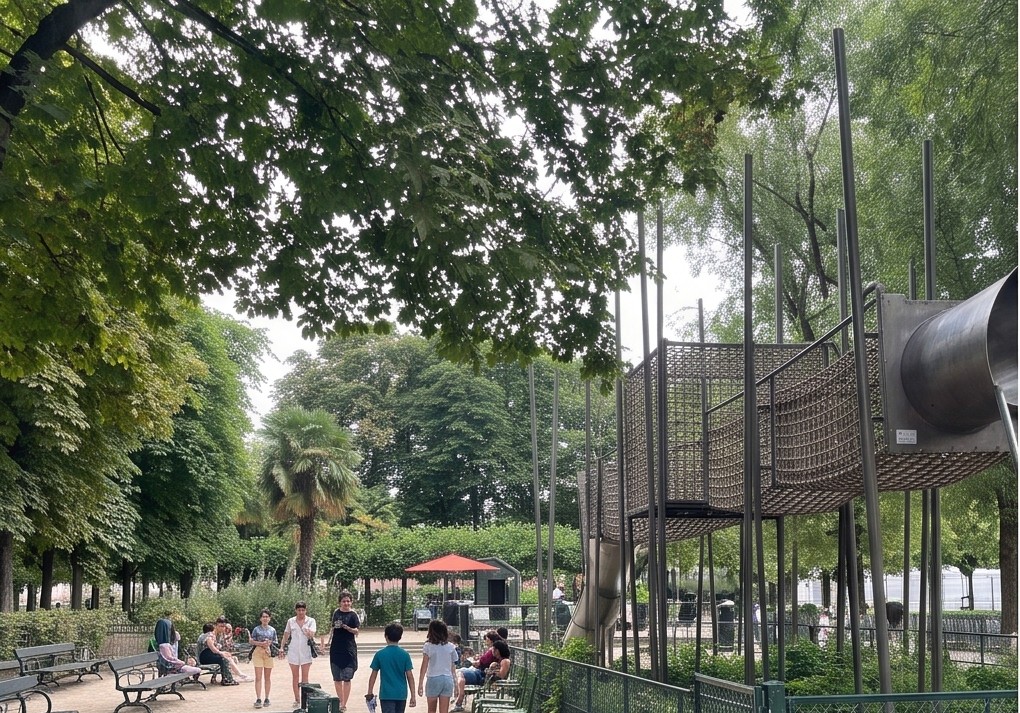
AI-generated image · may differ from the real place Enter the Tuileries Garden and make your way along the northern terrace near the Feuillants, where royal landscape intendants like Jacques Boyceau once imposed strict geometric parterres upon the earth. Tucked beneath the shade of manicured chestnut trees is a playground that offers a brilliant physical counterweight to French classical order. Sit on one of the green wooden benches and listen to the kinetic rhythm of the scene. Children scramble up woven rope pyramids, dash across timber platforms, and hurtle down smooth slides with the unrestrained energy of sugar boiling into caramel. Look down at the ground to notice the thick, fragrant blanket of cedar chips and fine limestone dust that cushions every leap. The crisp Parisian breeze carries the scent of damp foliage and river mist from the Seine. It is here that young travelers discharge their pent-up momentum, turning the formal choreography of royal lawns into pure, joyous motion.
Cross the Seine via the pedestrian footbridge and ascend the gentle slope of the Left Bank until the iron gates of the Luxembourg Gardens appear.
- 1 min · on site
Lacquered Sloops and Heirloom Pears
Photo · Wikimedia Commons Step through the tall wrought-iron gates into the grand gravel sanctuary of the Luxembourg, where the air hums with the soft chatter of neighborhood families and the rustle of ancient elms. Make your way directly toward the octagonal Grand Bassin, where miniature wooden sailboats with canvas sails skim across the shimmering water, gently nudged along by children wielding long wooden sticks. Observe the artisan craft in these little sloops, each hull coated in rich, weather-beaten lacquer that has survived decades of sun and pond water. Stroll past the raised stone balustrade where statues of French queens stand watch, and turn south toward the historic orchard of apple and pear trees. In late summer, the air here is perfumed with the sweet, wine-like aroma of ripening fruit. Standing beneath the canopy, you can feel the Tuscan spirit of Marie de' Medici lingering in the leafy shade, offering a garden that feeds the spirit as generously as a harvest banquet.
Wander eastward through the historic Latin Quarter, passing the dome of the Panthéon, until the leafy stone entrance of the Jardin des Plantes opens before you.
- 1 min · on site
The Kitchen Garden of Natural Science
AI-generated image · may differ from the real place Cross into the five-hundred-meter formal alley of the Jardin des Plantes, bordered by geometrically trimmed plane trees and thousands of botanical plant beds. Established under Louis XIII as a royal garden of medicinal plants, this living archive has always married intellectual rigor with the sensory wonders of the earth. Guide your companion along the central gravel esplanade, pausing to breathe in the earthy perfume of crushed mint, damp moss, and sun-warmed boxwood hedges. Look toward the winding knoll of the Butte Copeaux, where an ancient cedar of Lebanon planted in 1734 stands sentinel near the cast-iron Gloriette built by the Comte de Buffon. Walk past the historic amphitheater where early naturalists demonstrated the properties of world flora, and notice the ancient locust tree that has stood here since 1601. In this sanctuary, botany is not a dry academic pursuit, but an exhilarating kitchen garden of the natural world.
At the western terminus of the grand garden esplanade, step toward the monumental iron-and-glass facade of the Grande Galerie de l'Évolution.
- 1 min · on site
A Twilight Caravan in Glass and Iron

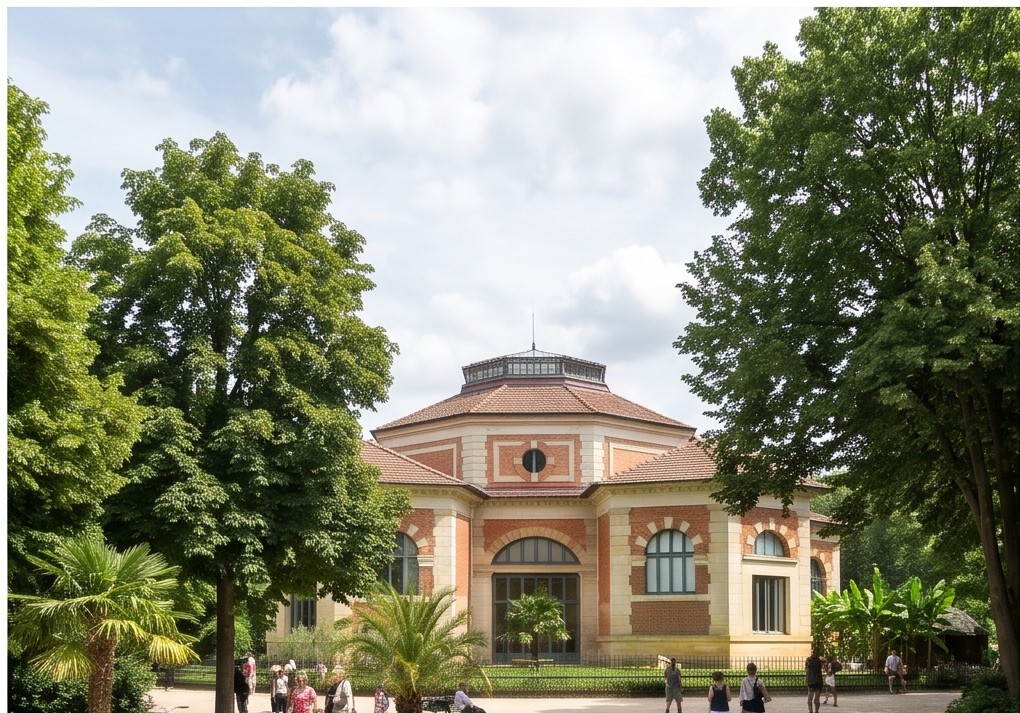
Photo: Ken and Nyetta · CC BY 2.0 · Original file Cross the threshold into the cavernous, glass-roofed nave designed by Louis-Jules André, and allow your eyes to adjust to the magical, subdued twilight. Suddenly, an awe-inspiring spectacle unfolds before you: a silent, frozen caravan of mounted savanna beasts marching across the central floor. Elephants, giraffes, lions, and leopards stride in suspended animation, their velvet hides and ivory curves lovingly restored by generations of master taxidermists. Take your child up to the mezzanine balcony to gaze down upon this majestic procession through the warm amber glow of shifting lights that simulate African dawn and dusk. Look around at the soaring three-tiered cast-iron framework that once stood open to Parisian rain before its dramatic restoration under François Mitterrand. In this cathedral of natural history, science sheds all clinical coldness, speaking directly to the imagination through theatrical grandeur and profound, heartfelt reverence for life.



When evening settles over Paris and the street lamps cast their warm butter-yellow glow across the Seine, you will notice something remarkable in your child's posture. They will not be recalling names, dates, or royal lineages recited from a brochure. Instead, their fingers will still remember the smooth curve of a wooden sailboat hull, the crunch of gravel under their soles, the sharp aroma of wild mint in the botanical beds, and the amber twilight of the savanna herd. In an age of fleeting digital spectacles, teaching a young mind to taste the physical world with patient curiosity is the greatest gift this city can offer.
Take it further
Open the tour in the appThe tour in the app
A Sensory Promenade from the Louvre to the Latin QuarterThis curated pedestrian route connects the cultural core of the Right Bank to the botanical gardens of the Left Bank. Designed for families who value sensory textures and open skies, the itinerary leads from intimate children's galleries and royal playground groves to miniature sailing ponds, historic medicinal orchards, and soaring glass-roofed natural history galleries.
+ Add the tour to your planIf you have the app the tour opens right away; otherwise you go to the store.FAQ
- How can families navigate this walking itinerary without exhausting young children?
- The route is intentionally divided into natural pauses between short strolls. After exploring the low-hung galleries at Le Musée en Herbe, children can burn off energy at the Tuileries playground, enjoy a quiet respite watching toy boats at the Luxembourg, and end with the tranquil garden alleys and sheltered spectacle of the Grand Gallery.
- What is the best way to introduce young travelers to the sensory details of Paris gardens?
- Encourage them to touch and smell rather than merely observe. Let them compare the rough texture of espaliered pear bark to the polished stone of palace balustrades, listen to the crunch of limestone gravel underfoot, and breathe in the aroma of damp earth and herbal beds at the botanical garden.