Winter in Madrid does not arrive with soft whispered warnings. It descends in a sharp blue dusk, clean and crisp, like a freshly cut diamond. By five in the late afternoon, the sky above the Guadarrama mountains fades into a brilliant indigo hue. The historical street lamps flicker to life along the sweeping avenues, casting warm amber reflections against red brick facades and hand-carved granite. There is a distinct, refined ritual to this particular hour. Madrileños wrap heavy wool scarves tightly around tailored cashmere coats, step out of quiet stone courtyards, and walk with quiet purpose toward the golden glow of the grand plazas. This is the velvet season of the Castilian capital, when the city sheds its dry summer languor and drapes itself in magnificent festive illumination.
To understand winter here is to master the timeless art of the evening promenade. Locals do not hurry through December nights. They stroll with deliberate poise and nonchalant style, transforming public squares into grand open-air drawing rooms. The cool winter atmosphere is an invitation to observe fine sensory details that the brilliant summer heat so easily obscures. Notice how the inviting scent of roasting chestnuts drifts across cold cobblestones, mingling seamlessly with the rich aroma of churros dipped in dark melted chocolate and freshly carved Iberian ham. Light in winter Madrid is not merely decorative. It is deeply architectural. It traces the elegant cornices of nineteenth-century boulevards and illuminates four centuries of rich civic memory. As you walk these glowing streets, you feel that the city is presenting a masterclass in urban elegance.
Echoes in Iron and Shadow
That deep civic memory echoes through every stone. Where the soaring iron roof of Mercado de San Miguel stands today, the ancient parish church of San Miguel de los Octoes once stood. It was inside that long-vanished sanctuary that the great Golden Age playwright Lope de Vega was baptized. After a destructive fire swept through the quarter in seventeen ninety, the visionary architect Juan de Villanueva urged its total clearance, leading King Joseph Bonaparte to open the public square in eighteen zero nine. Decades later, the famous costumbrista writer Ramón de Mesonero Romanos wrote passionately about the chaotic street markets that cluttered the capital, inspiring city leaders to erect covered iron market halls. History in Madrid is never hidden away in dusty archives. It is alive, vibrating gently beneath warm strings of holiday lights.
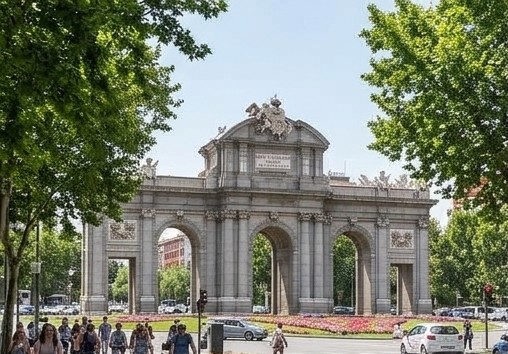
Beyond the market halls, history reveals even sharper drama under the starry winter sky. Near the neoclassical arches of Puerta de Alcalá, where modern light canopies trace grand stone columns, dark historical moments linger. Right at this busy crossroads in March nineteen twenty one, Spanish Prime Minister Eduardo Dato was shot inside his motorcar by anarchists on a motorcycle. Decades earlier in July eighteen fifty four, the flamboyant Count of Villahermosa paraded through the gate brandishing a captured spear like a Roman warrior, earning the sarcastic nickname Longinos from Madrileños who mocked his vanity. These captivating historical anecdotes remind us that Madrid wears its drama with effortless theatrical charm.
The Geometry of Evening Light
As you prepare to step into the evening chill, surrender to the unhurried rhythm of the city. The true luxury of Madrid in December lies in absolute presence. It is found in the soft clink of vermouth glasses against a cool marble bar, the sudden breathlessness of stepping beneath a shimmering canopy of lights, and the enduring warmth of a city that turns every winter night into a celebration of culture, beauty, and light.
Want to walk it yourself? Plan a trip with these places
The walk
On site, play just that chapter
- 1 min · on site
The Golden Enclosure of Tradition
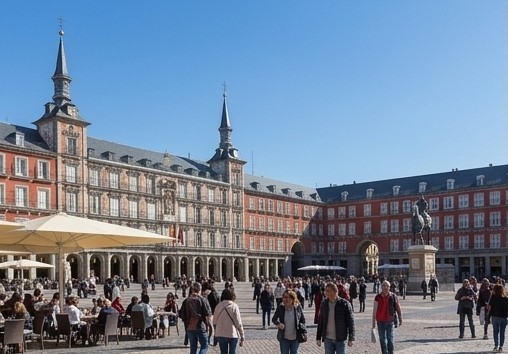
AI-generated image · may differ from the real place Step into the vast red enclosure of Plaza Mayor, where two hundred and thirty seven balconies look down like silent spectators upon the festive crowd. Built under King Philip III by architect Juan Gómez de Mora after sixteen seventeen, this classic square has endured catastrophic fires and public spectacles. At its center stands the bronze equestrian statue of Philip III, crafted by Giambologna and Pietro Tacca as a Medici gift. In December, the square transforms into a nostalgic wonderland filled with red wooden stalls offering nativity figurines, glass baubles, and festive trinkets. Arrive in the early evening while the light is pale blue. Walk along the perimeter arches of Casa de la Panadería to admire the grand painted frescoes before the evening crowds arrive.
Turn away from the central statue and exit through the southwest arch of Arco de Cuchilleros, taking a few steps toward the glowing glass pavilion of the market.
- 1 min · on site
The Iron Temple of Gastronomy

Photo: RL0919 · CC BY-SA 4.0 · Original file Before you stands a masterpiece of early twentieth-century iron architecture, inaugurated in nineteen sixteen and transformed into Madrid's premier gourmet hall. Long before iron beams were assembled here under architect Alfonso Dubé y Díez, this ground held the parish church where playwright Lope de Vega was baptized, followed by the noisy open air market criticized by writer Ramón de Mesonero Romanos. Today, warm light pours through crystal walls onto marble counters piled with acorn fed ham, artisan cheeses, and glistening seafood. Step inside the warm interior and order a glass of dark Castilian vermouth paired with a crisp croquette. Look up to admire the intricate iron cresting that crowns the glass roof.
Leave the lively market noise behind and follow Calle Mayor eastward for three short blocks until the open expanse of Puerta del Sol unfolds.
- 1 min · on site
The Beating Heart of Kilometer Zero
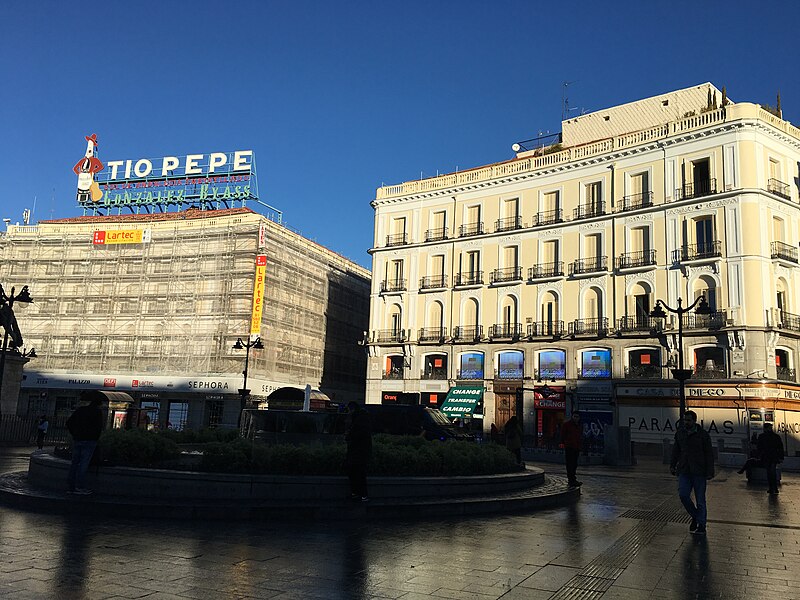
Photo · Wikimedia Commons Arrive at the vibrant crossroads of all Spain, where street life pulses beneath the iconic illuminated sign of Tío Pepe. This square takes its historical name from the eastern city gate that once caught the morning sun. Look down near the main entrance of the Royal House of the Post Office to find the brass Kilometer Zero plaque set into the stone pavement. This eighteen century post building once served as the headquarters of state security. High above, the famous tower clock stands ready to chime twelve times on New Year's Eve as thousands gather to eat twelve lucky grapes. Look toward the eastern corner to spot the famous bronze statue of The Bear and the Strawberry Tree standing proudly.
Walk north along Calle de Preciados, letting the festive shop windows lead you directly to the sweeping avenue of Gran Via.
- 1 min · on site
The Illuminated Boulevard of Dreams

Photo: Javier Perez Montes · CC BY-SA 4.0 · Original file Stand at the edge of Gran Via and look up at the breathtaking canopy of light suspended across Madrid's most famous boulevard. Carved through the dense historic center in the early twentieth century, this grand street showcases magnificent Beaux Arts and Art Deco facades towering into the night. As dark falls, thousands of glowing bulbs transform the asphalt canyon into a river of golden light. Walk the avenue starting from Callao towards Alcalá, keeping your eyes turned upward to notice how the illumination accentuates ornate stone balconies, decorative statues, and soaring towers. The rhythmic pulse of traffic and theatergoers creates an unmistakable energy that feels both classic and intensely modern.
Turn left into the stylish side streets of the Chueca district, where the grand boulevard yields to intimate neighborhood charm.
- 1 min · on site
The Chic Pulse of Neighborhood Light
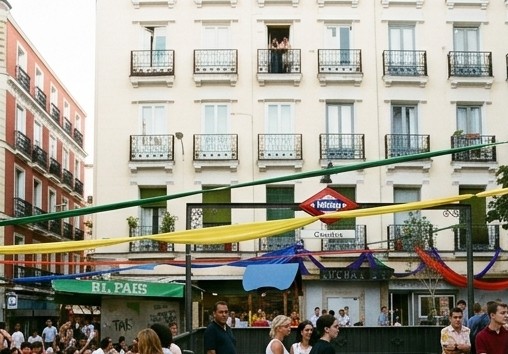
AI-generated image · may differ from the real place Welcome to Chueca, a neighborhood named after the celebrated Spanish zarzuela composer Federico Chueca. Known across Europe for its creative spirit and welcoming nightlife, this quarter wears its holiday lights with playful, contemporary style. Here, historic brick facades meet avant garde boutiques and buzzing tapas bars. The street decorations here are lighter, whimsical, and distinctly bohemian compared to the regal avenues nearby. Walk into Plaza de Chueca as the neighborhood comes alive for late evening drinks. Find a small table at a cozy corner tavern, order a glass of dry sherry alongside marinated olives, and watch locals gather under the glowing geometric stars suspended above the square.
Stroll east along Calle de Barquillo toward Calle de Alcalá until the majestic stone arches of Puerta de Alcalá appear illuminated against the Retiro sky.
- 1 min · on site
The Monumental Gate of Kings and Stars
AI-generated image · may differ from the real place Pause before the grand neoclassical arches of Puerta de Alcalá, glowing like a carved pearl in the night. Commissioned by King Charles III and designed by Italian architect Francesco Sabatini in seventeen seventy eight, this granite gate once marked the eastern entry into Madrid. Examine the Segovian granite pillars and white Colmenar stone sculptures, still bearing faint scars from historical battles. It was here in nineteen twenty one that Prime Minister Eduardo Dato was assassinated, and where the Count of Villahermosa earned his witty nickname Longinos. In modern times, stars like Katy Perry and Linkin Park performed beneath these arches for massive international crowds. View the monument from the quiet lawns of Retiro for the most dramatic perspective.
Cross Calle de Serrano northward into the refined grid of the Salamanca district to reach Mercado de la Paz.
- 1 min · on site
The Refined Sanctuary of Salamanca

Photo: Malopez 21 · CC BY-SA 4.0 · Original file End your evening journey inside Mercado de la Paz, tucked discreetly within the elegant Salamanca neighborhood. Built in eighteen seventy nine, this is the sole surviving nineteenth-century neighborhood market in the area, featuring a delicate iron structure hidden behind handsome residential brick facades. While costumbrista writer Ramón de Mesonero Romanos once campaigned for covered iron markets to clean up Madrid's unhygienic street market chaos, today this space represents the absolute pinnacle of neighborhood culinary refinement. Walk up the seventeen stone entrance steps from Calle Claudio Coello into a warm, beautifully orderly haven of gourmet stalls. Take a seat at a polished wooden counter, order a slice of freshly made Spanish potato tortilla alongside a glass of crisp Castilian white wine, and savor the sophisticated tranquility of this residential sanctuary as your winter tour reaches its graceful conclusion.


As the final lights glow quietly over Salamanca, Madrid reveals its truest secret: winter is not a season of cold, but a refined celebration of light, taste, and eternal style.
Take it further
Open the tour in the appThe tour in the app
Christmas Markets and Lights TourImmerse yourself in Madrid's winter glamour on a curated stroll from historic Plaza Mayor through glowing avenues to Salamanca. Discover golden Christmas markets, royal monuments, and iconic city illuminations paired with rich Castilian vermouth, hot chocolate, and artisan tapas along Madrid's most stylish avenues.
+ Add the tour to your planIf you have the app the tour opens right away; otherwise you go to the store.FAQ
- What is the best time to experience the Christmas lights in Madrid?
- Dusk is ideal, around five thirty in the evening, when the sky turns deep indigo and the festive lights illuminate the historic architecture before peak night crowds gather.
- How should I dress for an evening light walk in December?
- Opt for chic winter layering with a tailored wool coat, comfortable leather walking shoes, and a heavy warm scarf for strolling through open plazas.