To understand Barcelona properly, one must approach its stone facades and sunlit plazas the way an uncompromising culinary critic approaches a world-famous tasting menu. You do not merely look at a city; you taste the quality of its light, weigh the density of its mortar, and discern whether its creators worked with the steady patience of a master baker tending a sourdough starter or the hasty arrogance of an amateur cook. Barcelona is a feast prepared over centuries, a complex reduction of Mediterranean sea air, delicate ironwork, and raw Montjuic stone that demands a slow, deliberate palate. As morning mist rolls off the water, washing gently over the terracotta roofs of the Gothic Quarter, the city reveals its true technique. Here, architecture is not a passive background. It is an edible landscape of textures, where rough-hewn medieval granite meets the buttery, organic curves of Catalan Modernism with breathtaking precision.
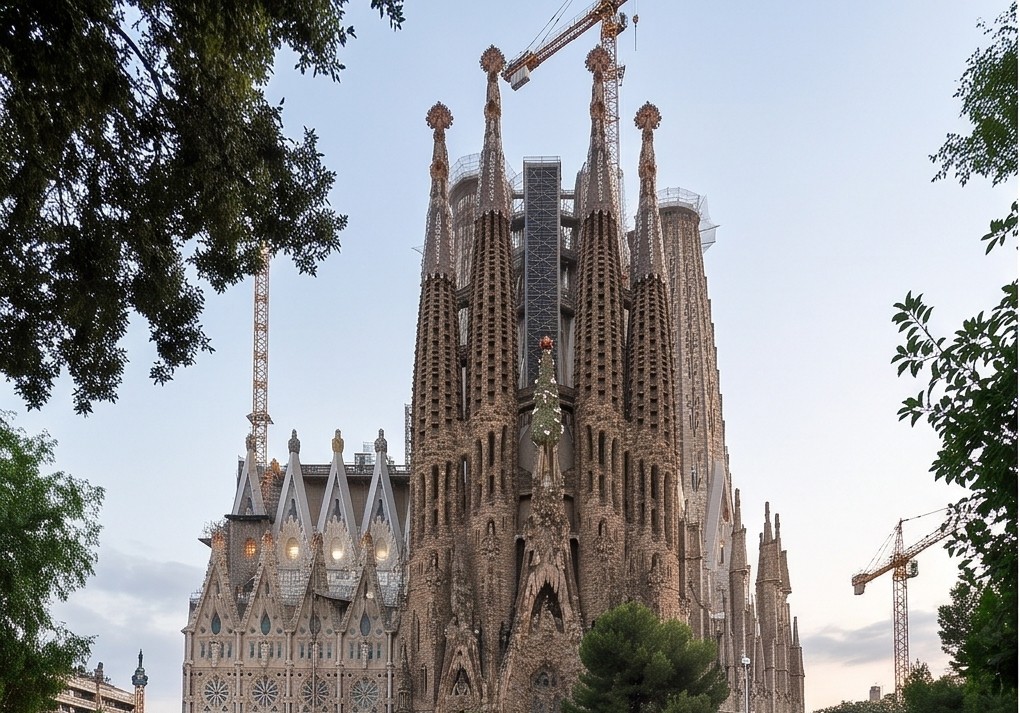
Consider the sheer obsession required to construct an urban masterpiece of this magnitude. Great kitchens are never built on timid consensus; they are forged by uncompromising visionaries who refuse to cut corners on ingredients or method. When the devout bookseller Jose Maria Bocabella returned from the Vatican in the late nineteenth century fired with the ambition to erect a monumental expiatory temple, he ignited a culinary recipe that would outlive generations. Antoni Gaudi inherited this kitchen and reshaped its menu entirely. When pressed by anxious patrons about the decades slipping away while his towering basilica remained unfinished, Gaudi offered the supreme confidence of a master chef who knows that a complex stock cannot be rushed. My client is not in a hurry, he famously remarked, acknowledging that God has all the time in the world. Gaudi understood that true artistic craftsmanship demands infinite patience, allowing stone, light, and faith to simmer together until the flavor achieves absolute perfection.
The Spice of Contradiction
Yet no legendary tasting menu is without its fierce critics and passionate arguments, and Barcelona has always invited opinionated diners to its table. Where some taste pure genius, others detect bitter failure. In the turbulent spring of nineteen thirty-eight, George Orwell marched through these avenues while writing his intense civil war memoir Homage to Catalonia. Gazing upon the unfinished spires of the Sagrada Familia, Orwell declared it one of the most hideous buildings in the world, sharply criticizing its extravagant, bone-like forms. Meanwhile, the celebrated American architect Louis Sullivan tasted the exact same creation and proclaimed it the greatest piece of creative architecture in the last quarter century, describing it as pure spirit symbolized in stone. This exquisite tension between horror and adoration is precisely what gives the city its pungent depth. Barcelona never aims to satisfy every bland palate; it prefers to provoke, challenge, and linger on the tongue long after you have departed.
A Table Set for the Senses
As you walk these historic avenues today, prepare your senses for an unhurried tasting tour. You will encounter the salty crunch of promenade life along La Rambla, where the Spanish poet Federico Garcia Lorca once wished the street would flow endlessly without an end. You will savor the cool, shaded tranquility of centuries-old cloisters, the kaleidoscopic burst of stained glass that feels like hand-blown sugar, and the organic bench curves of hilltop gardens designed like undulating ribbons of ceramic tapas. Do not hurry your steps through these streets. Listen closely to the rhythm of the cobblestones beneath your shoes and the whisper of coastal breezes through the palm trees. Barcelona is waiting to serve its finest courses, and every single corner holds a recipe worth remembering.
Want to walk it yourself? Plan a trip with these places
The walk
On site, play just that chapter
- 1 min · on site
The First Sip of Tradition
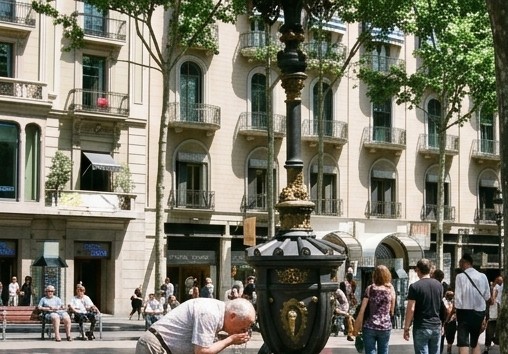
AI-generated image · may differ from the real place Stand at the top of the promenade near Plaça de Catalunya where the cast-iron lantern fountain of Font de Canaletes holds court. A seasoned food critic knows that the first bite of a meal sets the expectation for everything that follows, and this nineteenth-century fountain is Barcelona's ultimate palate cleanser. Notice the ornate bronze spouts and the elegant gas lamp crown towering above the water basin. The local legend promises that anyone who drinks a single sip from these bronze taps will inevitably fall under the city's spell and return to Barcelona. It is also where passionate football supporters gather in joy to celebrate victorious matches, spilling into the avenue in a legendary collective toast. Take a moment to step close, reach out toward the cool bronze, and taste the refreshing water before beginning your journey down the famous promenade.
From this refreshing opening sip, let the natural gentle downhill slope of the promenade guide your steps directly into the bustling heart of La Rambla.
- 1 min · on site
The Promenade of Continuous Flavor
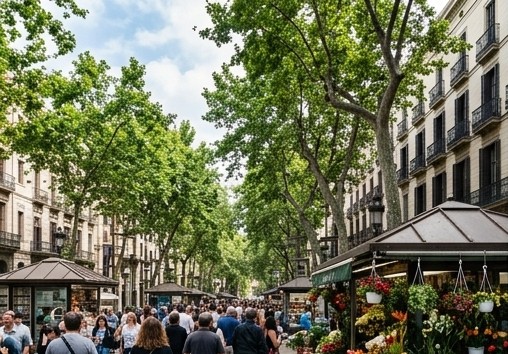
AI-generated image · may differ from the real place As you stroll beneath the overarching canopy of plane trees, La Rambla unfolds like a long, multi-course feast served along a five-part boulevard. Smell the rich aroma of roasted coffee and fresh flowers mingling with the salty Mediterranean breeze coming from the harbor. Step off the central walkway near the Pla de l'Os to admire the circular pavement mosaic embedded into the ground by master artist Joan Miró, its bold primary colors acting like a vivid garnish on the cobblestones. Look closely into the narrow side streets where hidden cafes simmer quietly away from the main torrent of strollers. The poet Federico García Lorca famously called this the only street in the world he wished would never end. Keep your personal belongings secure against your body as you soak in the lively sensory theatre of flower stalls, news kiosks, and street performers.
Turn east away from the tree-lined boulevard, weaving through the narrow stone alleyways of the Gothic Quarter until you reach the wide open square of Pla de la Seu.
- 1 min · on site
A Gothic Crust of Stone and Geese
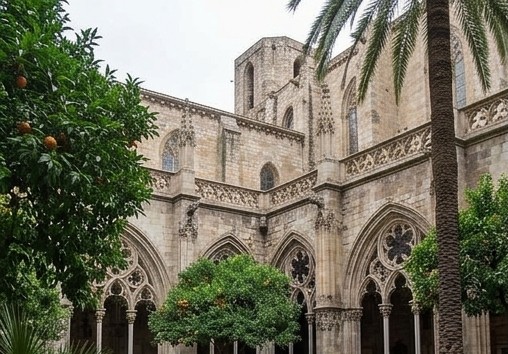
AI-generated image · may differ from the real place Pause before the dramatic Gothic facade of the Cathedral of the Holy Cross and Saint Eulalia, where gargoyles and slender spires reach toward the sky like crisp pastry pinnacles. Step inside the cool interior and navigate toward the remarkable fourteenth-century cloister, a secluded garden courtyard enclosed by soaring stone arcades. Look down into the central pond to spot the thirteen white geese that live here permanently, their snowy feathers representing the age of Saint Eulalia when she was martyred. The contrast between the heavy medieval masonry and the gentle splashing of the central fountain feels like a classic culinary pairing of rich density and subtle acidity. Before paying for elevator access to the panoramic rooftop terrace, check the notice board near the main entrance to see if free interior visiting hours are currently available.
Leave the peaceful sanctuary of the cloister behind and head northeast toward the artistic district of El Born to discover a palace built of music and stained glass.
- 1 min · on site
A Confection of Glass and Sound
Photo · Wikimedia Commons Tucked tightly into a narrow corner of Sant Pere Mes Alt, the Palau de la Música Catalana appears like an elaborate architectural dessert crafted from red brick, sculpted stone, and shimmering mosaic tiles. Designed by Modernist master Lluís Domènech i Montaner as a home for the Orfeó Català choral society, this concert hall rejects traditional architectural austerity in favor of pure sensory indulgence. Look up at the corner facade to admire the massive sculptural group featuring Catalan figures and allegorical heroes. Take a guided tour to step inside the main hall when no concert is in progress, where you will gaze up at the famous inverted stained-glass skylight hanging like a droplet of liquid honey. Notice how natural sunlight filters through the amber glass, bathing the acoustic hall in warm golden tones.
Cross the wide avenue of Gran Via and travel north into the structured grid of the Eixample district, where a monumental architectural obsession awaits.
- 1 min · on site
The Slow-Cooked Masterpiece of Faith
AI-generated image · may differ from the real place Approach the towering spires of the Sagrada Família, an architectural creation that has been slow-cooking under the Catalan sun for over a century. Antoni Gaudí dedicated his final decades to this colossal basilica, treating stone not as rigid mineral but as living, organic dough that twists into hyperboloid columns and branching forest vaults. Walk around the perimeter to compare the contrast between two distinct facades: the intricate, mossy organic carvings of the Nativity Facade and the stark, emaciated skeletal lines sculpted by Josep Maria Subirachs on the Passion Facade. Remember to book your timed entry ticket online well in advance, as walk-up slots sell out rapidly. Stand inside the central nave to watch sunlight pour through stained-glass windows, painting the stone floor in rich shades of cobalt blue and fiery orange.
Board the northbound metro toward Carmel hill, ascending into the breezy heights of Gràcia to reach Gaudí's whimsical hilltop garden.
- 1 min · on site
A Mosaic Banquet on Bare Mountain
Photo · Wikimedia Commons Ascend the southern slope of Carmel hill into Park Güell, originally commissioned by industrialist Eusebi Güell as an exclusive garden city for the Catalan bourgeoisie. Gaudí transformed this rocky slope into a surreal architectural buffet where nature and mosaic art blend effortlessly. As you pass through the main entrance, look directly ahead to greet the famous multi-colored ceramic salamander resting on the grand staircase. Climb to the main terrace above to sit along the undulating mosaic bench designed by Josep Maria Jujol, its ergonomic curves formed from broken ceramic shards using the trencadís technique. From this colorful perch, enjoy the panoramic views sweeping across the rooftops of Barcelona toward the shimmering blue Mediterranean. Arrive early in the morning to beat the largest crowds and savor the quiet air of this hilltop sanctuary.
As night settles over Barcelona and the streetlights cast warm amber shadows across the cobblestones, one realizes that this city is never truly finished. It is a perpetual feast where each generation adds its own ingredient to the simmer. Walk slowly, taste deeply, and remember that the finest architectural courses are meant to be digested over a lifetime.
Take it further
Open the tour in the appThe tour in the app
Barcelona Architectural Tasting WalkThis walking itinerary guides you from the iconic Font de Canaletes along La Rambla to the Gothic Cathedral, through the Palau de la Música, and upward to the towering Sagrada Família and hilltop Park Güell, exploring Barcelona's architectural feast.
+ Add the tour to your planIf you have the app the tour opens right away; otherwise you go to the store.FAQ
- Do I need to book tickets in advance for Sagrada Família and Park Güell?
- Yes, both landmarks require advance timed-entry booking online as walk-up tickets sell out quickly, particularly for the Monumental Zone of Park Güell and the basilica towers.
- What is the legend of Font de Canaletes?
- Legend says that anyone who drinks water from the Font de Canaletes will inevitably fall in love with Barcelona and return to the city.