To enter Barcelona through its historical layers is to realize that the city was never built simply in stone, but in accumulated memory. Before the grand avenues cut across the plain toward the sea, this landscape was a tapestry of monastic estates, fortified medieval guilds, and quiet villas tucked into the foothills. The morning light strikes the ancient Roman ashlar at an angle, revealing chiselled mason marks that have survived two millennia of salt air. Most travelers walk briskly past these weathered stones, drawn toward the dramatic heights of the cathedral or the kinetic pulse of the seafront. Yet the authentic pulse of this territory resides in its quieter corners, where objects and architecture tell stories of deliberate craftsmanship and quiet retreat.
As curators of material culture, we learn that every building is an archival document waiting to be deciphered. A city does not hide its secrets by locking them behind heavy doors; rather, it camouflages them in plain sight through daily use and shifting names. The threshold between what is celebrated and what is overlooked is surprisingly narrow. If you pause to trace the texture of glazed tile or observe the alignment of a neo-classical portico against the hills, the urban terrain begins to reveal an intricate dialogue between human ambition and natural form.
The Craftsmen of Memory
Consider the archival records of the late eighteenth and nineteenth centuries, when Barcelona began to outgrow its medieval boundaries. In seventeen ninety-one, Marquis Joan Antoni Desvalls gathered an Italian architect named Domenico Bagutti and master builders to lay out a hedge maze in Horta, using trimmed cypress and classical mythology to stage an inquiry into love and destiny. A century later, Catalan poet Joan Maragall stood within those same neoclassical pavilions to translate and present Goethe's classical drama, filling the stone amphitheater with verse under the open sky. In those same years, a young Antoni Gaudi sat under a simple parasol in Gracia, supervising stonemasons and ironworkers as they transformed yellow wild carnations and fan palms into ceramic friezes and wrought-iron grilles. These were not solitary monuments of isolated genius, but deeply personal experiments rooted in their physical sites.
Such episodes remind us that the makers of Barcelona treated the city as an evolving gallery. Lluis Domenech i Montaner conceived a hospital not as an austere fortress of sickness, but as a luminous garden city where subterranean corridors and vibrant mosaic pavilions offered light and dignity. Even the crowded marketplace of the Boqueria, whose humble origins began centuries ago as wooden butchers stalls near the city gate, preserved the vernacular memory of agrarian trade beneath its twentieth-century cast-iron canopy. These spaces were conceived as enduring public chambers, designed to outlive the political convulsions and industrial revolutions of their era.
An Archive Beneath the Sky
As you prepare to step into these secluded quarters, listen closely to the cadence of the paving stones beneath your feet. The true narrative of Barcelona does not announce itself with grand declarations; it speaks through the quiet patina of aged brick, the rustle of overgrown laurels, and the geometric precision of hidden arcades. We are about to trace a physical path through these sequestered artifacts, moving from ancient marketplace footings to shaded romantic terraces. What you will encounter is not merely picturesque scenery, but a living archive of stone, craft, and civic devotion that continues to breathe just beyond the rush of modern life.
Want to walk it yourself? Plan a trip with these places
The walk
On site, play just that chapter
- 1 min · on site
The Merchant Archival Ground
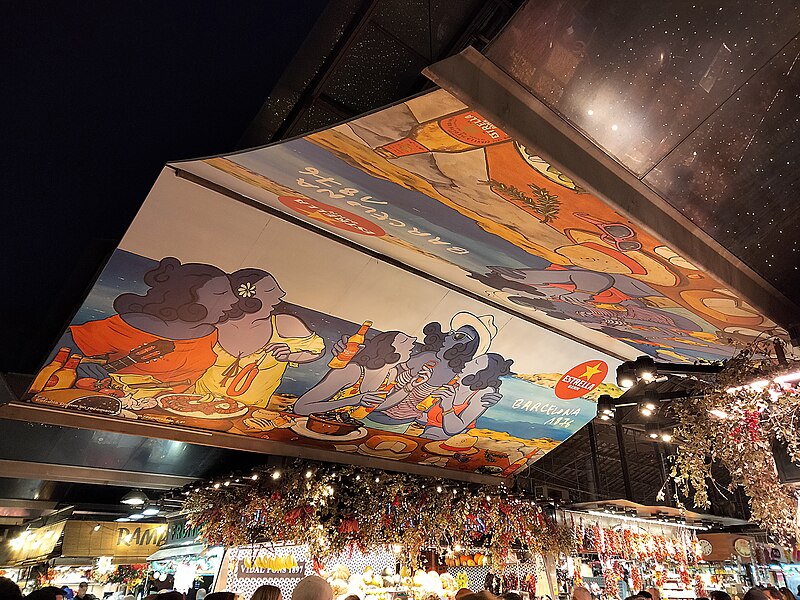
Photo · Wikimedia Commons Begin by stepping beneath the iron arch of the market entrance, leaving the midday rush of the Rambla behind. While visitors congregate around the front stalls, walk straight past the fruit displays toward the rear stone perimeter. In twelve seventeen, simple open-air trestles were erected here outside the medieval city gate, where countryside shepherds traded goat meat, giving the market its name from the Catalan word boc. By fourteen seventy, this expanse served as a livestock exchange named Mercadi Bornet, before evolving into a straw market. In eighteen forty, architect Mas Vila designed the formal neoclassical colonnade, capped in nineteen fourteen by the soaring cast-iron roof. Look up at the metal trusses where industrial ironwork frames the filtered Mediterranean sky. Here, amidst the scent of aged cheeses, you stand upon seven centuries of uninterrupted civic commerce.
Walk southeast along the medieval alleyways, cutting across the Gothic Quarter until you emerge into the broad flagstone promenade of the Born.
- 1 min · on site
The Chivalric Promenade

Photo: Pere López Brosa · CC BY-SA 4.0 · Original file Step onto the wide stone flagstones of Passeig del Born, flanked by ancient plane trees whose branches filter the coastal breeze. During the Middle Ages, this open concourse served as the dramatic center of civic and chivalric life. Jousting knights galloped between timber stands, while merchant guilds celebrated religious feasts beneath the towering bulk of Santa Maria del Mar at the eastern vista. Take a moment to explore the narrow adjacent lanes, which remain quiet pedestrian corridors where vehicles are limited. Look closely at the carved stone lintels above darkened doorways, where medieval trade guilds chiselled their insignia into the porous sandstone. Notice the wrought-iron gas lanterns suspended from balconies, casting deep evening shadows across weathered facades. The promenade retains the measured dignity of an open-air hall, where centuries of aristocratic tournaments have smoothed every stone.
From the shaded promenade, make your way north toward the Guinardo district to witness the extraordinary ceramic architecture of Hospital de la Santa Creu i Sant Pau.
- 1 min · on site
Hospital de la Santa Creu i Sant Pau
The Sanctuary of Light and Ceramic
Photo · Wikimedia Commons Enter the grand iron gates and stand within the central garden pavilion designed by master modernista architect Lluis Domenech i Montaner. Commissioned at the dawn of the twentieth century through an endowment from banker Pau Gil, this sprawling complex inherited a lineage dating to fourteen hundred and one, when six medieval hospitals merged. Domenech i Montaner rejected grim institutional wards, composing instead a tranquil sanctuary of twelve ornamental pavilions surrounded by orange trees. Walk slowly between the brick pavilions, examining the glazed polychrome roof tiles and intricate carvings of winged angels. Descend briefly into the subterranean brick corridors, where white ceramic tiles once allowed doctors and patients to travel safely beneath the gardens. Here, medicine joined with high decorative craft, guided by the conviction that sunlight and architectural beauty could actively comfort and restore the human spirit.
Continue westward across the residential avenues into the old village of Gracia, where Antoni Gaudi built his earliest residential masterpiece at Casa Vicens.
- 1 min · on site
The Orientalist Manor of Gracia
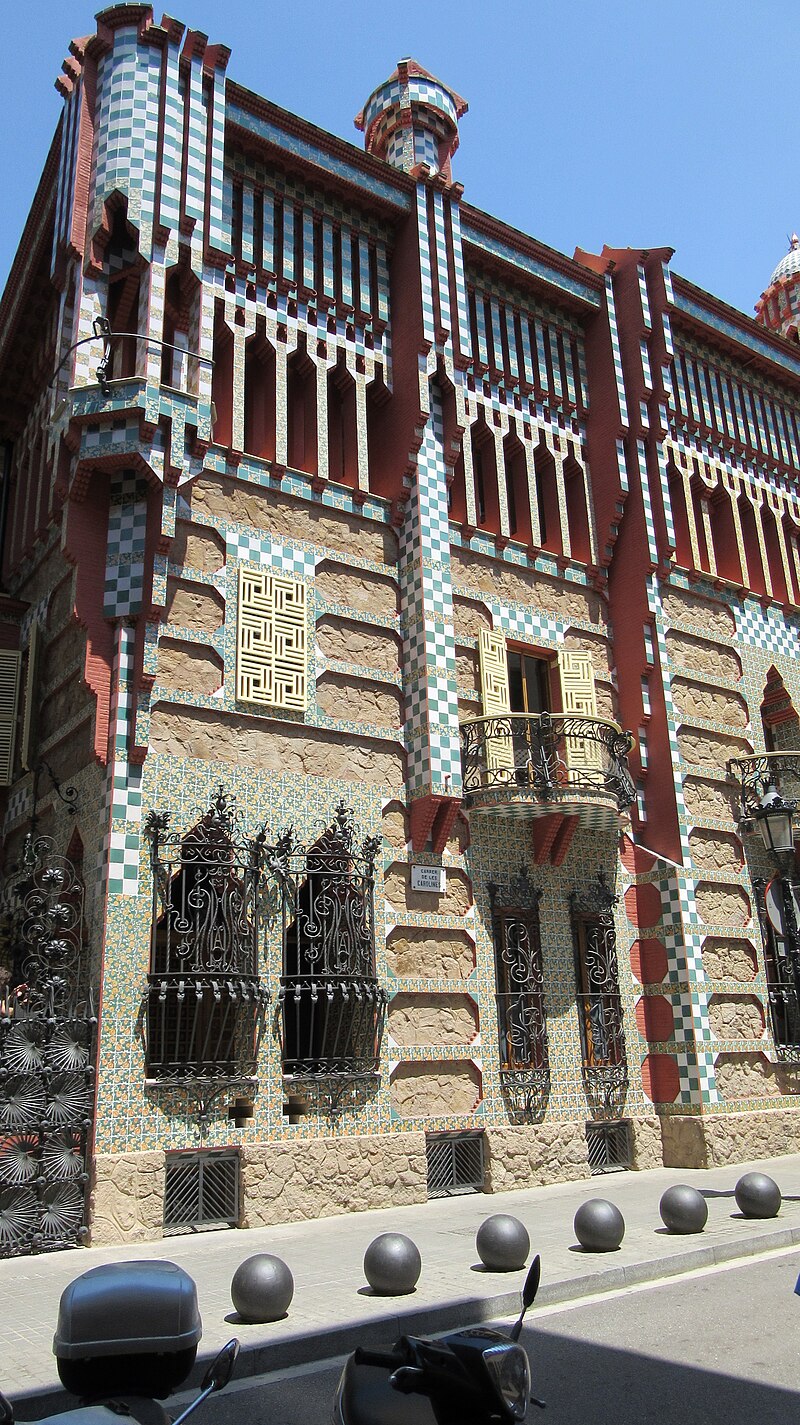
Photo · Wikimedia Commons Stand along the quiet cobblestones of Carrer de les Carolines to gaze up at the polychrome facade of Casa Vicens, completed in eighteen eighty-five. Commissioned by broker Manuel Vicens i Montaner as a summer residence when Gracia was still an independent rural township, this house marks the spectacular beginning of Gaudi's career. When Gaudi first surveyed the plot, he discovered wild yellow carnations and an exuberant fan palm growing across the earth. He captured both in his craft, molding the palm leaves into the magnificent cast-iron entrance fence forged by blacksmith Joan Onos, and firing the yellow blossoms onto thousands of glazed tiles. Notice the straight lines and Moorish-inspired brickwork, reflecting Gaudi's fascination with orientalist architecture. Step inside to admire the covered porch, where wooden latticework and a delicate fountain once cooled the summer breeze.
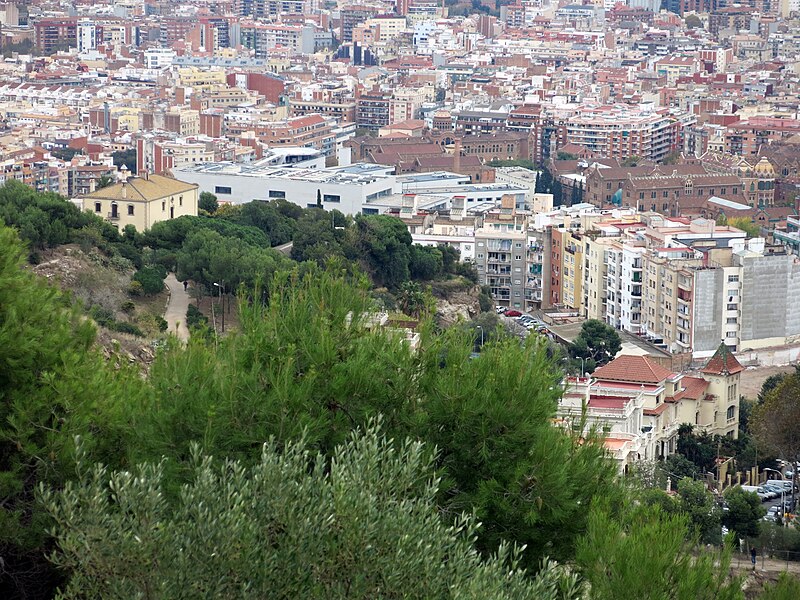
Conclude your journey by ascending north toward the Collserola foothills, where the quiet evergreen terrace of Parc del Laberint d'Horta awaits.
- 1 min · on site
The Neoclassical Garden of Love and Art
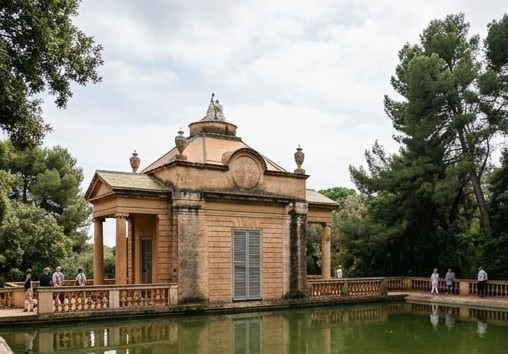
AI-generated image · may differ from the real place Step through the gates into Barcelona's oldest preserved historic garden, laid out in seventeen ninety-one by Marquis Joan Antoni Desvalls alongside Italian architect Domenico Bagutti. The lower terrace holds the famous hedge labyrinth, composed of seven hundred and fifty meters of meticulously trimmed cypress trees. At the entrance to the maze, look for the classical marble bas-relief depicting Ariadne and Theseus, with the sculpted figure of Eros standing at the center. Ascend the stone stairways past the classical bust of Dionysus to the intermediate terrace, where two Italianate temple pavilions overlook the green maze below. It was here in eighteen ninety-eight that Catalan poet Joan Maragall staged Goethe's tragedy of Iphigenia in Tauris against classical columns. Walk up to the third terrace to view the pavilion dedicated to the nine muses, inscribed with the Latin promise that harmony between art and nature yields true beauty.

When the afternoon light softens into amber, the stones of Barcelona surrender the warmth they collected throughout the day. From the ancient meat tables of the Boqueria to the neoclassical cypress walls of Horta, each sequestered space we have examined is an enduring chapter in a continuous dialogue between human imagination and raw material. These monuments do not demand your hasty admiration; they ask only for your patient attention. As you return to the animated boulevards, carry with you the quiet geometry of these hidden courtyards, where the true soul of the city remains lovingly preserved.
Take it further
Open the tour in the appThe tour in the app
A Curatorial Passage Through Barcelona's Hidden HeritageThis carefully curated walking journey spans the medieval merchant origins of Ciutat Vella at La Boqueria, the chivalric stones of El Born, the radiant modernista healing pavilions of Sant Pau, Antoni Gaudi's vibrant domestic debut in Gracia, and the tranquil eighteenth-century neoclassical hedge maze of Horta.
+ Add the tour to your planIf you have the app the tour opens right away; otherwise you go to the store.FAQ
- How should one best observe the architectural details along this route?
- Take time to examine the masonry junctions, ceramic tile glazing, and wrought-iron fittings from up close, as each element reflects distinct artisan techniques from medieval guilds to twentieth-century modernisme.
- Can this historical itinerary be completed comfortably in a single day?
- The route moves logically from the coastal historic center northward to the mountain foothills, allowing travelers to experience the old town on foot during the morning before exploring the northern pavilions and gardens in the afternoon.
- What makes these sequestered sites unique compared to major tourist landmarks?
- Rather than presenting isolated monuments, these spaces reveal the everyday civic, medical, and residential life of Barcelona through authentic material artifacts that have survived in their original urban settings.