Morning arrives over Barcelona not as a sudden awakening, but as an amber tide drifting in from the Mediterranean, bathing the octagonal corners of the Eixample in honeyed warmth before creeping upward toward the pine-fringed ridge of Collserola. To step out onto these wide stone pavements with a child at your side is to experience an immediate suspension of ordinary domestic haste. The city does not ask young travelers to whisper or walk on their tiptoes; instead, it greets their natural hunger for wonder with an urban canvas where rooftops arch like sleeping beasts, balconies resemble theatrical masquerade masks, and limestone walls curve like sea waves frozen mid-crest. Long before children learn the formal vocabulary of architecture or the doctrines of modernism, they understand instinctively what the Catalan builders set out to achieve. They perceive that a city need not be a rigid grid of concrete and iron, but can instead become an enchanted habitat where human shelter merges seamlessly with the organic patterns of the natural world.
The Geometry of the Tree Trunk
At the heart of this luminous playground lies the singular philosophy of Antoni Gaudi, who once observed with disarming simplicity that there are no straight lines or sharp corners in nature, and therefore human architecture ought not to possess them either. When Count Eusebi Guell attempted to establish a leafy residential garden city on the rocky southern slope of Bare Mountain, the venture failed commercially because the bourgeois families of the era found the hillside too remote from the urban center. Yet out of that commercial silence grew something infinitely more enduring. Guell persuaded Gaudi to invest his modest personal savings into an unsold show home, where the architect moved in nineteen zero six with his elderly father and young niece, inhabiting a quiet pink villa amidst aromatic pines while shaping stone viaducts that seem to sprout from the earth like petrified tree trunks. Nearby at the Sagrada Familia, amidst the dust of chisels and rising scaffolds, Gaudi took care to design a dedicated schoolhouse on the construction grounds in nineteen zero nine, ensuring that the young children of his stonecutters and laborers had a place of dignity, light, and undulating brick walls in which to study while their fathers raised the spires toward heaven.
Mechanical Dreams on the Cloudline
This tender alliance between architectural daring and the child's unbounded imagination has always drawn seekers to the Catalan capital. High upon the summit of Tibidabo, where the pharmacist Salvador Andreu first envisioned an amusement realm above the clouds at the dawn of the twentieth century, the vintage carousel and suspended aircraft still circle the sky. In nineteen fifty-seven, Walt Disney himself wandered into the park's Museum of Automats, fell hopelessly in love with the whirring clockwork figures, and offered blank checks to purchase the entire collection, only for the proud Catalan directors to politely refuse his fortune. Even the sharpest literary cynics could not remain neutral here. While George Orwell famously sneered at the rising basilica in nineteen thirty-eight, calling it one of the most hideous structures on earth, the visionary architect Louis Sullivan wept with admiration, declaring it the spirit of humanity symbolized in enduring stone. Walking these sunlit avenues hand in hand with a child, one discovers that Barcelona belongs neither to the pedants nor the hurried sightseers. It belongs to those who still remember how to look at a tower and see a forest, or gaze upon a tiled roof and hear the gentle breathing of a slumbering dragon.
Want to walk it yourself? Plan a trip with these places
The walk
On site, play just that chapter
- 1 min · on site
Serpents of Stone and Mediterranean Pine
Photo · Wikimedia Commons Begin your journey among the whispering pines of the southern Carmel slope, where Eusebi Guell dreamed of an English garden city. Enter through the upper entrance along the high ridge to spare small legs the exhausting climb with strollers, allowing you to descend gently into Gaudi's enchanted sanctuary. Here, elevated pathways supported by rough-hewn stone columns lean inward like ancient tree trunks, rooted directly in the bare rock. Ahead lies the grand central terrace, bordered by Josep Maria Jujol's serpentine mosaic bench, crafted from kaleidoscopic shards of discarded ceramic. Sit together in one of its rounded enclaves, gazing out across the Mediterranean where cargo ships drift like painted toys on the azure horizon. Before descending, pause by the monumental stairway where the celebrated polychrome salamander fountain keeps eternal watch, its glistening tiled back catching the golden sunlight as children lean forward to marvel at water tumbling from its smiling mouth.
Leaving the quiet pine shade of the high park, descend through the village-like alleys of Gracia toward the grand aristocratic boulevard of Passeig de Gracia.
- 1 min · on site
The Slumbering Dragon of the Discordant Block
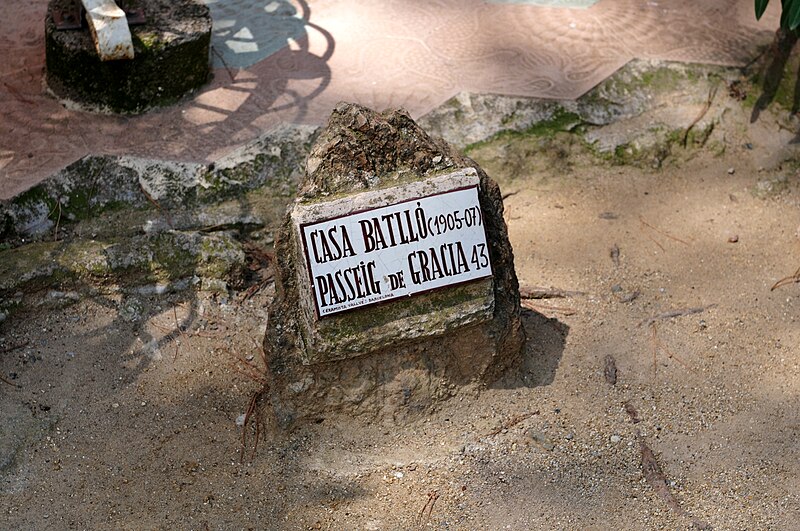
Photo · Wikimedia Commons Arriving on the fashionable Passeig de Gracia, look upward at the building locals call the House of Bones, an audacious masterpiece born from the fierce rivalry among wealthy industrialists along the Block of Discord. Josep Batllo hired Gaudi in nineteen zero four with the sole ambition to eclipse his neighbors, and the architect responded by banishing every straight line. Equip your children with the dedicated family audio guide, which turns the exploration of each undulating room into a captivating treasure hunt. Guide their eyes to the tortoise-shell skylights in the private entrance hall, then look down the central atrium where thousands of ceramic tiles transition from sky blue to oceanic cobalt to scatter daylight into the deepest chambers. Ascend finally to the rooftop loft, walking beneath white plaster arches that resemble the ribcage of an ancient leviathan, before stepping onto the terrace where the glazed spine of the dragon arches under the Mediterranean sky.
From the dragon's back on the grand boulevard, stroll eastward along the tranquil tree-lined grid of the Eixample toward the monumental spires that command the city's horizon.
- 1 min · on site
A Forest of Stone Under Stained Glass Sky
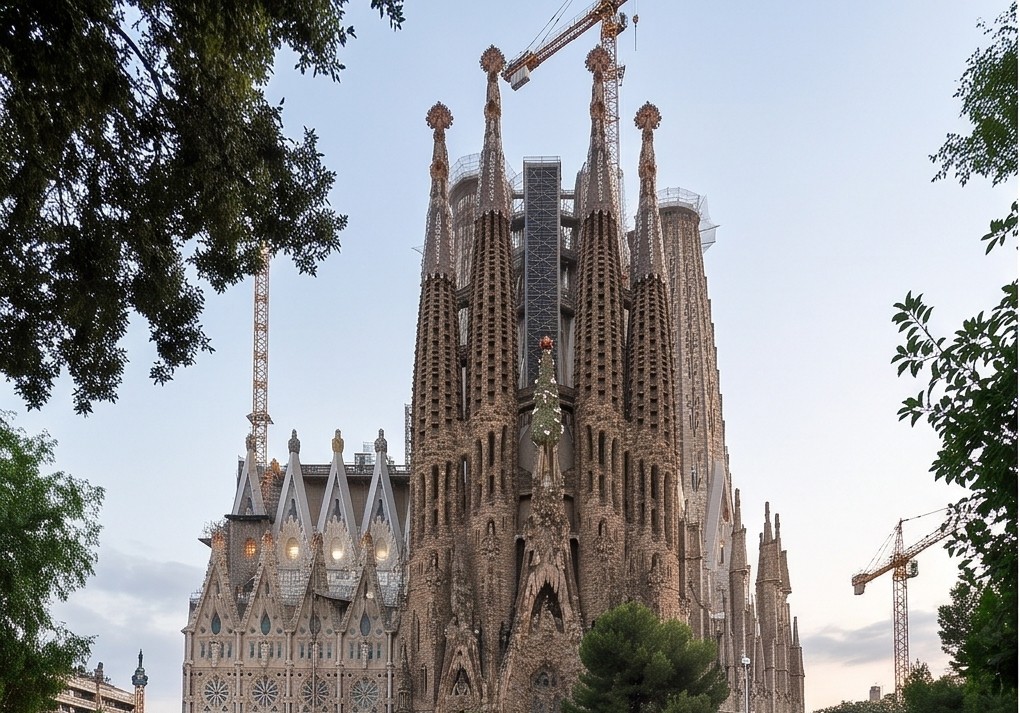
AI-generated image · may differ from the real place Nothing quite prepares a family for the sheer vertical breath of Gaudi's expiatory basilica, rising like a petrified forest in the heart of the Eixample. Pick up the family audio guide near the entrance, and if your children hunger for towering panoramas, secure separate tower access to ride high into the steeples. Step across the threshold into the central nave and tilt your heads backward: porphyry and granite columns branch outward into stone canopies sixty meters above, filtering daylight through stained-glass clerestories that wash the floor in ripples of cobalt, emerald, and molten gold. Here, where Gaudi remarked that his divine client was in no hurry, every detail sings of nature. Remember that the architect deliberately calibrated the central Christ spire to rise one meter lower than Montjuic hill, insisting that mortal craft must never overstep the works of creation, leaving young minds with an unforgettable vision of genius balanced by quiet reverence.
Leaving the sacred forest of stone behind, wander southward down the wide pedestrian promenade of Passeig de Sant Joan toward the bohemian lanes of El Born.
- 1 min · on site
Sweet Alchemy in the Barracks of El Born
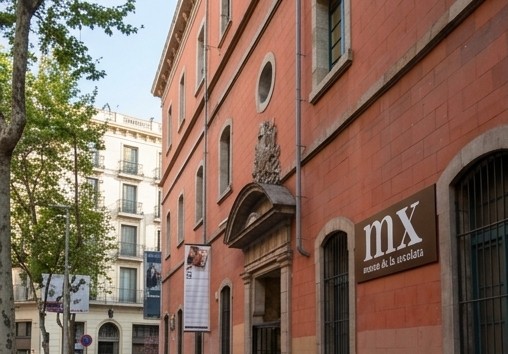
AI-generated image · may differ from the real place Tucked inside the weathered brick walls of an eighteenth-century military barrack on Carrer del Comerc, this delightful museum operated by the Barcelona pastry guild welcomes travelers with the rich, comforting fragrance of roasted cacao beans. Guide your children through the sunlit galleries where skilled chocolatiers have recreated iconic Catalan landmarks and storybook characters entirely out of tempered chocolate, turning solid confection into dazzling miniature architecture. To turn observation into pure tactile joy, reserve a hands-on workshop slot early in the morning, when the artisan kitchens are quietest and the instructors have ample time to guide small fingers. Children can pour liquid chocolate, temper sweet ganache, and mold their own imaginative souvenirs to carry away. It is a rare sanctuary where history, craftsmanship, and irresistible childhood indulgence meet, proving that art in Barcelona is something to be not only admired from afar, but joyfully tasted and touched.
Step out into the warm Mediterranean breeze and follow the stone arches of the old city westward toward the lively pedestrian thoroughfare of La Rambla.
- 1 min · on site
Sensory Feasts Beneath the Iron Canopies
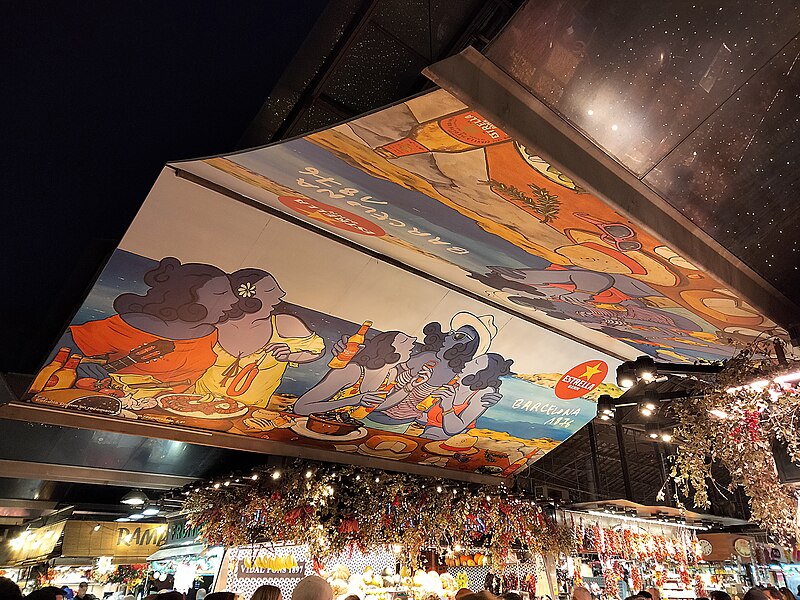
Photo · Wikimedia Commons Pass beneath the ornate nineteen fourteen wrought-iron archway on La Rambla into the bustling heart of Sant Josep de la Boqueria, where merchants have traded goods since twelve seventeen. The sensory rush is intoxicating: towering pyramids of velvety figs, glistening silver catches from the harbor, and hanging cured hams surround the lively stone passageways. Aim for a mid-morning visit when the vendors have freshly arranged their morning bounty, and invite your children to select a single vibrant treat from among the stalls. Watch their faces light up as they choose between chilled cups of ruby strawberries, golden mango spears, and freshly pressed dragon fruit juices resting on beds of sparkling crushed ice. As you lean against a wooden counter sharing sweet tropical nectar amidst the melodic cries of market sellers, the living pulse of Barcelona envelops you, creating a simple sensory memory that lingers far longer than any formal souvenir.
As twilight settles over the terracotta roofs and the distant Mediterranean deepens into indigo, Barcelona gently reminds the traveling family of what matters most. In the curving stones of its palaces, the dappled light of its cathedrals, and the sweet laughter echoing through its markets, the city offers a timeless sanctuary where adult intellect and childhood reverie walk side by side, discovering that the world is far larger and more wondrous than we had dared to remember.
Take it further
Open the tour in the appThe tour in the app
From Gracia's Slopes to Old Town's HeartThis lyrical family itinerary gently descends from the panoramic breezes of Park Guell down through the architectural wonderlands of Passeig de Gracia and Sagrada Familia, before weaving into the vibrant artisan quarters of El Born and La Rambla. It is a sensory feast designed for curious minds and unhurried steps.
+ Add the tour to your planIf you have the app the tour opens right away; otherwise you go to the store.FAQ
- How should families navigate the steep approach to Park Guell with strollers?
- Arrive via the upper entrance along the high ridge to descend smoothly through the park, sparing small legs and parents the exhausting uphill stair climb from the lower gates.
- How can parents keep young children engaged inside Casa Batllo and Sagrada Familia?
- Make generous use of the dedicated family audio guides provided at both monuments, which transform complex architectural history into an enchanting treasure hunt filled with animal allegories.
- What is the best time of day for families to explore Mercat de la Boqueria?
- Visit mid-morning when vendor stalls are freshly arranged with colorful fruit cups and juices, well before the narrow aisles become crowded with afternoon tourists.
This piece was newly written based on the Wikipedia articles ‘Tibidabo Amusement Park’, ‘Park Güell’, ‘Sagrada Família’ · CC BY-SA 4.0