I still remember the winter dusk that first brought me to Barcelona, when the December air carried the brisk salt of the Mediterranean and the warm smoke of roasted chestnuts drifting from corner braziers. It was an hour when the city seemed to soften its limestone edges, exhaling the lingering heat of summer and gathering close under strings of amber globes strung across ancient stone alleys. Most European winters offer a quiet, reverent hush, wrapping their squares in powdered sugar, fir branches, and solemn church carols. But here along the coast of Catalonia, the festive season arrived with an earthy vigor that felt entirely distinct, unapologetic, and vibrantly alive in every crowded corner of the Gothic Quarter.
Walking through the crowded plazas, I watched multigenerational families threading their way between stalls fragrant with freshly gathered forest moss, rough bark stripped from cork oaks, and bunches of wild eucalyptus. Children clutched hollowed logs adorned with bright red painted smiles, while grandparents leaned over wooden trestle tables to deliberate over handcrafted terracotta figurines. There was no theatrical pretense here, only a quiet, generational rhythm of bringing the wild Mediterranean countryside into the stone heart of the metropolis. In Catalonia, Christmas has never been a distant celestial tableau; it is an intimate homecoming rooted in the tactile grain of the soil, binding domestic warmth to the living pulse of the earth.
The Secret Blessing in the Moss
It was among the nativity scenes, or pessebres, that I first encountered the legendary caganer, that humble ceramic peasant tucked discreetly behind a shepherd flock or beside a cork cliff. To foreign eyes, the sight of a figure with lowered trousers answering nature call in the middle of a holy landscape can come as a startling shock. Yet as the eminent Catalan folklorist Joan Amades once recorded in his ethnographic studies, this mischievous character was never an act of mockery. In traditional nineteenth-century households, people genuinely believed that this symbolic deposit fertilized the earth, guaranteeing a bountiful harvest for the coming year along with physical vitality and peace of mind by the family hearth. To omit him was to court misfortune.
The architecture critic Robert Hughes observed in his landmark portrait of Barcelona that Catalan folklore possesses an innate, earthy realism that refuses to divorce spiritual joy from biological truth. Hughes highlighted the spirited local saying that still echoes across holiday dinners, urging everyone to eat well, live lustily, and fear no death. Rather than diminishing the sacred, this earthy figure grounds it in reality, reminding us that ordinary life, with all its biological humility and rustic humor, belongs at the manger alongside kings and angels. Holiness, in this Mediterranean worldview, is not exiled to remote heavens; it thrives right here in the fertile dirt.
A Sanctuary of Gathered Light
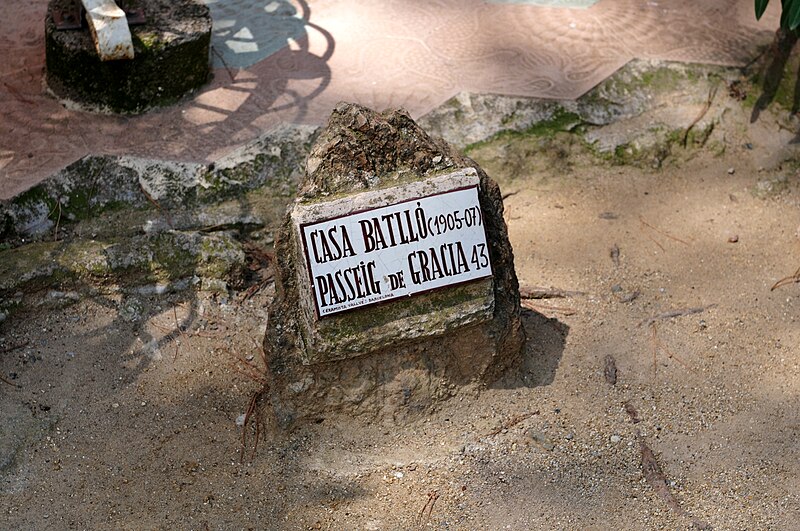
Further along the grand avenue, Antoni Gaudí understood this same communion between nature and grace when he shaped Casa Batlló on Passeig de Gràcia. When the ceramic finial for the four-armed cross arrived shattered in transit, Gaudí did not discard the pieces; instead, he instructed his artisans to press the broken shards directly into the mortar, transforming an accidental fracture into the luminous mosaic technique known as trencadís. Like that mosaic, a Catalan Christmas gathers fragments of daily existence, from the broken vessels of the year to rustic laughter and humble earth, binding them into something radiant and whole. As night deepens, the harbor lights begin to shimmer upon the Mediterranean, offering a warmth that lingers long after winter departs.
Want to walk it yourself? Plan a trip with these places
The walk
On site, play just that chapter
- 1 min · on site
Dragon Scales and Winter Shards
Photo · Wikimedia Commons Standing across Passeig de Gràcia on a December evening, Casa Batlló looks less like architecture and more like a slumbering creature draped in holiday luminescence. Commissioned by textile industrialist Josep Batlló, Antoni Gaudí transformed a conventional apartment into an undulating dreamscape of sandstone bones, stained glass, and iridescent tiles that ripple like the surface of a pond. Look up toward the roofline, where the ceramic ridge resembles the spine of Saint George's dragon. Gaudí famously declared that nature knows no straight lines, and during the festive season, special illuminations caress every organic curve of the facade. Seek out the elevated four-armed cross; when its glass finial arrived broken, Gaudí saw beauty in the mishap, embedding the shattered fragments into mortar to inaugurate his celebrated mosaic technique. Standing here amidst the winter twilight, the glowing balconies remind us that imagination can warm the coldest stone.
Follow the grand descent of Passeig de Gràcia southward as the illuminated storefronts lead you directly into the sprawling expanse of Plaça de Catalunya.
- 1 min · on site
Crossroads of Lanterns and Memory
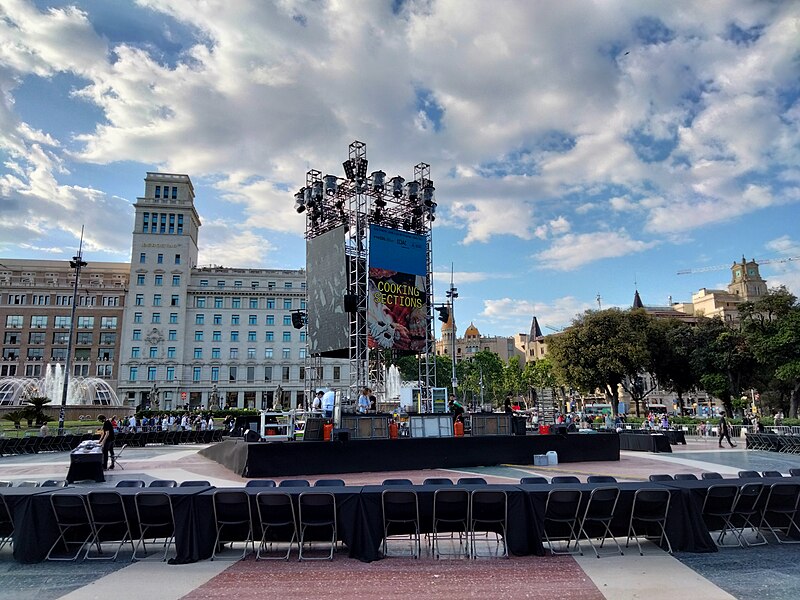
Photo · Wikimedia Commons Stepping into Plaça de Catalunya, you find yourself at the beating threshold where the orderly grid of nineteenth-century Eixample meets the ancient maze of the historic city. During the holidays, the vast plaza becomes an illuminated gathering point filled with radiant light sculptures, playful water fountains, and people meeting under the winter sky. Look toward the lantern tower of the Telefónica building to admire the striking stained glass windows designed by Brian Clarke, conceived as a colored beacon above the plaza. While historic bohemian haunts like Café Colón disappeared long ago, nearby Café Zurich still hums with lively conversation, preserving memories of an era when artists, writers, and even royalty mingled over warm coffee. Pause by the central esplanade to watch families rendezvous before plunging into the holiday markets. Here, the city collects its collective breath, suspended between past elegance and festive anticipation.
Turn your back to the broad avenues and venture south through the pedestrian corridor of Portal de l'Àngel until the soaring Gothic spires of Catedral de Barcelona emerge against the dusk.
- 1 min · on site
Bells, Cloisters, and Forest Moss
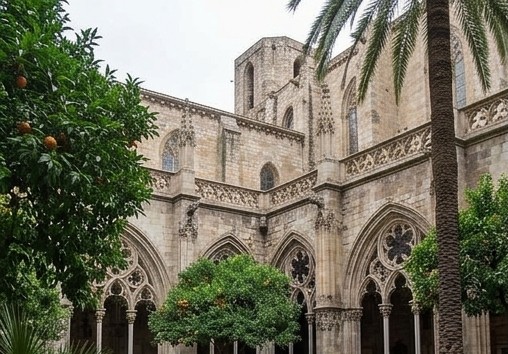
AI-generated image · may differ from the real place Arriving at Pla de la Seu, the grand Gothic facade of Barcelona Cathedral presides over a bustling sea of holiday booths. In the square below, the historic Santa Llúcia fair fills the air with the scent of pine boughs, bundles of fresh mistletoe, and shelves packed with handcrafted ceramic figurines. Weave through the stalls to admire the intricate nativity materials, from cork bark crafted into rustic mountains to moss gathered from damp ravines. When the lively hum of the market becomes overwhelming, step quietly inside the fourteenth-century cathedral cloister. Here, surrounded by soaring Gothic arches and swaying palm trees, thirteen white geese wander calmly around the central pond, honoring the young martyr Saint Eulalia. The cool, silent shadows of the cloister provide a serene sanctuary, offering a moment of quiet grace before you return to the vibrant bustle outside.
Slip around the northern flank of the cathedral into the intimate stone courtyard of Plaça Sant Iu to find the arched entrance of Museu Frederic Marès.
- 1 min · on site
The Collector's Pessebre
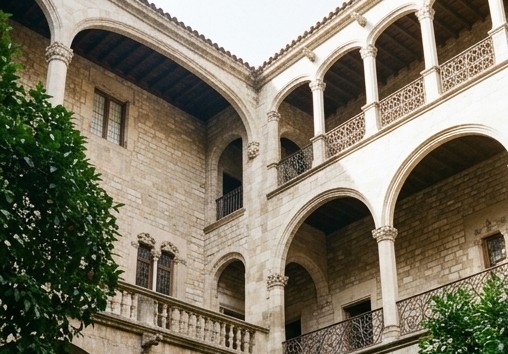
AI-generated image · may differ from the real place Tucked inside the ancient Royal Palace complex, Museu Frederic Marès holds the extraordinary life collection of sculptor Frederic Marès, whose passion ranged from medieval crucifixes to chambers brimming with antique fans and ornate iron keys. During the Christmas season, the museum courtyard and entrance hall become home to an exquisite traditional pessebre nativity display, meticulously constructed by local master artisans. Peer closely into the miniature Catalan pastoral landscape. Beyond the holy family resting beneath a timber farmhouse, you will discover washerwomen by simulated rivers, shepherds warming their hands over faux fires, and, tucked discreetly behind a rocky bluff, the mischievous caganer figurine fulfilling his humble duty. The scene reflects a deep reverence for everyday rustic life, celebrating human labor and ordinary moments within a sacred setting. In this hidden courtyard, the sacred and the domestic embrace in quiet, timeless harmony.
Weave through the narrow medieval shadows of Carrer de la Boqueria toward the west until the animated hum of La Rambla leads you to the iron gates of Mercat de la Boqueria.
- 1 min · on site
Sweet Nougat and Market Echoes
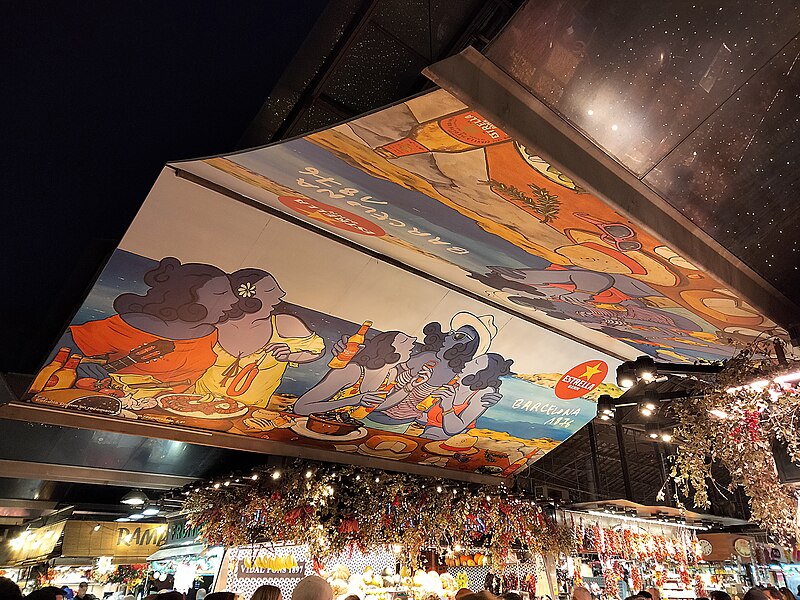
Photo · Wikimedia Commons Cross the threshold of La Boqueria into a cathedral of seasonal gastronomy, where trading has thrived since thirteenth-century meat tables stood near the old city gate. Beneath the soaring iron roof completed in 1914, winter brings a rich festival of aromas and festive Catalan delicacies. While the front entrance draws energetic crowds with vivid fruit displays, wind your way deeper toward the traditional confectioners and artisanal stalls at the rear. Here, wooden shelves groan under slabs of authentic turrón, from soft almond Jijona to crunchy Alicante studded with whole nuts, alongside fragile, rolled wafers called neules. Order a slice of toasted egg-yolk turrón and a paper cornet of roasted chestnuts to warm your fingers. In the bustling banter between vendors and longtime neighbors, you experience the sensory heart of Catalan holiday hospitality, honest, generous, and sweet.
Step back onto the central promenade of La Rambla and follow its gentle downhill slope toward the salty sea breeze and maritime lights of Port Vell.
- 1 min · on site
Harbor Lights upon the Mediterranean
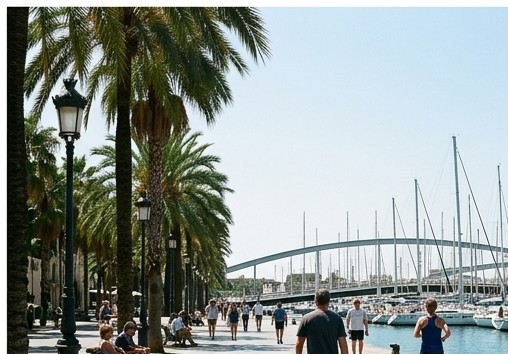
AI-generated image · may differ from the real place Crossing the undulating wooden deck of Rambla de Mar, the scent of brine and pine marks your arrival at Port Vell, Barcelona's historic harbor reborn under winter lights. Where merchant vessels once unloaded cargoes from distant ports, a waterfront holiday fair now glows against the twilight Mediterranean horizon. A grand illuminated Ferris wheel turns slowly into the evening sky, casting ribbons of sapphire and gold across the gentle harbor swell. Stroll along the dockside promenade to take in the floating light displays and vintage carousel, where children laugh against the backdrop of historic schooners and distant maritime cranes. The sea air provides a refreshing finish to your journey across the city, dissolving the density of stone alleys into open water and sky. Here on the edge of the Mediterranean, the festive season finds its wide, serene conclusion.
As midnight nears and the winter breeze rolls across the Mediterranean, Barcelona cradles its holiday traditions not in fragile glass, but in the enduring warmth of stone, humor, and communal life. Walking from the undulating mosaics of Gaudí down to the glistening harbor, you carry away a profound truth of Catalan winter: that the deepest joy is found when we celebrate both the sacred stars above and the fertile, imperfect earth beneath our feet.
Take it further
Open the tour in the appThe tour in the app
Gothic Alleys to Seafront LightsThis scenic walking route begins at Casa Batlló and descends through Plaça de Catalunya into the Gothic Quarter for the Cathedral and Museu Frederic Marès. Continuing through La Boqueria market for festive treats, the journey concludes gracefully at the illuminated seaside holiday fair of Port Vell.
+ Add the tour to your planIf you have the app the tour opens right away; otherwise you go to the store.FAQ
- What is the cultural significance of the caganer in Catalan nativity scenes?
- Dating back to at least the eighteenth century, the caganer represents a humble peasant fertilizing the earth. Folklorists note it symbolizes fertility, good fortune, and physical health, while injecting humor and human reality into the sacred manger scene.
- What traditional holiday treats should one look for in Catalan markets?
- Look for artisanal turrón, especially soft almond Jijona, crunchy Alicante, and toasted egg-yolk varieties. Pair it with neules, delicate rolled wafer biscuits traditionally dipped in sweet wine or sparkling wine during festive meals.
- How does Barcelona Cathedral celebrate the Christmas season?
- The cathedral plaza hosts the historic Fira de Santa Llúcia market with greenery and nativity figures, while inside, the serene fourteenth-century cloister with its thirteen white geese offers a tranquil retreat from the holiday bustle.