To step into Barcelona on a late November evening is to enter a city that regards light not merely as a decorative luxury, but as an architectural material in its own right. As dusk settles over the Mediterranean coast, a crisp stillness settles across the grid of the Eixample. Then, with a quiet collective breath across the boulevards, thousands of illuminated strands awaken overhead. The stone facades, carved with organic tendrils and fractured ceramics, emerge from the shadows. For a curator of architectural history, this annual switch on is far more than a seasonal pageant. It is a profound rediscovery of form. Antoni Gaudí understood with singular clarity that Mediterranean sunlight sculpts volume by day, yet it is artificial luminescence that isolates the structural skeleton and reveals the interior logic of his forms after nightfall.
Consider the central philosophy that governed the Catalan Renaissance at the dawn of the twentieth century. Architects, sculptors, and ironworkers did not seek to replicate historical styles from distant courts, but to invent an authentic regional vernacular grounded in natural law. Gaudí famously remarked that there are no straight lines or sharp corners in nature, arguing that human buildings must therefore abandon rigid angles. When the winter lights ignite along the avenues, his biomorphic contours appear not as eccentric whimsies, but as muscular anatomical responses to the physical stresses of stone and gravity.
The Civic Arena and the Block of Discord
This dialogue between civic ambition and private vision gave birth to one of the most remarkable chapters in modern urbanism. Along the grand carriage ways, wealthy textile industrialists and merchant patrons engaged in a fierce artistic rivalry to outdo one another. When the chocolatier Antoni Amatller commissioned Josep Puig i Cadafalch to reconstruct his town residence with a stepped Flemish gable, his neighbor Francesca Morera responded by enlisting Lluís Domènech i Montaner to adorn her home in florid floral ornamentation. Determined to surpass them both, the industrial magnate Josep Batlló approached Gaudí with orders to design something unprecedented. The resulting friction created the famous Block of Discord, a confrontation of differing artistic wills that still defines the streetscape under the winter constellations.
Further inland, the monumental silhouette of the Sagrada Família rose against the horizon with deliberate, meditative patience. When contemporaries questioned why the basilica took decades of labor and private devotion to complete, Gaudí offered his calm, legendary reply: My client is not in a hurry. He viewed the project as an enduring liturgical dialogue, calculating the central spire of Jesus Christ to reach one hundred and seventy-two point five meters, strictly one meter below Montjuïc hill so that mortal craft would never presume to overshadow God's natural landscape. Even when the crucible of the twentieth century brought political upheavals and critical debates, including George Orwell's sharp condemnation in nineteen thirty-eight and Walter Gropius's defense of its structural perfection, the stones continued to rise.
Reading the Living Archive
As you listen to this audio guide along the pavement tonight, allow your eyes to adjust to the subtle gradations of shadow, sandstone, and glowing glass. We are walking not through a preserved museum chamber under glass vitrines, but through a dynamic public archive. The winter illumination acts as a scholarly spotlight, teasing out the ceramic trencadís salvaged from nineteenth century demolition sites and highlighting the muscular columns that support soaring balconies. In this radiant winter twilight, Barcelona reveals the timeless conversation between stone, civic spirit, and the enduring architecture of light.
Want to walk it yourself? Plan a trip with these places
The walk
On site, play just that chapter
- 1 min · on site
The Threshold of Modernity and Civic Memory
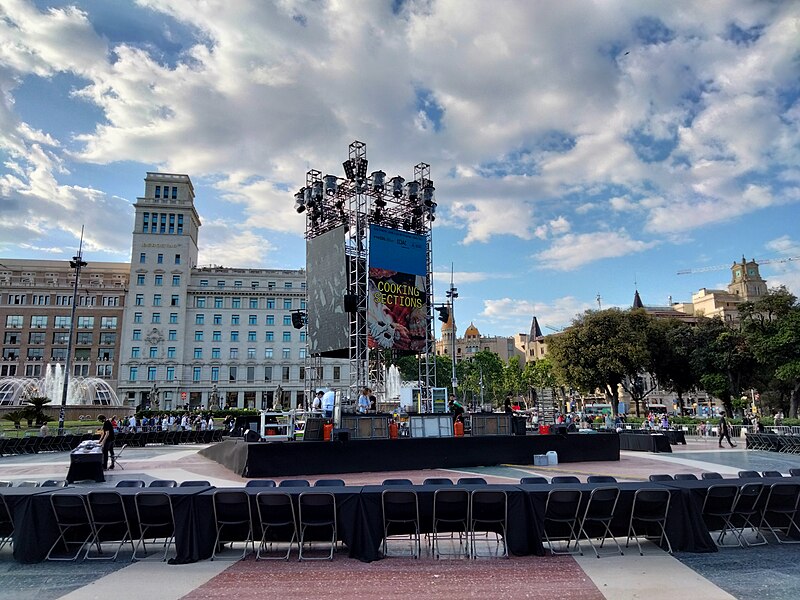
Photo · Wikimedia Commons Stand near the central compass rose paved into the stone terrace of the square, where the medieval heart of the old city meets the nineteenth century Eixample grid. This expansive fifty thousand square meter plaza functions as the civic hinge of Barcelona. Look upward toward the Edificio Telefónica lantern tower, where four stained glass windows crafted by artist Brian Clarke for the nineteen ninety-two Olympic Games project a soft beacon across the open space. In the cool evening air, flocks of pigeons settle near the fountains while crowds gather beneath the radiating strings of winter lights. Notice the classical statues by Josep Clarà and Pablo Gargallo standing sentinel amid the festive bustle. This square was designed by Francesc de Paula Nebot for the nineteen twenty-nine International Exposition, transforming a former boundary wall into a vibrant stage for urban assembly.
Turn your gaze north toward the grand boulevard opening directly ahead, and begin strolling uphill onto the illuminated avenue of Passeig de Gràcia.
- 1 min · on site
Iron Benches and the Promenade of the Bourgeoisie
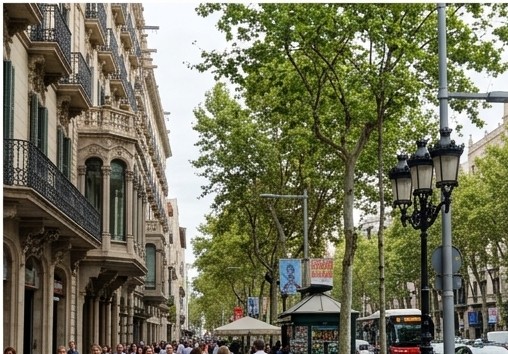
AI-generated image · may differ from the real place As you walk uphill along the forty-two meter wide promenade, step toward the curb to inspect the celebrated street fixtures beneath the golden holiday garlands. In nineteen-o-six, municipal architect Pere Falqués designed these remarkable curved iron lamp posts, anchoring each one into a sinuous white ceramic bench. Run your gaze over the fragmented tiles, noting how the curvilinear ironwork bends like organic tendrils into the winter canopy. Originally known as the Camí de Jesús, this thoroughfare evolved from a rural lane into the most prestigious carriage course in Catalonia. Look above the luxury shop windows to admire the elegant stone balconies designed by master architects Enric Sagnier and Josep Vilaseca. The street lights do not merely illuminate pedestrian footsteps; they celebrate civic craft, turning a commercial boulevard into an outdoor salon of Catalan decorative arts.
Continue ascending the avenue for two blocks until you reach the corner of Carrer d'Aragó, pausing on the opposite pavement across from number forty-three.
- 1 min · on site
The Upcycled Dragon and the Triumph of Fracture
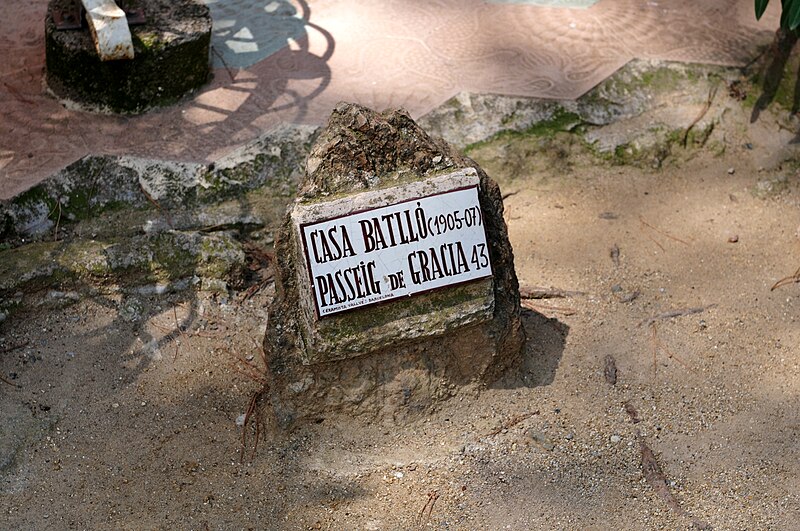
Photo · Wikimedia Commons Cross to the opposite sidewalk to observe the full drama of the facade, where the winter night mapping show washes across Antoni Gaudí's sculpted sandstone. Notice the undulating lower levels, carved from Montjuïc stone to resemble bone articulations, which earned the house its colloquial title of Casa dels ossos. Above, the shimmering skin of ceramic trencadís shifts from golden amber to deep sea green. Gaudí convinced textile baron Josep Batlló to preserve and remodel the original eighteen seventy-seven structure rather than demolish it, transforming domestic architecture through ecological upcycling. When the four-armed cross arrived broken on site, Gaudí ordered the masonry bound with mortar and cinched with a brass ring, finding grace in fracture. High above, the arched ceramic roof tiles evoke the scaled spine of the dragon vanquished by Saint George.
Walk north to Carrer de Mallorca and proceed eastward through the quiet residential blocks of the Eixample until the great towers of the basilica emerge against the night sky.
- 1 min · on site
Liturgical Geometry and the Measure of Faith
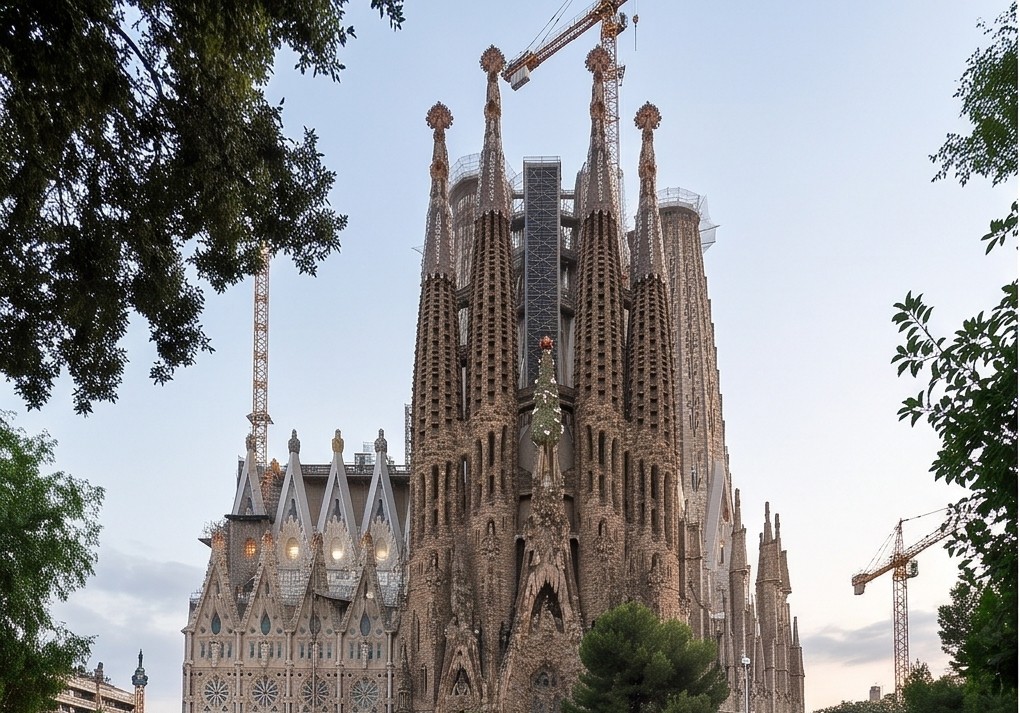
AI-generated image · may differ from the real place Position yourself across the open square of Plaça de Gaudí, where the illuminated reflection of the Nativity Façade shimmers across the duck pond. Look closely at the intricately carved stone portals, completed during the architect's lifetime, portraying the theological virtues of Hope, Faith, and Charity. Gaudí intentionally constructed this joyful eastern facade first, fearing that the skeletal severity of the western Passion Façade would terrify citizens if built initially. High overhead rises the central Tower of Jesus Christ, reaching one hundred and seventy-two point five meters, crowned with its monumental cross after its historic blessing. It stands exactly one meter lower than Montjuïc hill, an enduring tribute to natural humility. As floodlights wash the stone figures sculpted by Etsuro Sotoo and Subirachs, the basilica stands as a testament to patience, an expiatory temple funded solely by generations of private devotion.
Head southeast along the wide, leafy boulevard of Passeig de Sant Joan, following the gentle downhill incline toward the welcoming red brick monument ahead.
- 1 min · on site
The Gateway of Civic Welcome and Universal Brotherhood
Photo · Wikimedia Commons Stand directly beneath the soaring red brick arch, where the festive holiday lanterns cast warm crimson shadows onto the pedestrian promenade. Built by architect Josep Vilaseca as the ceremonial entrance for the eighteen eighty-eight Barcelona Universal Exposition, this triumphal gateway departs decisively from military tradition. Look upward at the front frieze to admire Josep Reynés's delicate stone relief entitled Barcelona rep les nacions, depicting the city warmly embracing international visitors. On the opposite face, Josep Llimona's early masterwork represents the awarding of exhibition honors. Notice the carved stone bats decorating the pillars, the ancient heraldic emblem of King Jaume the First. As dusk settles into deep winter night, the Neo-Mudéjar brickwork glows in harmony with the holiday illuminations, standing as an enduring symbol of Catalan civic pride, welcoming travellers from every corner of the earth.
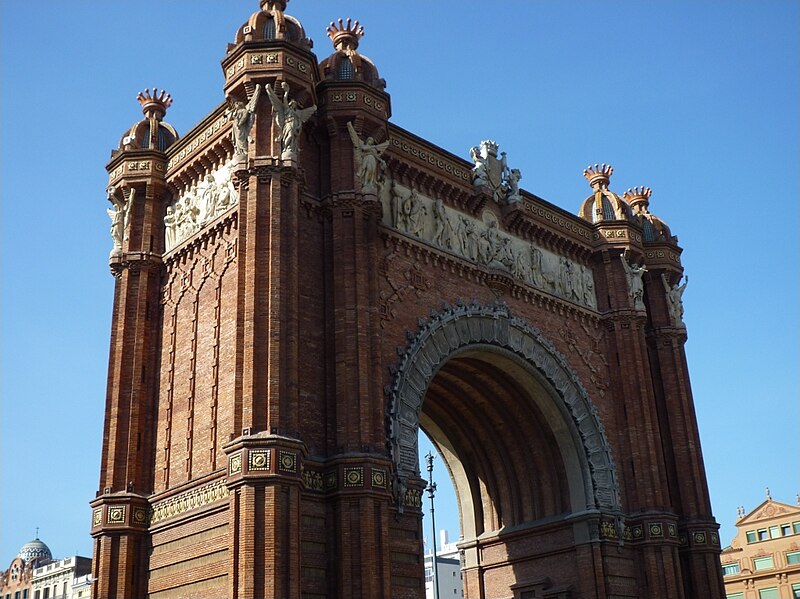
As our winter walking seminar draws to a close beneath the illuminated arch of Vilaseca, pause to look back along the radiant perspective of the promenade. The story of Barcelona in winter is not preserved in textbooks or quarantined within silent vitrines; it is an active conversation spoken through carved stone, bent iron, and radiant filament. When Gaudí and his contemporaries reshaped this urban landscape, they understood that architecture attains its true spiritual purpose only when inhabited by the movement and wonder of the living public. As you carry these impressions into the crisp Mediterranean night, remember that every curve, every fracture, and every deliberate proportion you encountered tonight was forged by artisans who believed that beauty is a sacred civic duty, meant to enlighten our shared journey through time.
Take it further
Open the tour in the appThe tour in the app
Architectural Illuminations: An Eixample Curatorial PromenadeThis curated winter evening walking route traces Barcelona's historic light sequence from the open heart of Plaça de Catalunya along the illuminated boulevard of Passeig de Gràcia. Marvel at Casa Batlló's dynamic night mapping, gaze at the newly consecrated central tower of Sagrada Família, and conclude beneath the radiant red brick arches of Arc de Triomf.
+ Add the tour to your planIf you have the app the tour opens right away; otherwise you go to the store.FAQ
- What is the significance of the annual winter illumination for Barcelona's architecture?
- The winter light switch on reveals the sculptural contours of Catalan Modernisme, separating biomorphic curves and stone joints from natural daytime shadows to highlight the structural audacity of nineteenth and twentieth century craftsmen.
- Why does the central spire of the Sagrada Família measure exactly one hundred and seventy-two point five meters?
- Antoni Gaudí deliberately kept the central Tower of Jesus Christ one meter shorter than the crest of Montjuïc hill, ensuring that his architectural achievement would never physically exceed the natural landscape created by God.
- What history lies behind the name of the Block of Discord on Passeig de Gràcia?
- The block earned its nickname from the intense stylistic rivalry among Barcelona's wealthy industrial patrons, particularly between chocolatier Antoni Amatller and textile baron Josep Batlló, who hired competing master architects to dramatically outshine one another on the same avenue.
This piece was newly written based on the Wikipedia articles ‘Sagrada Família’, ‘Casa Batlló’ · CC BY-SA 4.0