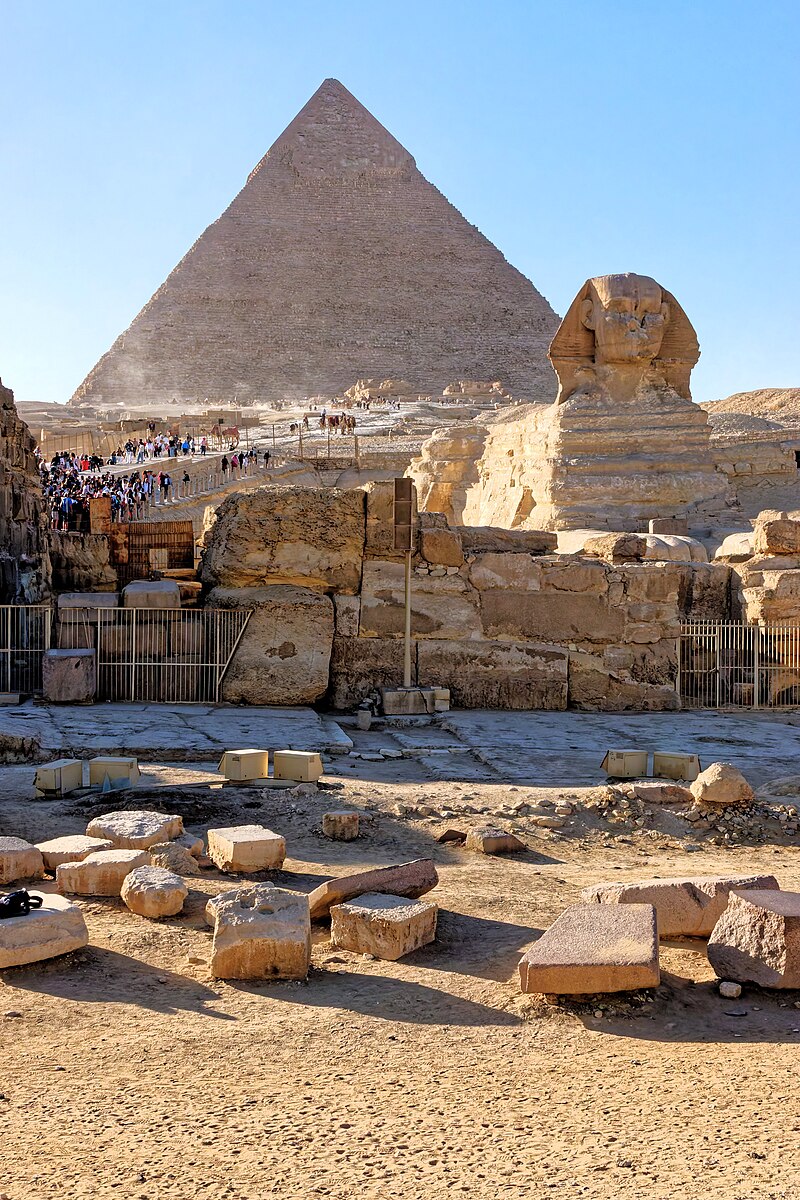
Late afternoon light slants across the desert plateau of Giza, turning the limestone ridges into a warm sea of amber. We begin this journey to explore how ancient sun worship and modern evening illuminations meet on the high sand dunes of western Cairo. On this walking route along the rocky desert rim, you will explore three grand royal pyramids, walk down an ancient stone causeway into an embalming temple, stand before the weathered face of the Great Sphinx, and take a seat for the evening light show.
For thousands of years, travellers have crossed the Mediterranean Sea to stand in the shadow of these geometric stone hills. The ancient Egyptians believed that the setting sun crossed the Nile each evening to enter the realm of eternal rebirth. These monumental tombs were built not as cold memorials to dead kings, but as stone engines designed to guide the ruler's spirit into that everlasting solar voyage. As the harsh midday glare softens, long indigo shadows stretch across the yellow bedrock, making the colossal blocks appear almost weightless against the pale African sky. You can hear the dry wind whistling softly through the crevices between the stones, carrying the faint dust of centuries across your cheeks as you walk.
Nightfall and the Philosophers
In the cool winter of 1783, French philosopher and travel writer Constantin Francois de Volney rode out to Giza on horseback and spent an entire night sleeping under the stars beside the pyramids. Wrapped tightly in a woollen travel cloak against the sudden desert frost, he lay on the sand and watched the massive silhouettes blot out constellations. In his published travel journals, Volney recorded that his initial wonder soon turned to moral contemplation, observing that an entire nation had laboured for twenty years to build a vain tomb for a single monarch. His words transformed Giza from a simple curiosity into an enduring meditation on power and human labour.
Four centuries before Volney, in 1435, Italian humanist Cyriacus of Ancona reached these sands by wooden boat along the Nile with the histories of Herodotus tucked in his luggage. Western travellers of his era still repeated the medieval legend that the pyramids were biblical grain storehouses built by the patriarch Joseph. Cyriacus took physical measurements of the limestone courses and correctly announced to Renaissance Europe that they were the tombs of ancient Egyptian kings. Writers and scholars have always gathered here to test their ideas against stones that refuse to yield to time.
A Horizon of Living Stone
Walking up the plateau today, the desert wind carries the crisp scent of dry clover from nearby irrigation canals. If you look closely at the rough stone blocks under your hand, you will see tiny fossilized disc shells of prehistoric sea organisms called nummulites, preserved from when this desert was an ancient ocean floor. Every course of stone still bears the faint chisel marks and red leveling lines painted by quarry workers more than four thousand years ago.
As dusk settles over the plateau, the yellow limestone reflects the pink and violet glow of the evening sky. The modern city of Cairo hums in the distance, but up here the desert air turns cool and fragrant. The true magic of Giza is not found in frozen silence, but in the way these ancient stones awaken once more when the evening lights begin to illuminate the horizon.
Want to walk it yourself? Plan a trip with these places
The walk
On site, play just that chapter
- 1 min · on site
The Geometry of the Sun King
Photo · Wikimedia Commons You stand before the Great Pyramid of Giza, rising directly from the northern rim of the limestone plateau. Built as the tomb of Pharaoh Khufu, its massive stepped tiers once gleamed with smooth white casing stone brought across the Nile. Move close to the eastern base where the original paving slabs meet the bedrock. Look down at the textured blocks to spot tiny shell fossils pressed into the yellow limestone over millions of years. Ancient Greek historian Herodotus recorded that one hundred thousand men laboured here in rotating shifts, marveling at the vast causeway that once led toward the river. You can feel the evening desert breeze cooling the sunbaked stone beneath your palms. High above, the missing apex leaves an open platform that seems to invite the sky itself.
Turn southwest along the stone pathway across the plateau to reach the second monumental tomb crowned with surviving casing stones.
- 1 min · on site
The Summit of Polished Stone
Photo · Wikimedia Commons Before you rises the Pyramid of Khafre, standing on a slightly elevated bedrock ridge southwest of the Great Pyramid. This tomb was built for Khufu's royal son, and its steep slope makes it appear even taller than its neighbor. Look up toward the sharp apex to admire the surviving band of smooth white limestone casing that still clings to the topmost third of the structure. Italian explorer Giovanni Belzoni breached the northern entrance in 1818, hoping to discover ancient treasures, yet found only an empty granite sarcophagus with animal bones on the floor. Take a moment to step along the northwestern corner, where ancient stonemasons cut straight into the natural bedrock like giant steps. The late afternoon sunlight casts a warm golden hue across these upper stones, outlining the precise geometric craftsmanship of the builders.
Continue walking southwest across the open sand to find the third and most intimate of the royal tombs.
- 1 min · on site
The Red Granite Horizon
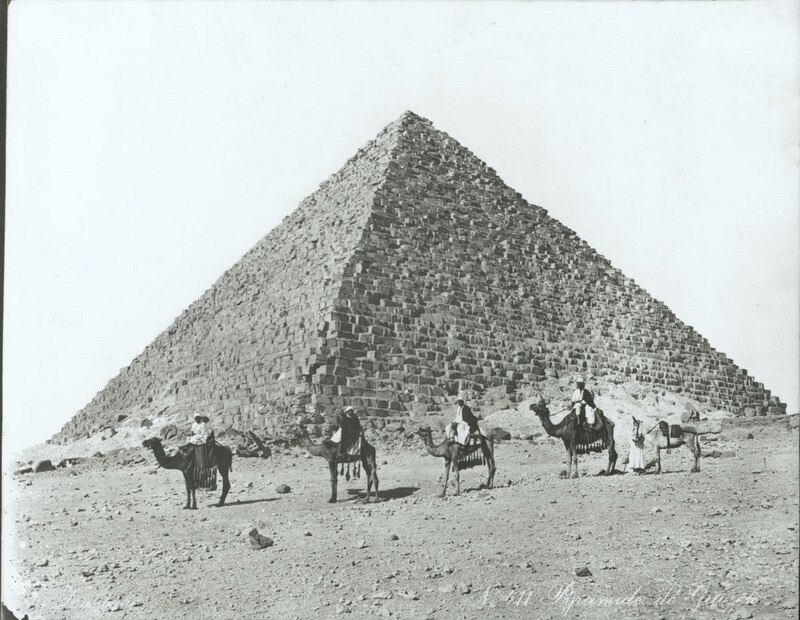
Photo · Wikimedia Commons Here at the southwestern edge of the high plateau stands the Pyramid of Menkaure, the smallest of the three royal tombs. Built for the son of Khafre, this monument displays sixteen lower courses of dark pink granite brought down the Nile from quarries in Aswan. Look directly at the base stones on the northern face to notice how several blocks were left unfinished when the king died young. A large vertical breach on the northern side reveals the inner stepped core, cut by twelfth-century workmen who attempted in vain to demolish the structure. In 1837, British officer Howard Vyse discovered the king's ornate basalt sarcophagus inside, only for the merchant ship carrying it to sink in a storm at sea. Run your fingers over the rough granite to feel the cool density of the southern stone.
Walk east down the gentle slope following the ancient causeway toward the lower edge of the plateau where the valley temples wait.
- 1 min · on site
The Chamber of Polished Alabaster

Photo: lienyuan lee · CC BY 3.0 · Original file You now enter the Valley Temple of Khafre, situated at the eastern base of the plateau where the desert sands meet the green valley. This ancient granite sanctuary served as the sacred gateway where royal embalming rituals and purification ceremonies were performed before burial. Step through the heavy doorway into the T-shaped pillared hall and pause to take in the sudden quiet. Look down at your feet to see the luminous white alabaster floor, smooth as polished ice, contrasting sharply with the massive red granite pillars quarried in southern Egypt. French archaeologist Auguste Mariette uncovered a famous dark diorite statue of Khafre hidden inside a deep floor well here in 1858. The thick granite walls block the desert glare, creating a serene sanctuary where every whispered word echoes softly against the stone.
Step outside through the northern exit corridor into the open sunken enclosure that cradles the desert guardian.
- 1 min · on site
The Guardian Facing Dawn
Photo · Wikimedia Commons Directly before you rests the Great Sphinx of Giza, carved from a single ridge of natural limestone bedrock on the eastern slope. Facing due east toward the rising sun, this colossal couchant lion with a human head has watched over the plateau for forty-five centuries. Stand by the designated wooden viewing platform and look between the enormous outstretched paws to locate the red granite Dream Stele. Young prince Thutmose IV fell asleep beneath this statue's midday shadow and dreamed that the sun god promised him the crown if he cleared away the choking sands. American travel writer John Lawson Stoddard observed that the desert waves rose against its breast like a winding sheet of gold, praising its solemn silence. Notice the faint traces of ancient red pigment that still cling to the weathered cheeks.
Stroll across the sandy plaza toward the open terraced seating directly facing the monuments for the nightfall spectacle.
- 1 min · on site
The Symphony of the Eternal Sun

Photo: MusikAnimal · CC BY-SA 3.0 · Original file You are now seated at the open-air Sound and Light terrace, located along Abou Al Hool Al Seiahi Street facing the Sphinx and the pyramids. As night falls over the desert plateau, colourful beams of violet, gold, and crimson wash over the weathered limestone monuments. Pull a light jacket closely around your shoulders to keep off the crisp evening breeze rising from the sands. Recorded voices and dramatic music rise into the darkness, narrating the ancient myths of solar barques sailing through the underworld to greet the dawn. The great stone silhouettes seem to float on waves of pure illumination against the dark Egyptian sky. Sitting here under the desert stars, you can feel how the ancient pharaohs' quest for eternal life finds new voice in this radiant symphony of light and sound.
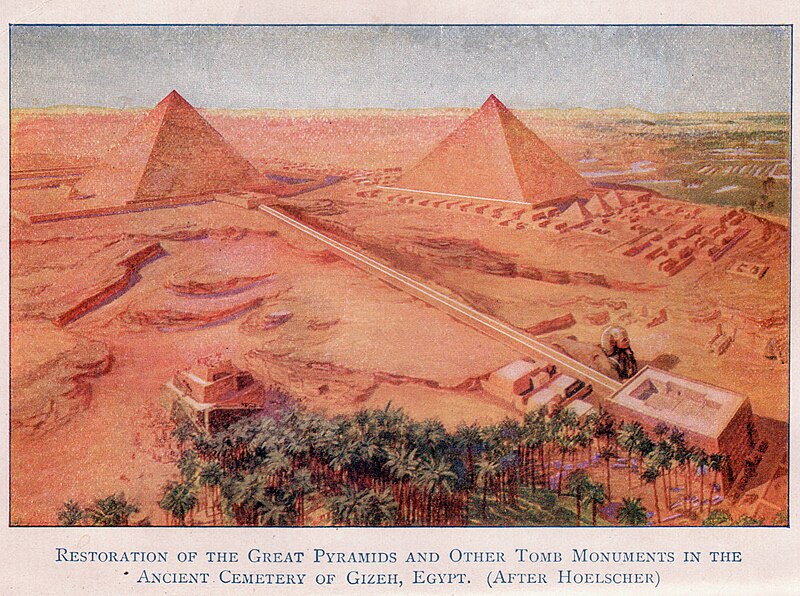


As the final spotlights dim and the desert quiet returns to Giza, the three royal pyramids stand once more as silent dark silhouettes against the starry sky. What remains in the traveler's heart is not merely the staggering weight of quarried stone, but the enduring human spirit that sought to capture the immortal light of the sun.
Take it further
Open the tour in the appThe tour in the app
Sunset and Illumination Promenade on the Giza PlateauThis walking tour traces the high limestone plateau from the Great Pyramid southwest to Khafre and Menkaure, descends through Khafre's ancient embalming temple, visits the Great Sphinx, and concludes at the Sound and Light terrace facing the illuminated desert monuments.
+ Add the tour to your planIf you have the app the tour opens right away; otherwise you go to the store.FAQ
- What should I wear for this plateau walking route?
- Wear sturdy walking shoes for the uneven limestone paths and bring a light jacket or wrap, as the desert air turns remarkably cool once the sun sets.
- Where can I best appreciate the ancient casing stones?
- Look at the topmost third of the Pyramid of Khafre, where the original smooth white limestone still clings securely to the steep summit.
- How does this walk connect with the eternal sun theme?
- The route follows the path of the setting sun from west to east, moving from the royal solar tombs into the evening light show that celebrates Egypt's timeless solar myths.