To enter Prague in the amber hush of late autumn is to understand that here, food and drink have never been trivial matters of physical appetite, but rather an enduring civic rite, a collective act of warmth staged against the winter chill and the heavy tides of European history. Along the winding cobblestones where the gas lamps cast long, amber shadows across Baroque stone facades, the aroma drifting from below ground level carries the unmistakable perfume of Central Europe: crushed caraway seeds, sweet paprika toasted in rendered fat, beef shanks gently stewing in copper pots, and the earthy, bitter sweetness of cold unpasteurized lager drawn fresh from cellar tanks. In Bohemia, the tavern is not merely a refuge from the street; it is a secular cathedral and a salon of ordinary life. For centuries, writers, composers, alchemists, and rebellious scholars have treated the tavern bench as an extension of their writing desks, knowing that the most profound truths of human existence are rarely discovered in gilded conference halls, but rather over scarred wooden trestles polished smooth by generations of elbows and foaming steins.
A Convivial Counterpoint
When Wolfgang Amadeus Mozart walked these narrow alleys between the Old Town and the Estates Theatre to conduct the world premiere of Don Giovanni, he found in Prague a populace whose passionate affection consoled him after the fickle snobbery of imperial Vienna, celebrating his triumphs in the lively halls where commoners and artists drank side by side. It was a spirit rooted deeply in the Bohemian soil, where even earlier Emperor Rudolf the Second had transformed Prague into Europe's greatest cultural crossroad, filling his court with the fantastical vegetable portraits of Giuseppe Arcimboldo, the skyward calculations of Johannes Kepler and Tycho Brahe, and the vibrant melodies of wandering court musicians who inevitably found their way into local cellars after nightfall. Here, high culture has always kept intimate company with the stew pot and the beer barrel, blurring the boundaries between royal intellect and tavern camaraderie.
The Memory of Ancient Trestles
Consider the quiet persistence of U Fleků, nestled within New Town along Křemencova street, where beer has been continuously brewed since fourteen ninety nine, surviving five centuries of imperial collapse, wars, and social upheavals. When Jakub Flekovský acquired the brewery in seventeen sixty two, he gave the hall his own name, yet he also preserved a sacred domestic hearth where ordinary citizens could gather in solidarity. It was at these very tables in nineteen eleven that four young Dalmatian students, having just witnessed a match between Sparta and Slavia Prague, raised their heavy glasses of dark thirteen degree lager and decided then and there to create the celebrated football club Hajduk Split, carrying the communal vitality of a Bohemian taproom all the way to the Adriatic coast. A few streets away, the classical walls of Bredovský dvůr echo the aristocratic legacy of the Breda dynasty, whose counts held grand court while maintaining public hospitality in the heart of the city.
As you listen to these footsteps echo along the stone pavements, do not expect hurried dining or fleeting culinary novelty. Prague invites you to linger, to lean into the murmur of neighborhood conversation, to watch the thick white head of beer slowly settle like fresh snow upon amber broth, and to taste dumplings so tender they seem designed specifically to absorb both rich gravy and the slow, contemplative passage of an afternoon.
Want to walk it yourself? Plan a trip with these places
The walk
On site, play just that chapter
- 1 min · on site
The Infinite Aisle of Bohemia
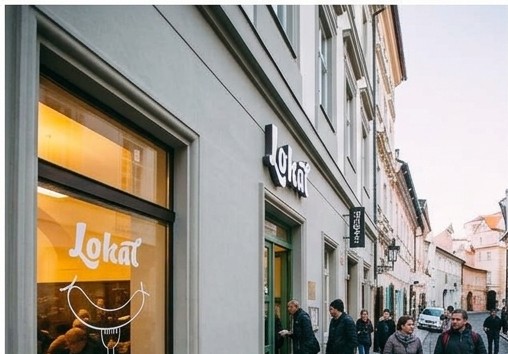
AI-generated image · may differ from the real place Step inside the long, tunnel-like expanse of Dlouhá street where Lokál stretches out before you like an endless nineteenth-century passenger car. The gleaming stainless steel tanks near the entrance hum with life, delivering unpasteurized Pilsner straight from Plzeň with a dense, velvety head that locals call hladinka. Arrive well ahead of the evening clamor to secure a modest wooden perch along the center aisle, where waiters in crisp aprons glide past carrying towers of heavy glassware. Order the beef goulash spooned over warm, cloud-like bread dumplings, and watch how the paprika-stained gravy seeps slowly into the dough. Here, there are no hushed museum whispers; the acoustic clatter of cutlery and resonant baritone laughter feel like an affectionate communal embrace, proving that the heart of Bohemia beats loudest where fresh beer flows without pause.
When you step back outside into the cool breeze of Dlouhá, turn west toward the historic alleys bordering the old Jewish quarter, where Krcma waits hidden beneath stone vaulting.
- 1 min · on site
Subterranean Fires and Medieval Shadows

Photo: Jan Vilím · Public domain · Original file Slip down the narrow stone stairs of Kostečná street and you are instantly swallowed by the medieval twilight of Krcma, a cellar tavern where time seems to have stopped several centuries ago. Look up at the low, blackened brick arches that have absorbed the smoke of tallow candles and wood fires since the Middle Ages. The cellar fills quickly with hungry souls seeking shelter, so making your way down before the dinner rush is essential to finding a wooden bench. Here, the aroma of garlic, bay leaves, and dark pan drippings hangs thick in the cool subterranean air. Order the slow-roasted pork knee or a steaming bowl of beef goulash, served in earthenware dishes that feel delightfully primitive. Sitting beneath these ancient vaults, listening to the muffled rumble of modern street traffic overhead, one realizes that Prague has always preserved its warmest sanctuaries deep underground.
Climb back to street level and wander south past the Old Town Square toward the grand avenues of New Town, where Bredovský dvůr awaits along Politických vězňů.
- 1 min · on site
The Courtyard of Aristocratic Solace

Photo: VitVit · CC BY-SA 4.0 · Original file As you approach Politických vězňů, look for the quiet passage leading into the tranquil courtyard of Bredovský dvůr, an address steeped in the noble memory of the Breda counts who once held grand estates across Bohemia. Inside, the rustic timber beams and exposed masonry create an atmosphere that is both dignified and thoroughly unpretentious. Settle into a booth beneath the framed historical prints and order the roasted duck leg served with sweet stewed red cabbage and a duo of potato and bread dumplings. The duck skin yields with an audible, caramelized crackle, while the tender meat melts into the tart sweetness of the cabbage. It is an idyllic introduction to the classical geometry of Czech comfort, where aristocratic lineage softens into the hearty, generous culinary heritage that has sustained Prague through generations of peaceful afternoons.
Step out from the courtyard, cross the quiet cobblestones, and continue around the corner onto Opletalova street, where U Staré Pošty keeps watch near the railway lines.
- 1 min · on site
A Courier's Respite in New Town

Photo: Jiří Sedláček · CC BY-SA 4.0 · Original file Just steps from the kinetic pulse of Wenceslas Square, U Staré Pošty stands as a steadfast reminder of nineteenth-century neighborhood civility, occupying a corner once frequented by postal couriers and railway travelers. Look for the modest entrance along Opletalova street, push through the heavy wooden door, and you will find an unfussy haven dominated by dark timber booths and regular patrons absorbed in their daily newspapers. Signal the barkeep for a perfectly drawn mug of Pilsner Urquell, its bitter floral hop notes balanced by sweet Bohemian malt, and order the tender roasted ribs glazed with spicy pan juices. There is an honest, comforting rhythm here, free from decorative posturing, where one can sit quietly and listen to the clinking of heavy mugs, reflecting on the generations of wanderers who found solace at these tables.
Take your leave of this quiet postal tavern and ascend toward the open expanse of Wenceslas Square, where Restaurant - Café Svatého Václava awaits amid the grand promenade.
- 1 min · on site
Restaurant - Café Svatého Václava
Under the Saint's Broad Gaze
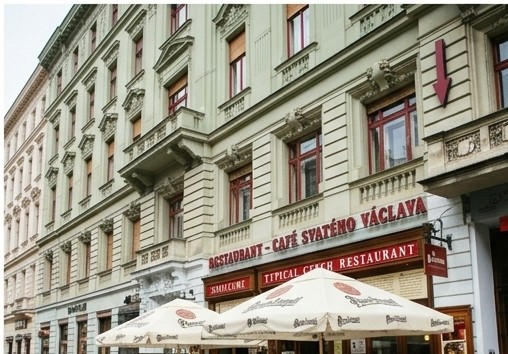
AI-generated image · may differ from the real place Emerge onto the sweeping boulevard of Wenceslas Square and seek out Restaurant - Café Svatého Václava, an elegant establishment nestled beneath the watchful gaze of the patron saint. The interior blends the relaxed dignity of a traditional Czech dining room with the romantic flair of an urban salon, where soft lamplight reflects off polished woodwork. If you visit on a weekday evening, you may be greeted by the warm syncopation of live jazz floating through the dining room, providing a lilting soundtrack to your meal. Order the classic roast duck or the tender roasted pork knee accompanied by pickled cabbage and warm dumplings, savoring the contrast between savory crispness and aromatic caraway gravy. It is a place that celebrates the festive spirit of Prague, where good food and melodic conversation transform an ordinary supper into an occasion of genuine delight.
From the bustling promenade of the saint, walk westward through the quiet historic streets toward the river, where the ancient halls of U Fleků await on Křemencova street.
- 1 min · on site
The Five-Century Clock of Křemencova
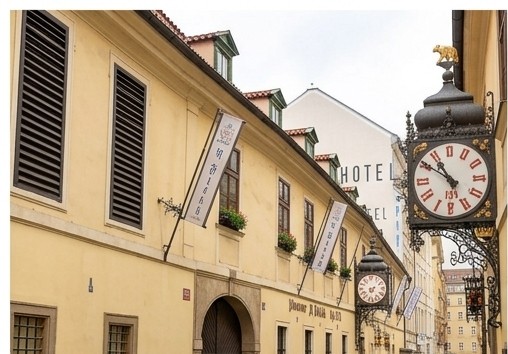
AI-generated image · may differ from the real place Enter through the arched portal on Křemencova street beneath the famous painted clock, and you step directly into five centuries of brewing legend at U Fleků. Walk past the central courtyard into the storied Academy hall, where dark Gothic woodwork and painted heraldry line the high ceilings. Find an empty space on one of the long communal wooden benches, nodding to your neighbors as strolling accordion players fill the room with spirited Bohemian polkas. Do not wait for a drink menu; waiters bearing large trays will immediately slide a glass of the legendary Flekovský tmavý ležák onto your coaster, a dark thirteen degree lager brewed on site with notes of roasted chocolate, espresso, and caramel. Pair it with tender pork knee and soft dumplings, raising your glass where Croatian students once dreamt of football history and Bohemian writers celebrated life.


As night envelops Prague, the city surrenders to the soft hiss of beer taps, the steam of evening kitchens, and the gentle murmur of shared tables that have weathered centuries without losing their welcoming warmth. Walking away along the damp stones of New Town toward the river, you carry with you not just the taste of roasted caraway and caramelized malt, but the enduring realization that here, true nourishment is found in the timeless art of sitting together in fellowship.
Take it further
Open the tour in the appThe tour in the app
From Old Town Vaults to New Town BrewhousesThis culinary stroll begins along the lively hall of Dlouhá street, descends into medieval cellar vaults, traverses the historic courts of New Town, and concludes inside Prague's oldest functioning brewery, celebrating the city's living tavern culture through classic roasts, steaming dumplings, and fresh unpasteurized lagers.
+ Add the tour to your planIf you have the app the tour opens right away; otherwise you go to the store.FAQ
- What is the proper etiquette for ordering and drinking beer in a traditional Czech tavern?
- Place a cardboard coaster flat on your table immediately upon sitting down, which signals to the tapster that you wish to be served. Fresh mugs of beer will often be placed before you without asking until you signal your finish by setting your coaster atop your empty glass.
- How should one approach sharing communal wooden tables at historic halls like U Fleků?
- Communal seating is an integral part of Bohemian pub culture. Simply make polite eye contact, ask if a seat is vacant, and sit down without hesitation. Conversations and toasts among table companions often follow naturally as the evening progresses.
- What makes Czech bread dumplings distinct from dumplings in other Central European cuisines?
- Bohemian bread dumplings, known as knedlíky, are prepared from light yeast dough folded with cubes of stale bread, steamed in large loaves, and sliced with thread. Their airy texture is specially crafted to soak up rich meat gravies and velvety goulash.
This piece was newly written based on the Wikipedia articles ‘U Fleků’, ‘Bredové’ · CC BY-SA 4.0