Before dawn breaks across the vast expanse of the south Atlantic, Rio de Janeiro rests suspended between the cool maritime mist of the ocean and the immovable mass of primeval granite. To approach this shoreline along a winding mountain pass or through the golden haze of an early morning flight is to understand why travelers, poets, and chroniclers have forever struggled to capture this impossible geography in plain prose. The city does not merely sit upon its natural landscape; it is thrust violently into vertical amphitheaters of stone where maritime moisture, shifting cloud banks, and equatorial glare continually alter the color of the day. One looks outward from these soaring heights not to inspect a rational map of civic commerce, but to confront an ancient tension between human longing and geological permanence, where every high terrace, knife-edge ridge, and hidden belvedere offers an intoxicating vantage on beauty, memory, and solitude.
The Obsession of the Solitary Craftsman
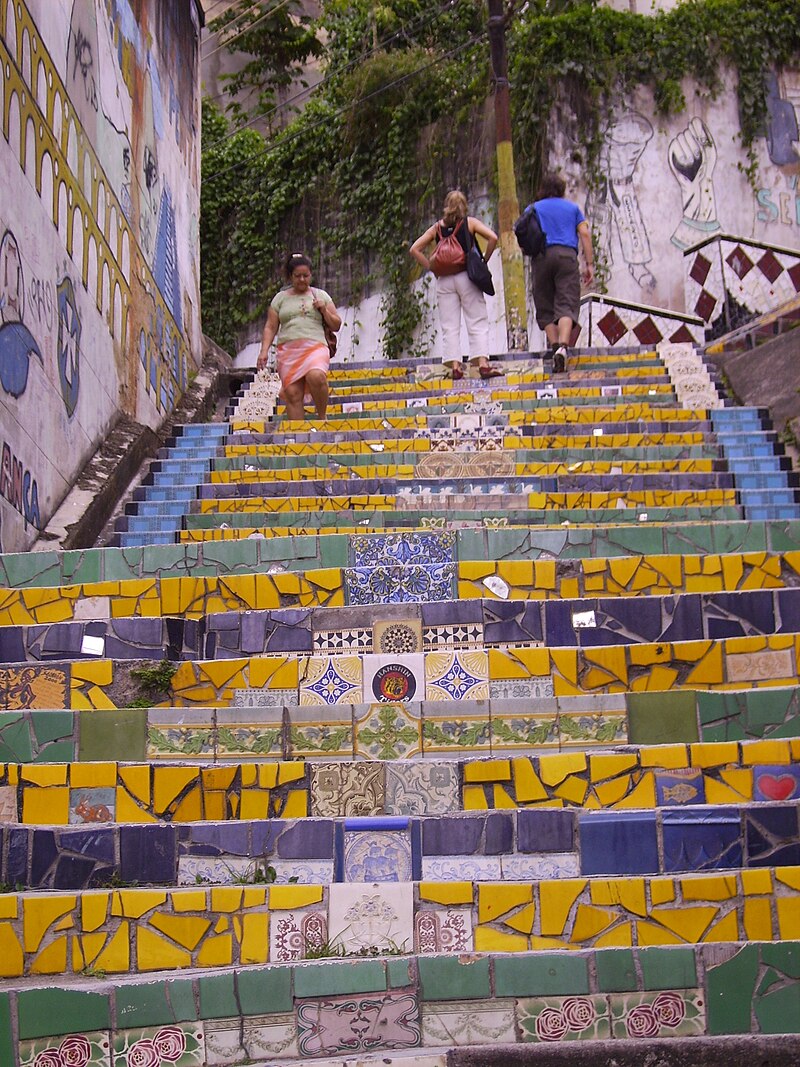
Centuries ago, when Portuguese navigators first entered this sheltered bay beneath the dark monoliths, they perceived an empire in the contours of the rock, naming mountains after the square topsails of their vessels. Yet it was the restless eccentrics and nighttime wanderers who truly defined how we perceive these heights today. In the bohemian quarters of Lapa, where eighteenth-century aqueduct arches once channeled cool mountain spring water directly into the bustling city plazas, the Chilean painter Jorge Selaron began in nineteen ninety an astonishing, solitary pilgrimage across the fractured stone steps outside his modest doorway. Mocked initially by skeptical neighbors for plastering shards of blue, yellow, and green porcelain into dilapidated mortar, Selaron gradually surrendered his entire livelihood to the slope. To finance more than two thousand ceramic fragments gathered from sixty countries across the globe, he spent decades painting twenty-five thousand portraits of an enigmatic pregnant woman, declaring to any wanderer who paused beside him that his crazy and magnificent dream would cease only when death arrived on those very stairs.
Arias and Altars Above the Forest Canopy
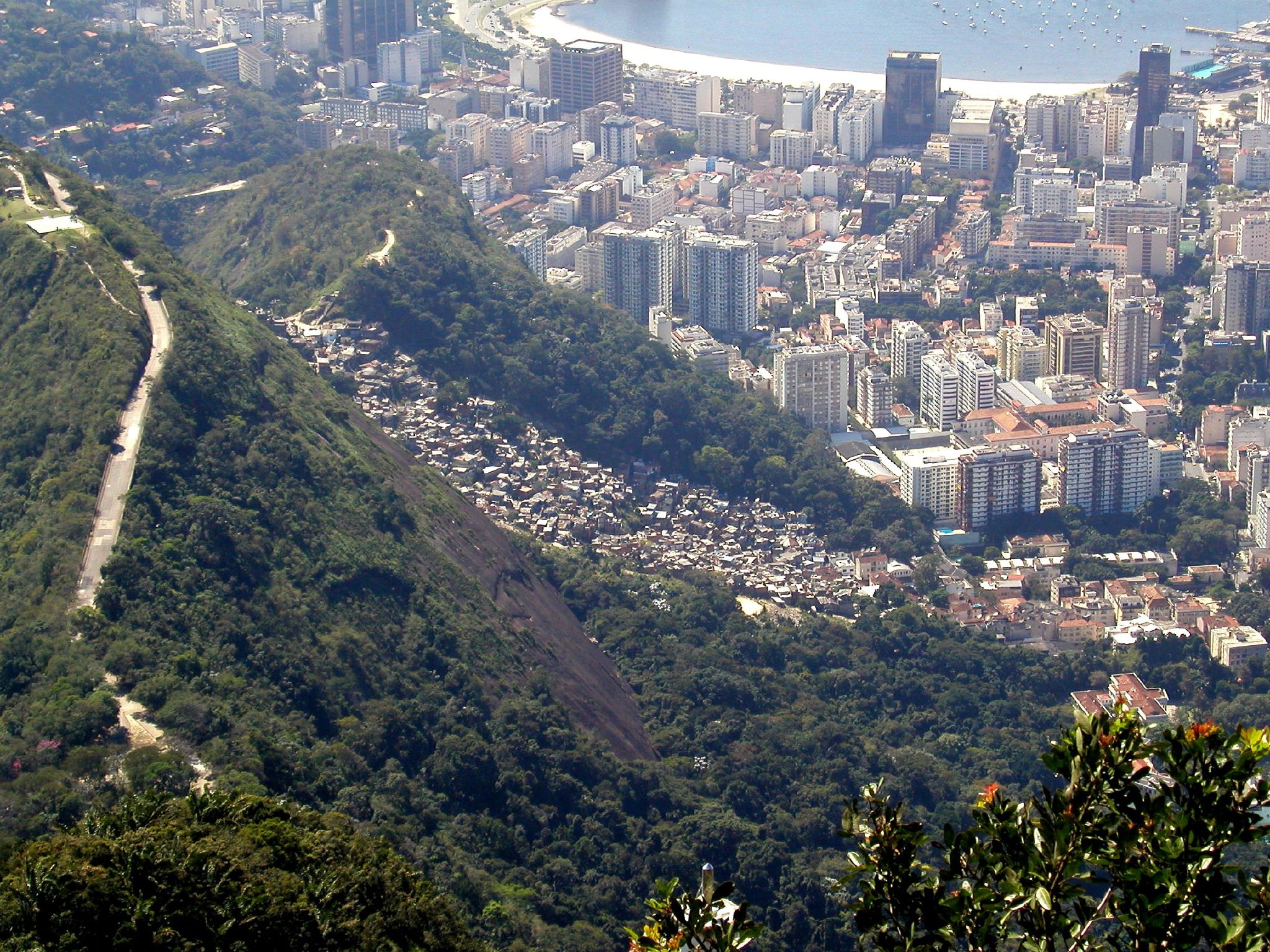
Further inland, where the tangled roots of the Tijuca rainforest press against domestic courtyards, another romantic devotion endures inside the grounds of Parque Lage. There, in the vibrant nineteen twenties, industrialist Henrique Lage commissioned Italian architect Mario Vodret to reconstruct an Italianate mansion for his beloved wife, the celebrated lyric singer Gabriella Besanzoni. Lage designed a tranquil courtyard plunge pool bordered by classical colonnades where her rich mezzo-soprano voice could soar into the humid evening air and reverberate against the precipitous granite crown of Corcovado. Even earlier, around sixteen eighty, Father Clemente Martins de Matos had acquired the steep wilderness of Dona Marta, choosing not to dedicate the ridge to a canonized saint, but consecrating the mountain instead to the memory of his deceased mother, Marta Figueira de Matos, before carving out the rugged trail that eventually became Rua Sao Clemente.
Rio de Janeiro has always possessed this strange alchemical power: it absorbs private grief, solitary obsession, and aristocratic devotion, transforming them into public horizons that belong to everyone and no one at once. As you ascend these stone lookouts today, you do not simply gaze upon a panorama of sea and jungle; you inhabit the lingering yearnings of those who stood before this vast blue abyss of Atlantic sky and dared to engrave their devotion into the living stone, leaving behind sanctuaries where the soul can pause, listen, and look beyond itself.
Want to walk it yourself? Plan a trip with these places
The walk
On site, play just that chapter
- 1 min · on site
White Arches in the Dusk

Photo: Wilfredor · CC0 · Original file Stand before the monumental white aqueduct of Lapa as late afternoon dissolves into tropical dusk. Inaugurated in seventeen fifty to bring fresh water from the Carioca River to city fountains, these forty-two soaring Roman arches were transformed over a century ago into a viaduct carrying the rattling yellow streetcars of Santa Teresa across the urban canyon. Look upward from the plaza pavement as the warm twilight arrives, when the streetlights ignite along the arches and the nocturnal cadence of samba begins to pulse from nearby taverns. Notice how the immense masonry softens against the violet sky, framing the transition between the working city and the bohemian hilltops above. Order a cool mineral water or a fresh fruit juice from a corner kiosk and listen to the faint iron screech of the tram crossing the heights overhead.
Turn south away from the bustling tram arches and follow the gentle slope along Rua Manuel Carneiro toward the foot of the vibrant ceramic stairs.
- 1 min · on site
The Mosaic of a Wanderer
Photo · Wikimedia Commons Arrive at the foot of these two hundred and fifteen steps in the calm hours of early morning, before the daily tide of admirers washes over the incline. Run your hand lightly along the cool glazed surfaces where Jorge Selaron embedded fragments of mirror, broken porcelain, and decorated tiles collected from travelers across sixty nations. Look closely at the lower risers to find the artist's recurring motif, an enigmatic painted pregnant woman whose quiet gaze financed decades of unrelenting labor against poverty and neglect. As you climb slowly between Lapa and the lower slopes of Santa Teresa, pause at the landing where mirrors catch the steep green hillside above. What began as a spontaneous gesture of love for his adopted countrymen became a living canvas that consumed its creator completely until the morning he was found resting here for the last time.
Leave the colored stairway behind and take the climbing road up into the forested shoulders of the ridge toward the serene balcony of Dona Marta.
- 1 min · on site
A Summit Consecrated to Memory
Photo: Brian Snelson from Hockley, Essex, England · CC BY 2.0 · Original file Step out onto the stone balcony of Mirante Dona Marta, poised three hundred and sixty meters above the shimmering sweep of Botafogo and the bay. This high spur was christened in the late seventeenth century when Father Clemente Martins de Matos purchased these slopes and named the mountain after his deceased mother, dedicating the granite heights to maternal memory rather than colonial triumph. Stand at the northern perimeter rail where Christ the Redeemer appears startlingly close, crowned against passing mountain clouds with the Sugarloaf anchoring the blue harbor below. Notice the deep contrast between the dense emerald foliage of the slopes and the geometric towers of the coastline. Breathe in the cool forest air scented with wild eucalyptus and ocean salt, keeping your gaze fixed on the quiet majesty of the bay as morning light illuminates the distant sea.
Descend the winding forest route toward the Jardim Botanico district, where the stone gates of an aristocratic sanctuary open beside the road.
- 1 min · on site
The Opera Singer's Reflection
Photo · Wikimedia Commons Step through the shaded gates of Parque Lage and enter the central courtyard of the grand Italianate manor built for industrialist Henrique Lage and opera singer Gabriella Besanzoni. Walk directly to the edge of the calm courtyard pool and look down into the mirrored water, where the classical stone colonnade frames the towering peak of Corcovado and its summit statue in a single composition. Stroll along the gravel paths behind the palazzo into the rustic garden designed by John Tyndale, pausing before the artificial grotto whose cool, damp volcanic stones conceal quiet aquarium tanks. Notice how the subtropical forest creeps down the cliff face, threatening to reclaim the manicured estate in waves of wild greenery. Find a shaded wooden bench beneath the towering imperial palms and listen to the water trickling from classical fountains into the jungle moss.
From the quiet garden paths, begin the ascending journey up the winding mountain road of Estrada da Vista Chinesa deep into the heart of the rainforest.
- 1 min · on site
The Pagoda Above the Clouds
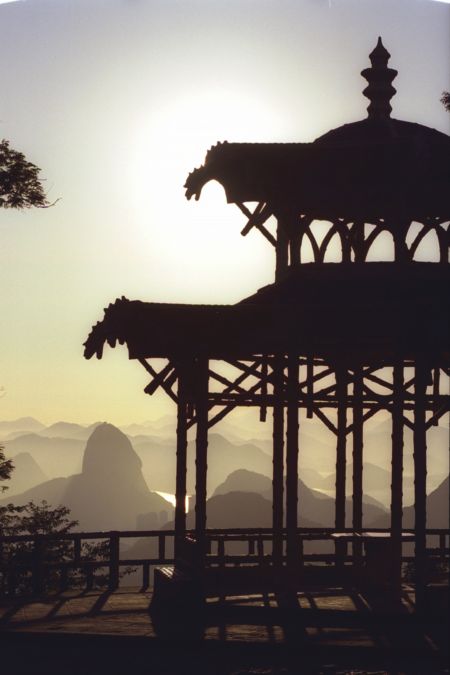
Photo: Rafaeloliveira · Public domain · Original file Emerge from the dense green twilight of Tijuca forest onto the lofty ridge where the oriental pagoda of Vista Chinesa crowns the mountain road. Erected at nearly four hundred meters of elevation, this delicate bamboo-inspired pavilion frames an immense view stretching across the botanical gardens, the southern coastal beaches, and the distant blue Atlantic horizon. Lean against the carved stone balustrade and look downward across the sprawling canopy, watching sea breezes send silver ripples through the cecropia leaves below. Notice how the entire topography of Rio reveals itself from this eastern overlook, where mountains fold into lagoons and the coastline curves away toward eternity. Savor the profound silence of the high ridge, interrupted only by the calls of toucans and the murmur of wind sweeping through the tropical forest canopy.



As darkness settles over Guanabara Bay, the city lights flicker to life like constellations cast across the foothills. Standing upon these stones, one realizes that the true beauty of Rio is never found in a single panoramic vista, but in the layered memories of those who looked out across the Atlantic abyss before us and dared to pour their longing into the immortal rock.
Take it further
Open the tour in the appThe tour in the app
A Literary Pilgrimage Across the Heights of RioThis curated walking and driving route traces five iconic viewpoints from the colonial arches of Lapa to the misty pagoda of Vista Chinesa. Journey through historic bohemian staircases, aristocratic estates, and panoramic granite ridges that have long inspired the city's artists and wanderers.
+ Add the tour to your planIf you have the app the tour opens right away; otherwise you go to the store.FAQ
- What is the best way to travel between these elevated viewpoints?
- While the walk from Arcos da Lapa to Escadaria Selaron is an easy stroll of a few minutes, navigating between the higher mountain lookouts like Mirante Dona Marta, Parque Lage, and Vista Chinesa is best done by taxi or a hired car, as the winding forest roads are steep and lack continuous pedestrian walkways.
- When is the most atmospheric time of day to experience these views?
- Early morning offers the clearest mountain light and quietest moments at Escadaria Selaron and Mirante Dona Marta before mist and crowds gather, while late afternoon and golden hour lend an extraordinary warmth to the white stone arches of Lapa and the reflective pool of Parque Lage.
- What should travelers look for when visiting Parque Lage?
- Beyond the iconic courtyard pool framed by Corcovado, wander behind the mansion along the garden trails designed by John Tyndale to explore the quiet artificial grotto, which houses twelve peaceful aquarium tanks embedded directly into the historic masonry.
This piece was newly written based on the Wikipedia articles ‘Escadaria Selarón’, ‘Parque Lage’, ‘Morro Dona Marta’ · CC BY-SA 4.0