I still remember the soft golden light that bathed Rio de Janeiro when I first decided to step away from the sun-drenched sands of Copacabana and venture into the quiet, cobblestone interior of the city. There is a secret version of Rio that does not shout its presence through grand postcard monuments or bustling beachside avenues. It lives instead in the shadowed backstreets of Santa Teresa, along the ancient stone harbor of Saúde, and behind heavy carved wooden doors in Centro where the scent of old paper and roasted coffee beans has lingered undisturbed for more than a century. Walking through these intimate spaces feels like stepping into a personal memory, where every turn reveals a forgotten chapter of human passion, resilience, and quiet beauty.
My journey began with a deep desire to experience the true pulse of Rio rather than merely observe its polished surface. This city is a tapestry woven from profound contrasts, where ruined nineteenth-century mansions stand adjacent to exuberant modern street art, and where solemn archaeological stones become the nightly stage for ecstatic musical celebrations. As I wandered from the old maritime docks up toward the winding hills, I realized that the genuine spirit of Rio is held within its hidden corners, preserved by dreamers and community matriarchs who transformed ordinary streets into permanent sanctuaries of collective memory.
The Socialites and Matriarchs of Old Rio
To truly understand these historic neighborhoods, one must listen to the voices of the remarkable historical figures who breathed life into them. High on the crest of Santa Teresa, the open red brick archways of Parque das Ruínas recall the golden days of Laurinda Santos Lobo, the celebrated Belle Époque socialite and arts patron. In the early years of the twentieth century, her grand salon served as the vibrant intellectual heart of Rio’s cultural elite, bringing together famous painters, writers, and classical musicians for evening gatherings overlooking Guanabara Bay. Though her mansion suffered decades of neglect after her passing, its preserved ruin structure now stands as an inspiring monument to artistic expression.
Farther downhill toward the old port district of Little Africa, a very different kind of cultural royalty laid the groundwork for Brazil’s musical identity. At Pedra do Sal, Aunt Ciata—Hilária Batista de Almeida—became a legendary matriarch of Carioca tradition. Arriving from Bahia in 1876, she was a respected Mãe-de-Santo and an accomplished confectioner who sold traditional sweets on Rua da Carioca while dressed in her striking Bahian attire. Her home became a safe haven for pioneering sambistas such as Pixinguinha, Donga, and Heitor dos Prazeres, who gathered in her courtyard to shape early samba ranchos away from police scrutiny. Without Aunt Ciata’s courage, modern Brazilian Carnival might never have emerged.
Traces Written in Stone and Paper
As you walk these historic paths today, you are constantly accompanied by the spirits of restless creators. You can feel the intense devotion of Jorge Selarón, the Chilean-born artist who spent over two decades transforming a neglected flight of steps in Lapa into a brilliant mosaic of over two thousand ceramic tiles gathered from around the world. Funding his labor of love by selling hand-painted portraits of a pregnant African woman, Selarón worked indefatigably until his death on those very stairs in 2013, leaving behind an ever-changing masterpiece dedicated to the Brazilian people.
From the ancient stone foundations of Cais do Valongo to the towering rosewood bookcases of the Real Gabinete Português de Leitura, these landmarks invite you to slow down and listen. Take a moment to savor the gentle clink of china at Confeitaria Colombo, where literary masters like Machado de Assis once gathered to debate art and philosophy. These hidden sanctuaries ask only for your quiet attention as Rio reveals its timeless story.
Want to walk it yourself? Plan a trip with these places
The walk
On site, play just that chapter
- 1 min · on site
Where Memory Resting on Sacred Stones Speaks to the Harbor Breeze
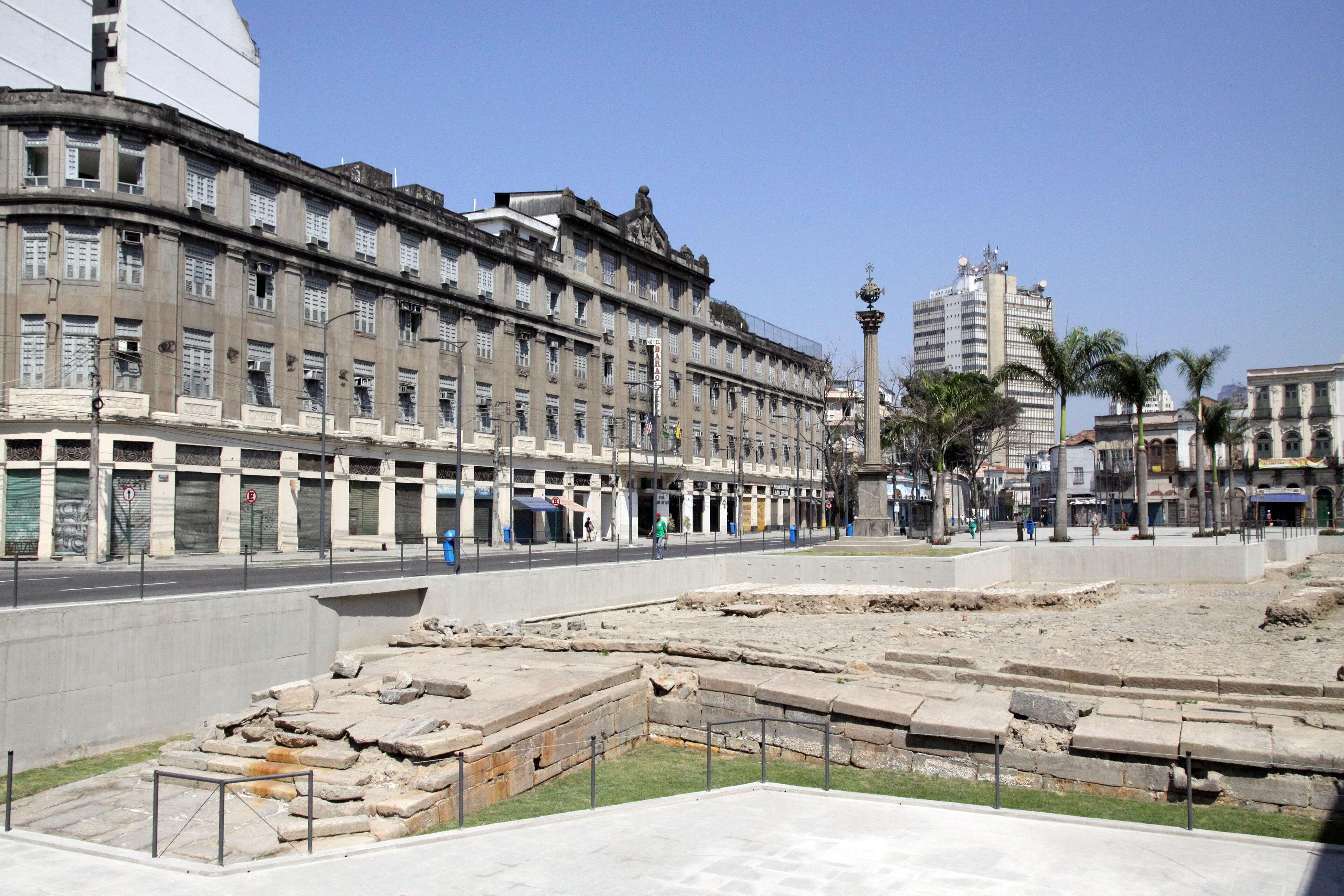
Photo: Halley Pacheco de Oliveira · CC BY-SA 3.0 · Original file Standing at the intersection of Coelho e Castro and Sacadura Cabral streets in the historic port area, you step directly into the sacred archaeological clearing of Cais do Valongo. As you arrive, look down at the rough, hand-fitted stone paving that lay buried for over a century beneath modern street surface layers. This UNESCO World Heritage site served as the primary landing wharf for over one million enslaved Africans during the nineteenth century, holding the solemn memory of human suffering and cultural endurance. Take time to read the informative interpretive panels arranged along the perimeter wall, which explain how archaeological excavations uncovered hundreds of protective amulets, quartz crystals, and ceramic beads left behind by arriving souls. The quiet harbor breeze here carries an undeniable emotional gravity that demands quiet reflection before you venture deeper into Little Africa.
From these quiet stones, walk three short blocks south along the narrow street toward the towering granite outcrop of Pedra do Sal.
- 1 min · on site
The Granite Cradle of Samba and Sacred Afro-Brazilian Rhythms
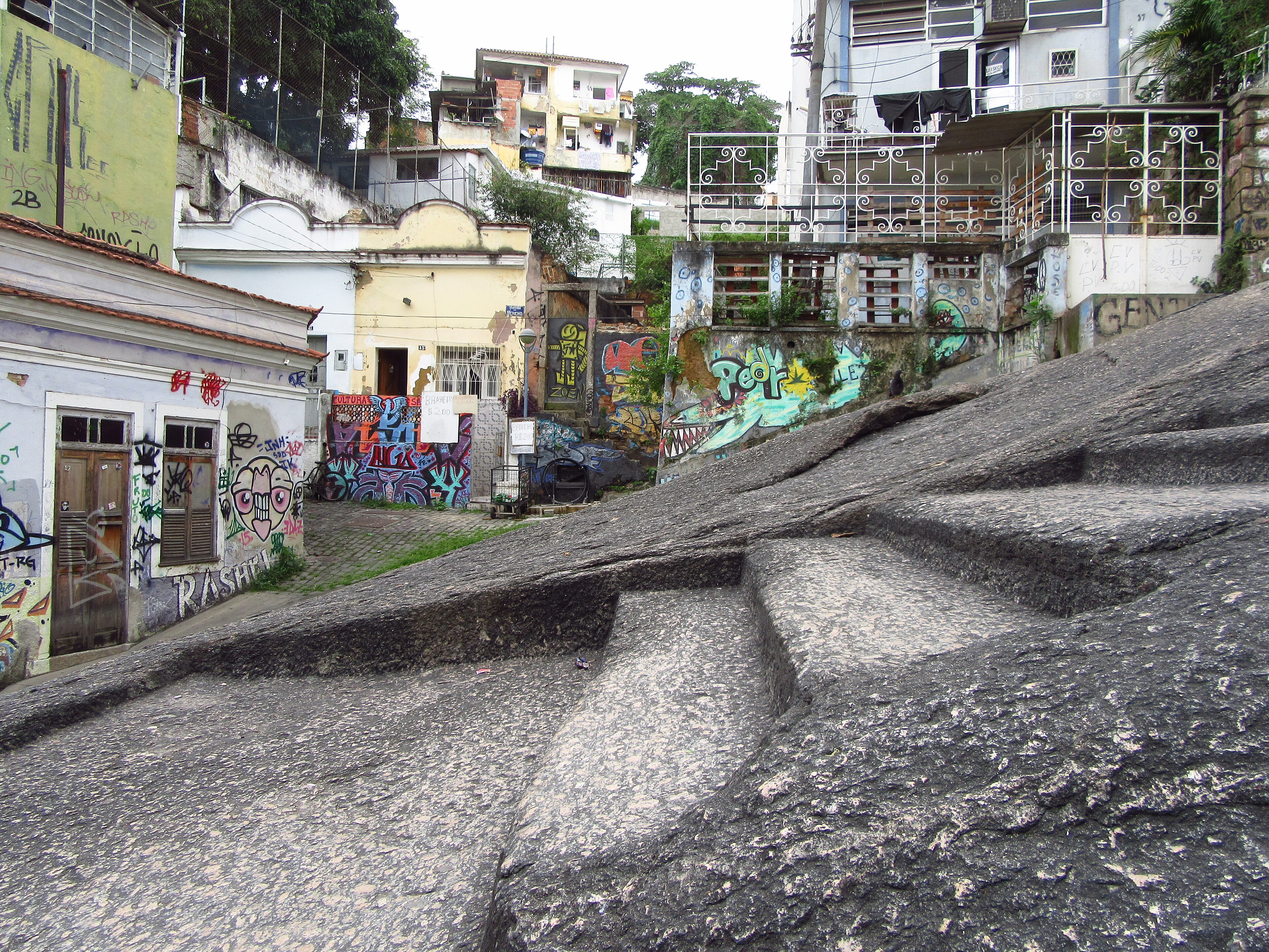
Photo: Felipe Restrepo Acosta · CC BY-SA 4.0 · Original file As you turn onto Rua Tia Ciata, the dramatic dark granite slope of Pedra do Sal rises before you at Largo João da Baiana. This sacred rock was originally where salt was unloaded from cargo ships, but it quickly became the cultural heart of Rio's Afro-Brazilian community. Notice the historic stone steps carved directly into the rock face, and observe the vibrant murals honoring the legendary Bahian matriarch Aunt Ciata. It was right here in these surrounding communal houses that musical pioneers like Pixinguinha and Donga gathered to play early choro and craft the foundational rhythms of Carioca samba. If you arrive in the late afternoon, look for the local musicians setting up tables for a traditional roda de samba under the open sky, filling the stone amphitheater with joyous singing and clapping.
Now leave the port district behind and stroll fifteen minutes south into Centro toward Rua Luiz de Camões.
- 1 min · on site
Real Gabinete Português de Leitura
A Cathedral of Books and Carved Rosewood in Downtown Rio
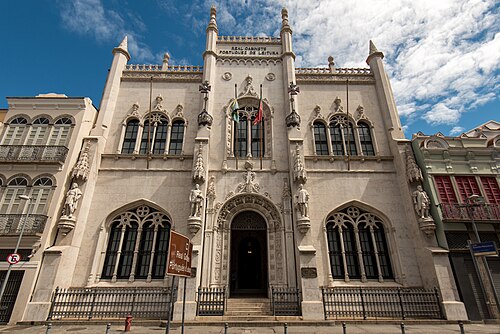
Photo: Donatas Dabravolskas · CC BY-SA 4.0 · Original file Stepping through the grand limestone entrance at Rua Luiz de Camões thirty, you enter the breathtaking neo-Manueline reading hall of the Real Gabinete Português de Leitura. As you walk inside, look up immediately to admire the massive iron chandelier suspended from a magnificent stained-glass skylight that bathes the hall in soft cathedral illumination. Marvel at the three towering tiers of dark carved rosewood bookcases containing over three hundred thousand volumes, including priceless first editions of Portuguese literature. This quiet sanctuary served as an intellectual home for Brazil's legendary writer Machado de Assis, who presided over the earliest solemn sessions of the Brazilian Academy of Letters within these very walls. Take a quiet seat at one of the dark wooden reading desks and let the timeless aroma of leather bindings envelop your senses.
Walk three blocks east along the bustling pedestrian streets of Centro to reach the mirrored doors of Confeitaria Colombo.
- 1 min · on site
Belle Époque Elegance and Sweet Traditions on Rua Gonçalves Dias

Photo: Voscaptureis · CC BY-SA 4.0 · Original file Pushing open the heavy wooden doors at Rua Gonçalves Dias thirty-two, you step into the opulent Art Nouveau interior of Confeitaria Colombo. Founded in 1894 by Portuguese immigrants, this legendary coffeehouse was known as a branch of the Brazilian Academy of Letters, where intellectuals like Olavo Bilac and Villa-Lobos debated poetry over afternoon tea. Take a seat in the central salon and look up at the soaring ceiling opening that reveals the stained glass skylight on the upper tearoom floor. Admire the gigantic crystal mirrors imported from Antwerp set within hand-carved rosewood friezes along the walls. Be sure to order a warm pastel de nata and a rich espresso while taking in the nostalgic murmur of conversation that has echoed through this salon for over a century.
Head south toward Lapa and follow the cobblestones to the foot of the brightly tiled Escadaria Selarón.
- 1 min · on site
A Living Mosaic of Color and Devotion Connecting Lapa to Santa Teresa
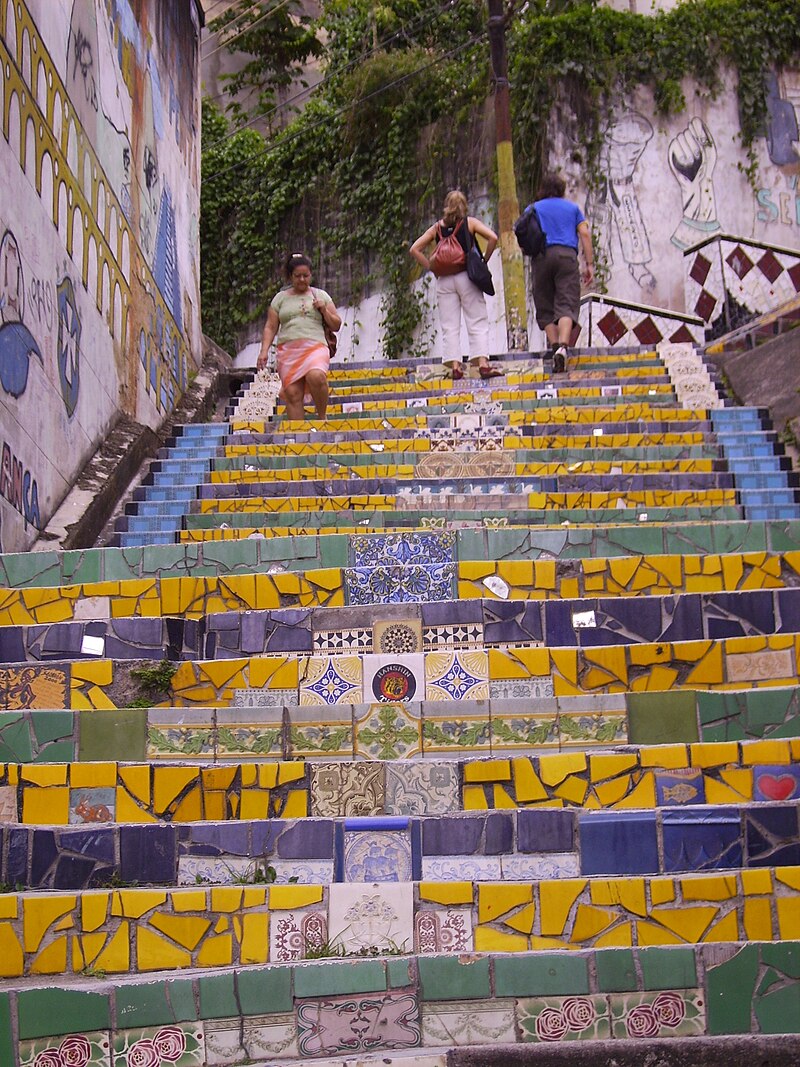
Photo · Wikimedia Commons Arriving at Rua Manuel Carneiro in Lapa, your eyes are immediately drawn to the exploding spectrum of colors covering the two hundred fifteen steps of Escadaria Selarón. Designed by Chilean artist Jorge Selarón as a personal tribute to the Brazilian people, this world-famous staircase stretches one hundred twenty-five meters up toward Santa Teresa. As you climb, look closely at the individual ceramic tiles from over sixty countries, and notice the recurring hand-painted image of a pregnant African woman that Selarón created to fund his lifelong obsession. Pause halfway up the steps to observe how mirror fragments reflect the tropical sunlight, creating an ever-changing kaleidoscope of light and movement. Selarón considered this work an ongoing dream that would only end on the day of his death, leaving behind an unforgettable triumph of public art.
Continue climbing the cobblestone incline of Santa Teresa up to the panoramic terrace of Parque das Ruínas.
- 1 min · on site
Arched Brick Ruins and Soaring Views Over Guanabara Bay

Photo: Tet · CC BY 4.0 · Original file Reaching the crest of the hill at Rua Murtinho Nobre one hundred sixty-nine, you step into the breezy open grounds of Parque das Ruínas. Built around the preserved red brick ruins of socialite Laurinda Santos Lobo's Belle Époque mansion, this cultural center seamlessly blends historic romanticism with modern architectural steel and glass walkways. Walk up the contemporary stairs to the topmost observation platform and pause to take in the breathtaking panoramic vista overlooking Guanabara Bay, Downtown Rio, and the distant mountains. Look for the vibrant mural painted on the grounds by artist Eduardo Kobra, which honors the memory of Brazilian journalist Glória Maria. The combination of open sky, exposed brick archways, and distant harbor sea breeze makes this one of the most serene view points in the entire city.
Walk just a few steps down the shaded cobblestone driveway to enter the adjacent gardens of Museu da Chácara do Céu.
- 1 min · on site
Modernist Architecture and Masterpiece Collections High Above the City

Photo: Ministério da Cultura · CC BY 2.0 · Original file Entering the quiet estate gates at Rua Murtinho Nobre ninety-three, you arrive at Museu da Chácara do Céu, the former modernist residence of industrialist and arts patron Raymundo Ottoni de Castro Maya. Designed by architect Wladimir Alves de Souza in the nineteen fifties, the house is set within lush landscaped gardens that offer magnificent panoramic views of Guanabara Bay and the surrounding city skyline. Walk through the meticulously preserved residential rooms to admire an extraordinary private collection featuring modern European masters like Matisse and Modigliani alongside legendary Brazilian painters like Portinari and Di Cavalcanti. Be sure to step out onto the quiet garden terrace where mature shade trees frame the coastline below, allowing the delicate harmony of fine art, modernist design, and mountain nature to settle deeply into your memory.


As your walking journey through these secret sanctuaries comes to a quiet end high above the city in Santa Teresa, the true spirit of Rio de Janeiro remains with you. Beyond the famous beaches and sunlit postcards lies a city built by dreamers, poets, and resilient communities who poured their souls into stone, paper, and song. May the quiet memories of these hidden alleys accompany you long after your footsteps have faded.
Take it further
Open the tour in the appThe tour in the app
Rio de Janeiro Hidden Alleys and Historic Sanctuaries WalkEmbark on an enchanting self-guided walking journey connecting Rio de Janeiro's historic port, Little Africa, downtown literary sanctuaries, and the romantic hilltops of Santa Teresa. Discover sacred archaeological wharves, vibrant tile staircases, grand rosewood libraries, and Belle Époque ruins in one seamless cultural walk.
+ Add the tour to your planIf you have the app the tour opens right away; otherwise you go to the store.FAQ
- What is the best time of day to start this hidden walk through Rio de Janeiro?
- Starting early in the morning allows you to visit Cais do Valongo and Pedra do Sal in cool daylight, enjoy midday tea at Confeitaria Colombo, and reach the high view points of Santa Teresa before sunset.
- How long does it take to complete the walking tour from Cais do Valongo to Santa Teresa?
- The walking route spans approximately three to four hours at a relaxed pace, including time to explore museum galleries, photograph staircases, and enjoy a coffee break in Centro.
- Are the walking locations accessible by public transport or walking between stops?
- The route connects logically from the port area through Centro to Lapa on foot, followed by a scenic walk or historic tram ride up into Santa Teresa.
This piece was newly written based on the Wikipedia articles ‘Pedra do Sal’, ‘Escadaria Selarón’, ‘Parque das Ruínas’, ‘Real Gabinete Português de Leitura’ · CC BY-SA 4.0