We stepped out into the Buenos Aires morning just as the street sweepers were clearing the fallen purple blossom of the jacarandas, the air cool and fragrant with roasted espresso and river damp. Traveling with a child through a city famed for late dinners and nocturnal melancholy is an exercise in gentle inversion. You do not chase the twilight taverns or the tragic elegance of midnight tango; instead, you surrender your stride to the slower cadence of a smaller companion who stops to examine every damp tile on the sidewalk and marvels at the street dogs sleeping beside newspaper kiosks. It is a quiet revelation to discover that this vast South American capital, so often celebrated for its proud, European-tinged gravity, softens completely when approached at knee height.
Across the wide avenues, the morning light filtered through the dense green canopy of the parks, turning the urban sprawl into an archipelago of shaded clearings. I held a small, sticky hand warm inside my coat pocket, realizing that a child does not experience a city as a grand historical narrative or a sequence of architectural movements. For them, a metropolis is an immediate landscape of sensations: the gravel crunching under rubber soles, the mysterious gleam of a pond where golden carp drift beneath arched red bridges, and the echoing hush of high stone vaults where giant plaster bones seem to graze the ceiling. In their eyes, Buenos Aires shed its intellectual armor and became a playground of pure wonder.
The Geometry of Wonder
Sitting on a wooden bench beneath the tipa trees, watching the pigeons flutter around an empty mate gourd, I recalled the quiet figures who once dreamed of wonder in this very soil. In June of 1967, a mathematics professor named Antonio Cornejo stood beneath the newly completed concrete dome of the Galileo Galilei planetarium. He had gathered schoolboys and girls from Banfield, dimming the hall until the darkness was total, before lighting up the southern constellations. He showed them how sailors and wanderers found their way home by looking for the Southern Cross, teaching children that the sky above their city was a living map waiting to be deciphered.
A century and a half earlier, in 1812, Bernardino Rivadavia had written urgent decrees to the interior provinces, pleading with governors and priests to gather stones, petrified wood, and animal skeletons so the young republic might possess a natural history museum of its own. Those first odd relics were carefully sheltered inside the upper cloister cells of the Santo Domingo convent, safeguarded by monks before growing into the monumental halls that today shelter ancient Patagonian titans. These were not mere bureaucratic undertakings; they were acts of radical faith in curiosity, founded on the belief that a civilized city must preserve the vastness of the universe for its newest generations.
The Hand We Hold
By late afternoon, the golden light of the pampas slants low against the facades of Palermo and La Boca, bathing the crumbling cornices and brick towers in honeyed warmth. We walked without haste, stopping for warm medialunas and listening to the distant hum of traffic on Avenida del Libertador. What remains from such journeys is rarely the famous monuments or the completed itineraries, but the small, shared moments that slip between them: a child whispering to a bronze turtle, a sudden burst of laughter inside a mirrored science gallery, and the reassuring weight of a sleepy head resting against your shoulder on the bus ride back. In Buenos Aires, we learned that to guide a child through a city is ultimately to allow oneself to be led back to the beginning of the world.
Want to walk it yourself? Plan a trip with these places
The walk
On site, play just that chapter
- 1 min · on site
A Saucer in the Park
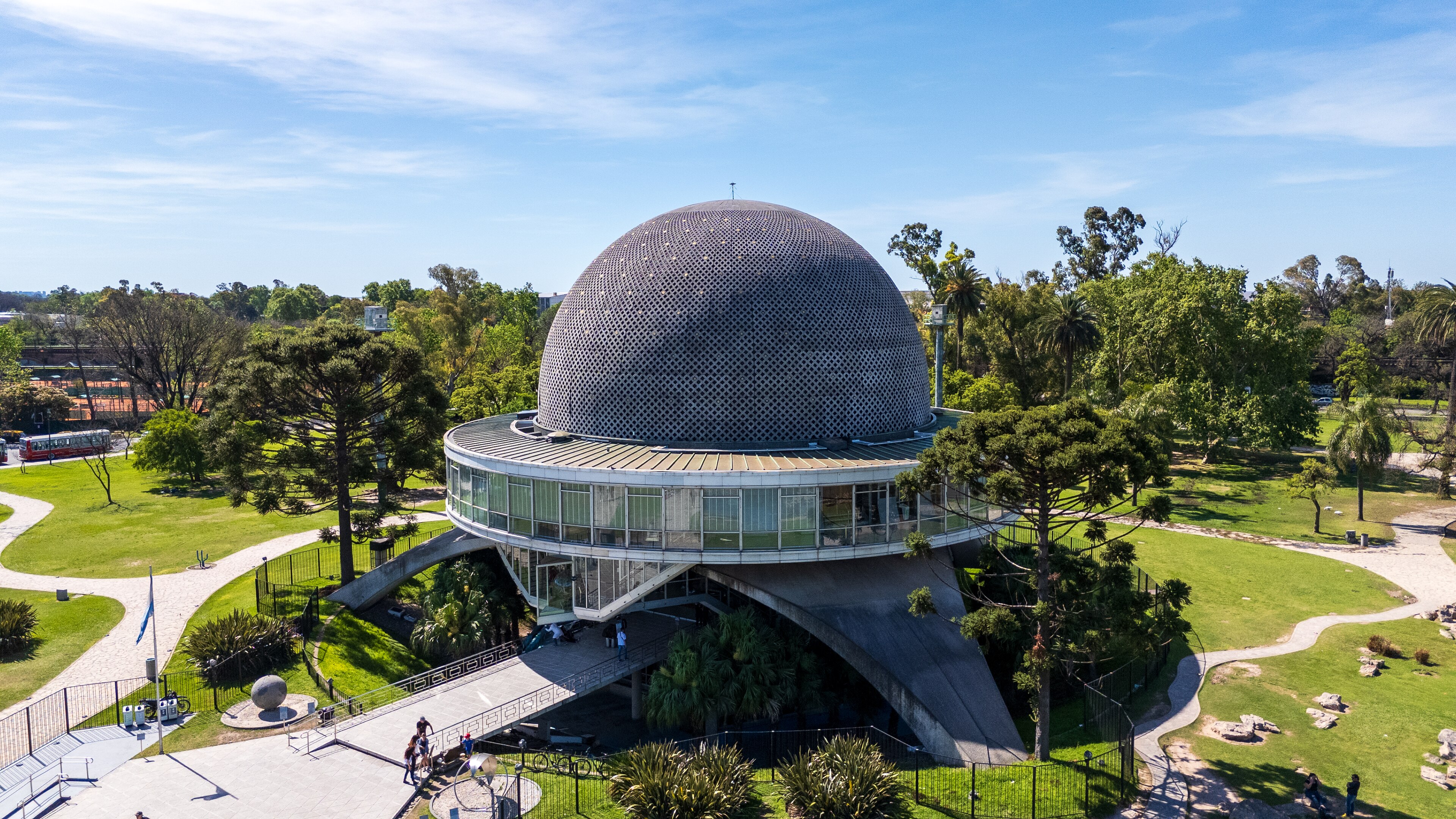
Photo: ProtoplasmaKid · CC BY-SA 4.0 · Original file Rising like a silver spacecraft above the green meadows of Bosques de Palermo, the planetarium seems plucked from a mid-century utopian dream. Standing before its wide entrance esplanade, my child immediately ran toward a colossal block of dark iron—the meteorite named La Perdida, plucked from the prehistoric craters of Campo del Cielo in Chaco. Inside the soaring twenty-meter dome, the memory of Professor Antonio Cornejo still lingers in the hushed gloom. In 1967, he gathered the city's schoolboys beneath this ceiling, teaching them to steer through life by finding the Southern Cross. Looking up as thousands of mechanical stars ignited across the curvature, my little one held my thumb in pure, motionless awe. Before leaving, pause on the first floor to glimpse the tiny fragment of lunar bedrock brought back by Apollo Eleven, a silent reminder that wonder knows no borders.
Follow the leafy footpaths south across Parque Tres de Febrero until you reach Avenida Casares, where the wooden gates of the Japanese garden beckon.
- 1 min · on site
The Geometry of Serenity
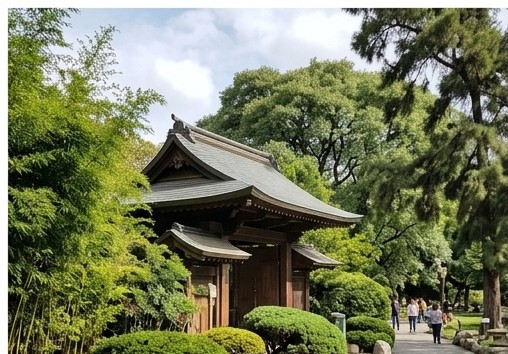
AI-generated image · may differ from the real place Stepping through the gate onto the damp gravel, the roaring city falls into an immediate whisper. Inaugurated in 1967, this sanctuary honors the classical twelfth-century Sakutei-Ki treatise, which instructs gardeners to fulfill the natural desires of the stones rather than force human will upon them. My child paused at the crest of the steep scarlet wooden bridge, leaning over the handrail to watch a school of golden koi ripple through the reflection of weeping willows. The landscape is designed around shakkei, the art of borrowed scenery, seamlessly framing the modern apartment towers of Palermo behind delicate Japanese black pines and bamboo thickets. Walk slowly along the meandering shoreline path, breathing in the scent of damp moss, and encourage your little companion to spot the stone granite lanterns half-hidden among the ferns, miniature houses of light waiting for dusk.
Take a short cab ride southeast toward the cultural heart of Recoleta, where the white terrace of the historic cultural center overlooks Junín.
- 1 min · on site
Museo Participativo de Ciencias
The Permission to Touch
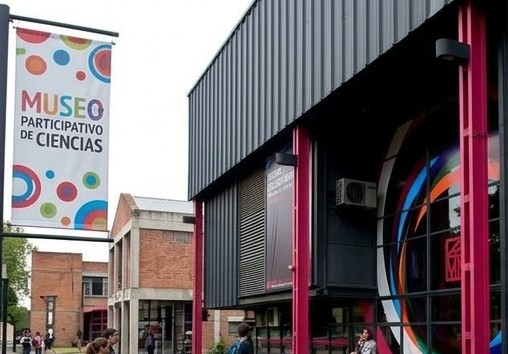
AI-generated image · may differ from the real place Most museums are sanctuaries of restraint, full of stern placards and glass barriers, but here inside the cloisters of Recoleta, the golden rule is turned delightfully upside down. The sign at the threshold proudly invites young hands to touch everything in sight. My child sprinted from one tactile contraption to the next, cranking brass levers that sent whirlpools spinning through glass cylinders and whispering into acoustic dishes placed across echoing galleries. Here, physics sheds its austere blackboard equations and becomes an immediate physical comedy of pulleys, mirrors, and luminous magnetic pendulums. Guide your family toward the perception room, where optical tricks make the smallest toddler appear larger than their parents. Watching my child's face light up with sudden understanding as a soap film created an iridescent dome, I realized that true education is simply curiosity set free to play.
Head south toward the historic tango neighborhood of Balvanera, where the grand arches of the Abasto market loom over Avenida Corrientes.
- 1 min · on site
A Metropolis Built to Scale
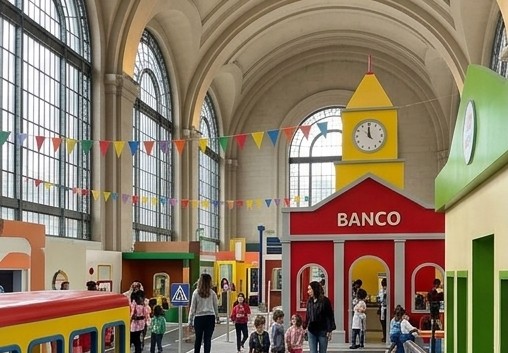
AI-generated image · may differ from the real place Inside the soaring Art Deco shell of the former Abasto central produce market, a magical miniature republic unfolds beneath the vaulted concrete ceiling. This is an entire working metropolis engineered exclusively for small citizens. As soon as we crossed the pint-sized threshold, my child took possession of the world, rushing to captain a miniature container vessel, weigh plush avocados in a scaled-down grocery aisle, and climb into the driver cab of a cheerful yellow city colectivo. In a city where children spend so much time looking up at high marble countertops and grown-up knees, there is profound joy in watching them master a world perfectly tailored to their height. Find a seat on the tiny plaza bench near the faux television broadcast studio, watching your child interview fellow travelers with genuine, solemn professionalism.
Travel southwest along Avenida Ángel Gallardo to the circular oasis of Parque Centenario, where ancient stone facades guard the park edge.
- 1 min · on site
Museo Argentino de Ciencias Naturales Bernardino Rivadavia
The Guardians of Deep Time

Photo: Roberto Fiadone · CC BY-SA 4.0 · Original file Guarding the perimeter of Parque Centenario, this imposing 1937 temple of natural history feels like a cathedral carved from memory. Before stepping inside, look closely at the brick masonry to admire the intricate stone ornaments sculpted by Alfredo Bigatti and Emilio Sarguinet, depicting owls, bats, and coiled serpents. The lineage of this hall stretches directly back to 1812, when Bernardino Rivadavia pleaded for the provinces to collect prehistoric fossils, first sheltering them inside the cloister cells of Santo Domingo. Inside the grand paleontology hall, my child gasped into silence beneath the towering skeletons of Patagosaurus and the bizarre, spiked spine of Amargasaurus. Notice the immense armored shells of the glyptodonts that once roamed the pampas, their ancient bone shields looking like fantastical domed chariots designed by nature to captivate the imagination of a wandering child.
Take a journey south toward the harbor waters of La Boca, where the highway curves past the great red brick powerhouse.
- 1 min · on site
A Palace of Brick and Song

Photo: Unknown author Unknown author · CC BY 2.5 ar · Original file Standing proudly beside the waters of La Boca, this former electrical powerhouse was designed between 1912 and 1916 by Italian architect Giovanni Chiogna. Modeled closely after the Palazzo della Signoria in Florence, its crenelated brick tower, gargoyles, and Romanesque arches brought Renaissance dignity to the working-class industrial waterfront. Decades after the giant dynamos went cold, the complex was reborn in 2012 with a symphonic homage to Astor Piazzolla, transforming industrial grit into an acoustic sanctuary for families and artists alike. We sat together on the wooden floor of the vaulted nave, listening to a youth chamber ensemble rehearse while golden afternoon light streamed through the steel-trussed clerestory windows. As the violin notes soared upward into the cavernous brick rafters, my child leaned gently against my arm, resting after a long day of wonder beneath the southern sky.


When we finally board the evening ferry or the flight back toward the north, the memories that linger are not of statues or grand avenues, but of the sudden, unscripted moments: the weight of a sleepy hand in your palm beneath the jacarandas, the shared gasp inside the darkened planetarium, and the ancient stone turtles of Parque Centenario. Buenos Aires taught us that childhood is not an obstacle to travel, but its truest, most luminous compass.
Take it further
Open the tour in the appThe tour in the app
A Promenade of Wonder: From Palermo Green to Boca BrickA gentle, memory-rich journey through Buenos Aires tailored for curious children and wandering parents, connecting the cosmic dome of Palermo, quiet Japanese water bridges, hands-on science galleries in Recoleta, miniature avenues in Abasto, prehistoric giants in Caballito, and the soaring brick concert halls of La Boca.
+ Add the tour to your planIf you have the app the tour opens right away; otherwise you go to the store.FAQ
- How stroller-friendly is Buenos Aires when exploring these family spots?
- The grand green parks of Palermo and the gentle gravel loops of the Japanese Garden are wonderful for strollers, though you will want to take extra care across the uneven pavement tiles of older districts like Balvanera and La Boca.
- What is the best daily rhythm when visiting cultural museums with young children?
- Start mornings in the open green spaces of Palermo or Parque Centenario before moving indoors to interactive halls during the midday warmth, keeping afternoons unhurried so children can set the pace.
- How can families comfortably combine science stops with neighborhood exploration?
- Pair the hands-on science galleries in Recoleta with a quiet shaded walk through neighboring plazas, or follow a morning among the dinosaur fossils with playground time in the surrounding park circle.