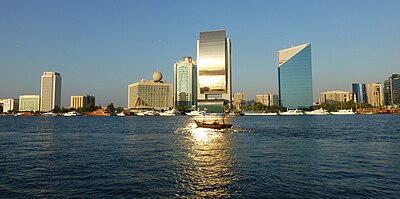
Whenever I return to Dubai, I begin before sunrise at the edge of the saltwater, watching the low morning mist dissolve across the bows of weathered wooden dhows. Most travelers imagine this metropolis as an instantaneous mirage of chrome and reflective glass, an artificial wonderland summoned overnight from vacant sand dunes. Yet the truer city reveals itself slowly to those who walk its waterlines. Long before structural engineers sank deep foundation piles into fragile siltstone, Dubai was shaped entirely by the ebb and flow of the tide. In the cool dawn air, the mingled scent of marine diesel, sea brine, and sun-bleached rope anchors you in an enduring human geography that refuses to be overshadowed by the soaring skyline behind you.
That morning stillness always reminds me that Dubai is neither an accident of geography nor a mere byproduct of sudden petroleum reserves. It is a deliberate creation of human tenacity, an urban landscape forged through successive wagers on trade, architecture, and memory. When the global market for natural pearls collapsed in the nineteen-thirties following the invention of cultured pearls, the families along this inlet did not retreat into the desert. They looked outward across the Persian Gulf, transforming their natural harbor into a crossroads of maritime commerce. The city does not ask you to marvel solely at its record-breaking heights, but to trace the quiet seams where maritime tradition sustains modern ambition.
The Dredged Channel and the Chicago Window
The story of this modern expanse began with mud, limestone, and sovereign patience. In the nineteen-fifties, when the natural creek began choking on its own silt, threatening the dhows arriving from the ports of India and East Africa, Sheikh Rashid bin Saeed Al Maktoum made the audacious choice to dredge the shallow channel. By nineteen-sixty-one, ocean vessels with deep drafts were gliding directly into the town center, giving Dubai a vital commercial advantage over neighboring ports. That single dredging project anchored the city's modern destiny.
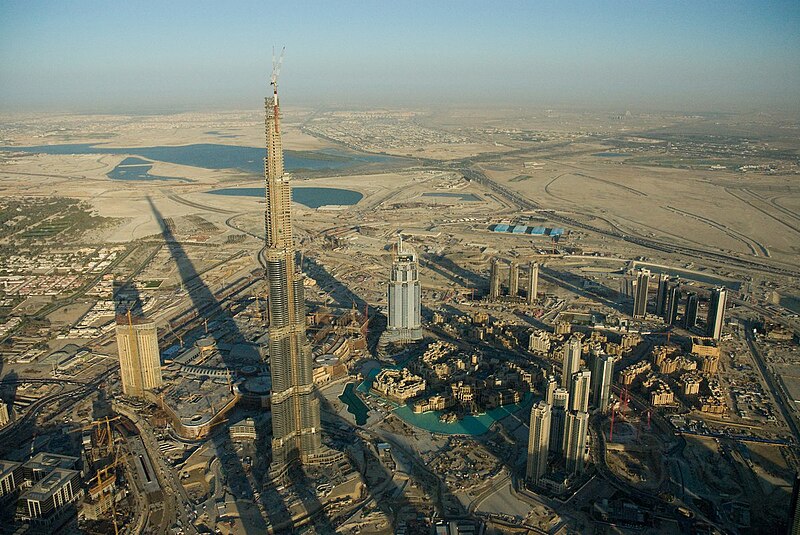
Decades later, in a Chicago design studio high above the American Midwest, chief architect Adrian Smith sat staring through his window at the curved three-winged layout of Lake Point Tower and realized he had found the prototype. From that sudden glance emerged the spiraling tripartite silhouette of the Burj Khalifa, rising along Sheikh Zayed Road with structural steel partly salvaged from the demolished Palace of the Republic in East Berlin. Think of that poetic transit: the parliamentary girders of a vanished European state melted down to anchor a desert spire that sways five feet in the Gulf winds, its concrete pumped at night with crushed ice to prevent premature cracking under scorching desert temperatures.
A Sanctuary of Gifted Stone
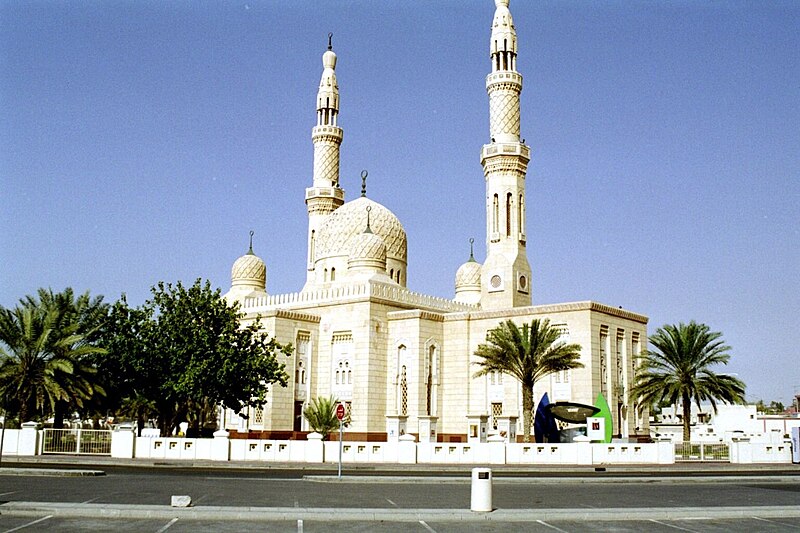
A short distance along the coast stands the Jumeirah Mosque, carved from warm yellow-pink sandstone. It was commissioned in nineteen-seventy-nine by Sheikh Rashid as an intimate personal gift to his son, Sheikh Mohammed bin Rashid Al Maktoum. Step inside, and you discover prayer halls whose ascending colors, moving from desert beige and salmon pink up to a ceiling of tranquil sky blue, echo the decorative philosophies recorded by Owen Jones in his nineteenth-century studies of classical Islamic design. It remains an enduring sanctuary of contemplative stillness in a city renowned for speed.
As you wander these streets today, listening to the ambient murmur of the streets and water, allow yourself to look past the dazzling spectacles of contemporary luxury. Notice instead how the old pearling creek and the cloud-piercing tower belong to the same unbroken continuum of survival and imagination. The walk that follows is an intimate journey through those layered thresholds.
Want to walk it yourself? Plan a trip with these places
The walk
On site, play just that chapter
- 1 min · on site
The Salty Arteries of the Bani Yas
Photo · Wikimedia Commons Stand along the stone embankment of Baniyas Road on the Deira waterfront just as the late afternoon light softens the water into beaten copper. Before you, heavy wooden dhows sit two and three abreast, their weathered timber gunwales stacked high with cargo destined for ports across the Arabian Sea. It was right along these shallows that the Bani Yas tribe first settled in the nineteenth century, establishing the ruling dynasty that would guide Dubai from a modest pearling hamlet into a global crossway. If you pause beside the loading slips, listen for the low thrum of the diesel marine engines and the shouts of dock hands tying thick hemp lines to iron bollards. Step down to the water’s edge and watch the motorized wooden abras skim back and forth across the saltwater channel. This waterway is not a relic of the past, but the living heart that taught a desert city how to look across horizons.
Turn away from the water and cross Baniyas Road into the shaded entryway of the narrow market alleyways directly ahead.
- 1 min · on site
Aromatic Labyrinths in Al Ras
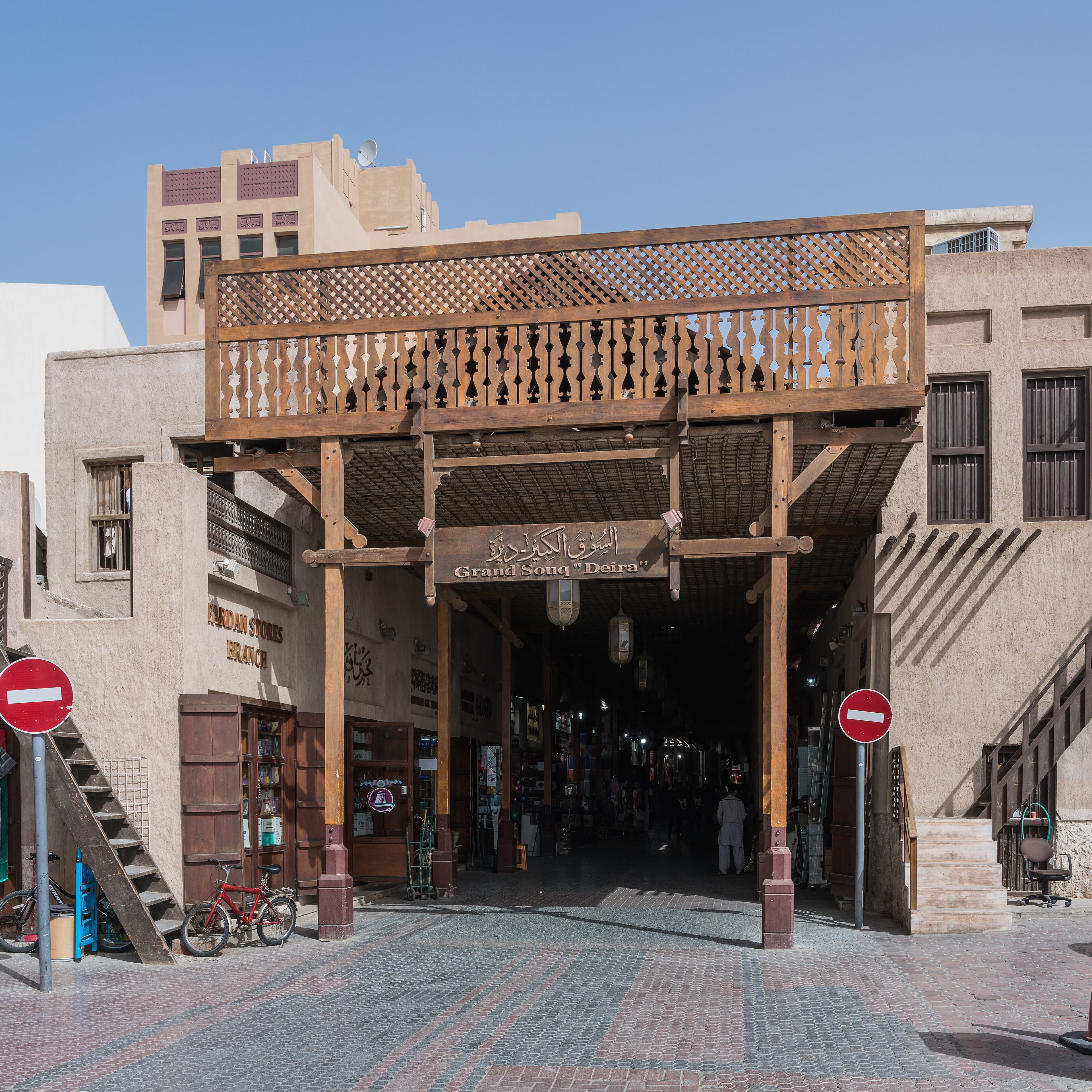
Photo: A.Savin · FAL · Original file Step under the carved timber lattices of Sikkat Al Khail in the historic district of Al Ras, where the warm desert breeze suddenly gives way to the deep, intoxicating scent of crushed coriander, dried Persian limes, and amber resins of frankincense. The narrow lanes, protected overhead by open and slatted wooden roofs, still preserve the intimate scale of traditional Arabian commerce. Walk slowly past the open burlap sacks and let the merchants offer you a pinch of yellow saffron or a fragment of aromatic bark to rub between your fingers. Here, trading has never been an impersonal transaction, but an unhurried social ritual conducted through polite bargaining and quiet conversation. Notice the delicate balance of spices that traveled across ancient sea routes from South Asia and the Levant. In these sensory corridors, the historic pulse of old Dubai lingers unaltered, inviting you to touch, inhale, and remember how markets once joined distant continents.
Follow the main covered lane northward as it widens gently and transitions into the radiant storefronts of the neighboring jewelers.
- 1 min · on site
The Glittering Corridor of Merchants
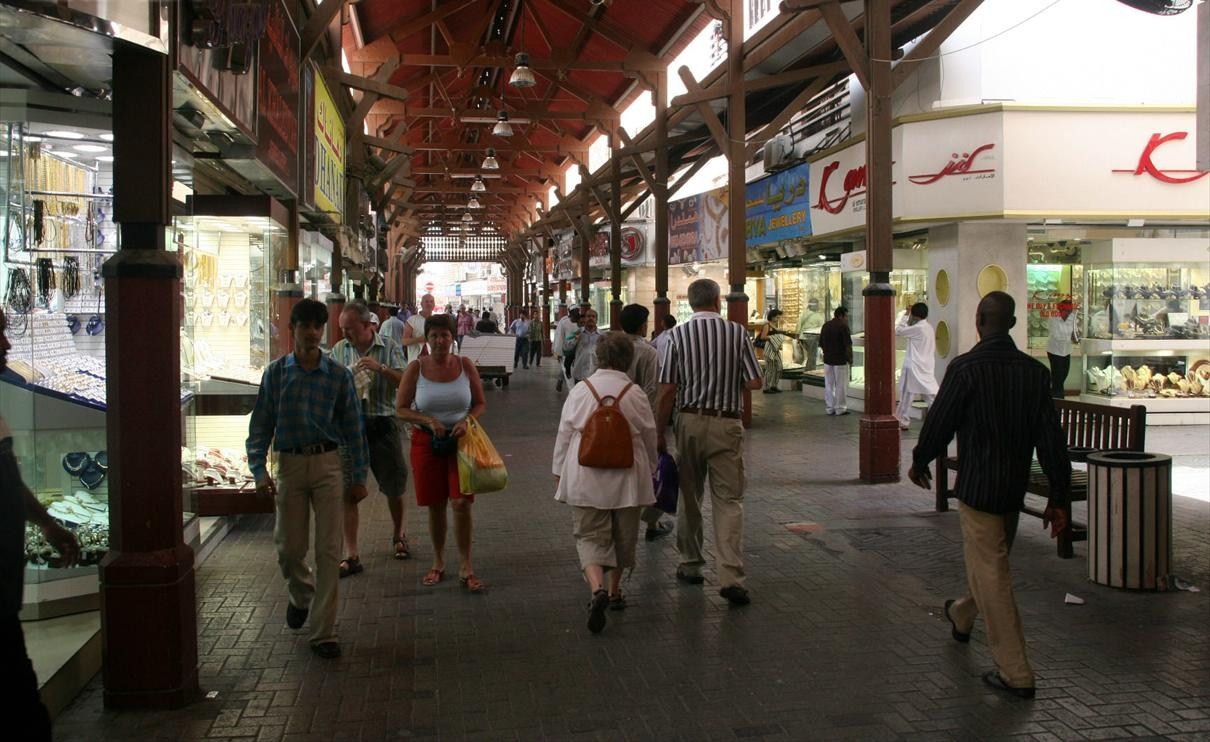
Photo: Imre Solt · CC BY-SA 3.0 · Original file Emerging into the pedestrian avenues of the Gold Souk, the warm scents of incense are replaced by the cool brilliance of three hundred and eighty storefronts ablaze with gold, platinum, and polished gemstones. When Dubai adopted liberal free trade policies in the nineteen-forties, merchant families from India and Iran settled along these very pavements, establishing a bustling center for wholesale bullion and handcrafted adornments. As you stroll beneath the lofty wooden arches, pause in front of the illuminated corner windows to examine the intricate bridal filigree and heavyweight necklaces draped like cloth. Look closely inside Taiba jewelry to spot the famous Najmat Taiba, celebrated as the world's heaviest gold ring weighing sixty-four kilograms. Take your time comparing designs between the venerable family shops and newer boutiques before you agree on a crafted piece, savoring the radiant hum of an exchange that has endured for almost a century.
From the historic lanes of Deira, journey southwest along the coast toward the tranquil residential sanctuary of Jumeirah Beach Road.
- 1 min · on site
Sandstone Hymns under an Azure Dome
Photo · Wikimedia Commons Arrive at Jumeirah Beach Road where the creamy yellow-pink sandstone of Jumeirah Mosque rises gracefully against the coastal sky, framed by two intricately carved minarets and deep relief stonework inspired by historical Fatimid and Egyptian Mamluk traditions. Commissioned in nineteen-seventy-nine as a father's gift from Sheikh Rashid to his son, this sacred space remains one of the few places of worship in the city that warmly welcomes non-Muslim visitors through guided cultural encounters. Before stepping through the arched tourist portal, observe the tranquil courtyard fountains where worshippers perform ablution before prayer. Once inside, let your gaze wander upward across the grand hypostyle hall: the painted walls transition in gentle stages from warm desert beige and salmon pink to a ceiling and central dome clothed in serene, cloudless blue. The soft floral carpet underfoot and the hushed acoustics create an oasis of unhurried spiritual contemplation.
Leave the coastal greenery behind and head southeast toward the soaring center of Downtown Dubai where Sheikh Zayed Road meets the skyline.
- 1 min · on site
The Glass Spire above the Clouds
Photo · Wikimedia Commons Emerge onto the sweeping promenade of Sheikh Mohammed bin Rashid Boulevard and tilt your head back until your neck aches: the Burj Khalifa rises eight hundred and twenty-eight meters into the desert atmosphere, its spiraling silhouette sculpted into twenty-seven setbacks that baffle the whistling Gulf winds. Chief architect Adrian Smith conceived its three-winged geometry after observing Chicago's Lake Point Tower, while Fazlur Rahman Khan's bundled tube structural system enabled this needle of reinforced concrete to rise with extraordinary lightness. When you enter the high-speed double-deck elevator and ascend to the observation terraces at At The Top, notice how the city below appears like an architect's blueprint traced in sand and water. On clear winter afternoons, look across the shimmering Persian Gulf toward the distant horizon where the coast of Iran sometimes appears. High up here, time stretches and the city's vast ambition becomes completely visible.
Depart the towers of Downtown and travel along the sea-girt arterial trunk toward the outer crescent of Palm Jumeirah.
- 1 min · on site
Water, Fire, and the Island's Edge
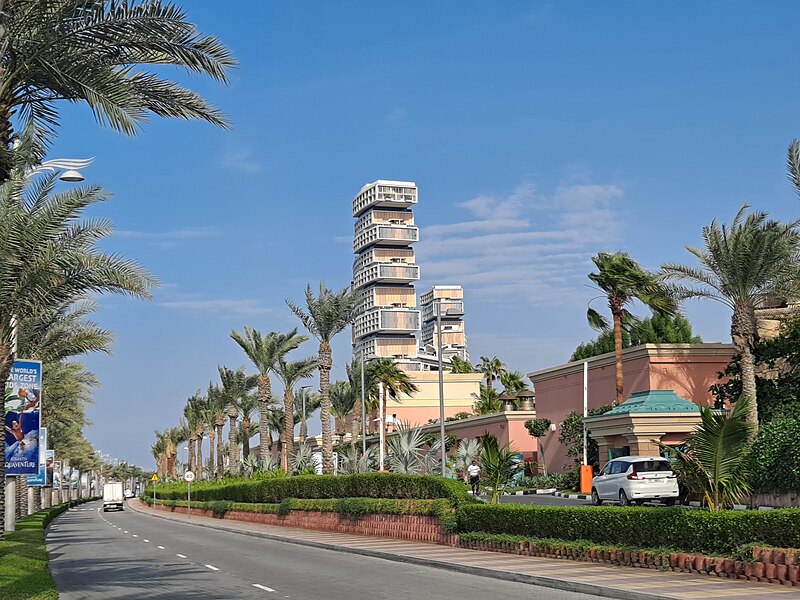
Photo · Wikimedia Commons Stand upon the sweeping beachfront terrace along Crescent Road at the apex of Palm Jumeirah, where Atlantis The Royal appears as a monumental, deconstructed lattice of cantilevered glass and stone. Opened in early twenty-twenty-three, this seaside resort merges the elemental drama of the Arabian Gulf with daring contemporary architecture. Step into the grand interior atrium to gaze at the world's largest jellyfish aquarium, where thousands of translucent marine creatures drift in luminous cylindrical columns. As dusk falls, walk out toward the courtyard to witness the Skyblaze fountain show, where towering plumes of pressurized water erupt alongside choreographed blasts of live fire. It was here that Beyoncé delivered her historic private performance, her soundchecks echoing across the palm fronds days before opening. Breathing in the cool sea spray, you realize you have reached the outer frontier where Dubai reimagines the shoreline into habitable myth.


Looking back at the city lights glittering across the Persian Gulf, I find that Dubai's true power does not reside in its steel records or boundless scale. It lives in the restless human courage to build meaning upon shifting sands, bridging ancestral seafaring memory with the quiet grace of stone and light.
Take it further
Open the tour in the appThe tour in the app
From Creek Wharves to Gulf CrescentsThis curated walking and driving route traces Dubai evolution from the historic saltwater wharf of Dubai Creek and aromatic alleyways of Deira to the serene sandstone arches of Jumeirah Mosque, culminating at the cloud piercing observation decks of Burj Khalifa and the dramatic marine terraces of Atlantis The Royal.
+ Add the tour to your planIf you have the app the tour opens right away; otherwise you go to the store.FAQ
- What is the best way to experience both Old Dubai and modern landmarks in a single journey?
- Begin early in the morning along the Deira waterfront at Dubai Creek and wander through the Spice and Gold Souks before traveling southwest to Jumeirah Mosque and Downtown Dubai, allowing you to witness the city's historical continuity from maritime trade to architectural ambition.
- Are visitors of all backgrounds permitted to enter Jumeirah Mosque?
- Yes, Jumeirah Mosque welcomes non-Muslim visitors through guided cultural tours organized by the Sheikh Mohammed Centre for Cultural Understanding under its Open Doors, Open Minds philosophy, provided guests dress modestly.