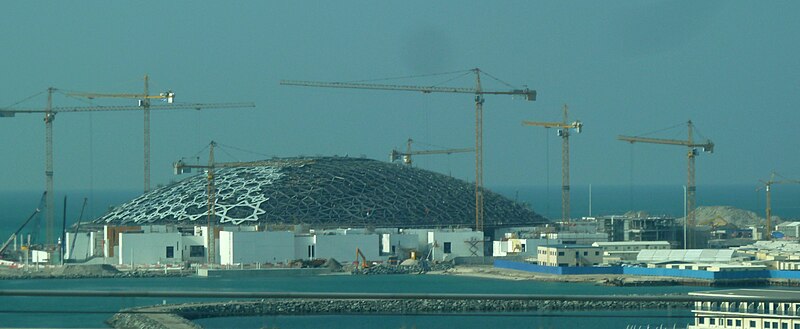
To arrive on Saadiyat Island across the azure sweep of the Persian Gulf is to witness a profound recalibration of how human history is arranged. For centuries, museums across the world gathered artifacts into rigid national enclosures, isolating antiquity from the living present and cordoning East from West behind marble pediments. Here, along the coastline of Abu Dhabi, where the desert gives way to salt water, an entirely different curatorial proposition has taken shape. The island itself, whose name translates from the Arabic as happiness, does not simply present a sequence of monuments. It functions as an open intellectual archipelago, an intentional landscape where civilizations do not confront one another as rivals, but converse across vast expanses of time.
As you approach along the low-lying coastal boulevard, the desert light reflects sharply against the water, revealing a skyline unlike any other on earth. Low-slung pavilions and monumental geometries rise from the reclaimed sand, anchored by the vast, silvery dome of the Louvre Abu Dhabi that appears to float upon the tide. What captivates the curatorial mind here is not the sheer scale of the enterprise, but the deliberate effort to dismantle the geographical and chronological barriers that have governed museum scholarship since the Enlightenment. In this district, objects are liberated from imperial hierarchies. A Buddhist bodhisattva, an archaic Greek bronze, and an early Islamic ceramic vessel are invited to share the same hall, illuminating the shared anxieties, spiritual longings, and artistic currents that have always connected humanity.
Diplomacy, Palms, and the Architecture of Light
This visionary cultural geography did not emerge by happenstance. Its architectural and philosophical foundations were forged through a series of unprecedented diplomatic and artistic dialogues. In the summer of two thousand and five, Crown Prince Mohamed bin Zayed Al Nahyan addressed a personal letter to French President Jacques Chirac, proposing a radical cross-continental collaboration that would bring the historic authority of France's premier cultural institutions to the shores of the Emirates. Chirac embraced the vision with unyielding resolve, recognizing that the true destiny of a great museum lies not in guarding treasures within secluded European vaults, but in championing a genuinely universal discourse across continents and generations.
When French architect Jean Nouvel was entrusted with giving form to this ambition, he turned away from western palace typologies. Instead, he studied the traditional desert oasis, where life has endured for centuries beneath the sheltering shade of date palms. Nouvel envisioned a colossal web-patterned canopy through which harsh sunlight would be softened into a gentle, dappled shower. Structural engineers turned that lyrical intuition into a staggering geometric reality, layering seven thousand eight hundred and fifty unique aluminum stars across eight intricate planes. The resulting rain of light transforms the stone courtyards below into an ever-shifting meditation on time, shadow, and nature.
Memory Engraved in Stone and Stardust
Wandering through these precincts before entering the exhibition galleries, one notices how public art anchors this universal dialogue into the soil and memory of the Emirates. Under the canopy, American artist Jenny Holzer carved ancient Sumerian and Akkadian creation myths, the philosophical prose of Michel de Montaigne, and the fourteenth-century historical texts of Ibn Khaldun into monumental limestone walls. Nearby, Italian sculptor Giuseppe Penone planted a bronze tree and cast a sweeping porcelain panel whose concentric rings trace the actual fingerprint of Sheikh Zayed bin Sultan Al Nahyan, the founding father of the United Arab Emirates. The universal and the local are thus bound together in permanent material resonance.
As you begin your walk through Saadiyat Cultural District, allow yourself to shed the habit of viewing culture as a fixed ledger of dates and dynasties. The galleries and creative pavilions that follow are not silent mausoleums, but living instruments of encounter. Here, seven-billion-year-old stardust, prehistoric Arabian fossils, and contemporary light installations exist along a single unbroken continuum. Listen closely to the materials, the architecture, and the surrounding waters, for they invite you into a deeper understanding of our collective human passage.
Want to walk it yourself? Plan a trip with these places
The walk
On site, play just that chapter
- 1 min · on site
Under the Canopy of Palm Fronds and Stars
Photo · Wikimedia Commons Step onto the open waterfront promenade where the morning air carries the clean brine of the Arabian Gulf. Before you enter the galleries, pause to gaze at the colossal silvery dome that seems to float over twenty-three white cubic pavilions, echoing the low-slung houses of traditional coastal settlements. Inside, look upward as seven thousand eight hundred and fifty geometric stars filter the intense desert sun into a dappled shower known as the rain of light. Notice how the museum dissolves conventional borders, placing ancient Mediterranean bronzes, medieval Japanese screens, and early Islamic ceramics in shared chronological chambers. In the open courtyards beside the rising tide, seek out Giuseppe Penone's porcelain panel, where delicate concentric lines radiate outward from the actual fingerprint of Sheikh Zayed, anchoring this universal journey in the memory of the desert.
When you leave the shelter of the dome, walk east along Jacques Chirac Street toward the monumental terraced forms of the Natural History Museum.
- 1 min · on site
Natural History Museum Abu Dhabi
Chronicles of Deep Time and Arabian Soil
Photo · Wikimedia Commons Step into the cool cavernous atrium, where natural history expands beyond human memory into thirteen point eight billion years of cosmic time. Look immediately to the towering skeleton of Stan, one of the most intact and complete Tyrannosaurus rex fossils ever unearthed, standing in silent majesty beside ancient marine reptiles. Further along the central pathway, bend down to examine a quiet glass case holding a fragment of the Murchison meteorite. Dating back seven billion years, this Australian stone contains pre-solar grains and organic stardust compounds older than the sun itself. Notice how the museum connects these cosmic wonders directly to the Arabian Peninsula, presenting life-size reconstructions of ancient four-tusked elephants that roamed these very shores when the desert was a lush delta. It is a sobering meditation on the resilience of planetary life.
Step outside and cross the shaded connecting plaza into the darkened threshold of teamLab Phenomena next door.
- 1 min · on site
Immaterial Realms of Floating Light
AI-generated image · may differ from the real place Enter without preconceived boundaries, trading the solidity of fossilized stone for the ephemeral world of digital phenomena. Ensure you are wearing comfortable flat shoes, as the floors rise, dip, and mirror the ambient light across dynamic chambers. Here, light, water, and digital algorithms do not simply project onto walls; they coalesce into physical sensations that respond directly to your movement. Walk slowly into the central vortex where luminous particles drift like swirling desert sands or cosmic nebulae, dissolving the barrier between the observing self and the environment. From a curatorial standpoint, this is the modern heir to Islamic geometric abstraction, translating age-old metaphysical inquiries into radiant immaterial forms. Every beam of light exists only for a fraction of a second before reforming, reminding us that art is an ongoing state of transformation.
Leave the shimmering darkness and take the cultural district pathway southward toward the open courtyard of Manarat Al Saadiyat.
- 1 min · on site
The Hearth of Island Memory and Community

Photo: دانية دروبي · CC BY-SA 4.0 · Original file Cross the welcoming sunlit threshold of Manarat Al Saadiyat, whose Arabic name fittingly translates as the lighthouse of happiness. Before this district became an international museum destination, this very pavilion served as the inaugural exhibition space where the dream of the cultural island was first shared with the public. It was here, in the historic Birth of a Museum exhibition, that Abu Dhabi revealed its earliest acquisitions, from an ancient Cypriot terracotta to early modern masterworks. Today, take time to check the temporary galleries, where contemporary Emirati photographers, sculptors, and community printmakers present work that pulses with contemporary regional vitality. Notice how the open atrium invites quiet reflection, acting as a civic salon where curators, artists, and families mingle, proving that culture thrives most vibrantly when grounded in daily community life.
Step through the adjoining creative wing to discover the soundstages and rehearsal suites of Berklee Abu Dhabi.
- 1 min · on site
Harmonic Resonances in the Modern Pavilion
AI-generated image · may differ from the real place Step into the acoustic corridors of Berklee Abu Dhabi, housed within the distinctive contemporary structure designed originally by Norman Foster for the Shanghai Expo. Here, the preservation of visual heritage yields gracefully to the intangible legacy of musical tradition. Walk along the perimeter glass to observe the recording studios and masterclass stages where traditional Middle Eastern oud melodies intersect with contemporary jazz harmonies and film scoring. Check the daily program at the entrance desk, for the institute regularly opens its performance halls for public rehearsals and cross-cultural concerts. Listening closely to the notes floating down the hall, one realizes that the dialogue of cultures championed on this island is auditory as well as visual. The improvisational spirit of the desert and modern symphonic form weave together, creating an ever-evolving soundtrack for this island of ideas.
Conclude your cultural promenade by taking a short walk toward the turquoise coastline at Mamsha Al Saadiyat to reach Beirut Sur Mer.
- 1 min · on site
Culinary Heritage Beside the Coastal Waves
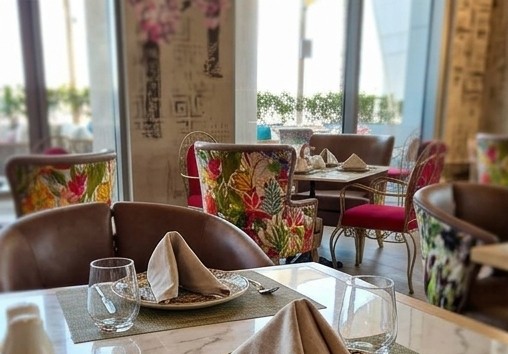
AI-generated image · may differ from the real place Arrive at the sun-dappled terrace of Beirut Sur Mer, where Jacques Chirac Street meets the white sands of Mamsha Al Saadiyat. Ask the host for an outdoor table facing the turquoise sea, where the rhythmic wash of the waves provides a tranquil counterpoint to hours of gallery contemplation. Here, Levantine culinary tradition is presented with the nuance of an artisanal craft. Order the silken hummus drizzled with fragrant olive oil, crisp spiced kibbeh, and warm manakish straight from the oven, each dish celebrating centuries of shared Mediterranean and Middle Eastern trade routes. As the afternoon sun lowers toward the water, cast your gaze back toward the distant silhouette of the museum domes. Holding a glass of mint-infused tea, you can reflect upon the timeless artifacts, prehistoric stardust, and melodic rhythms that make Saadiyat Island a triumphant crossroads of human memory.
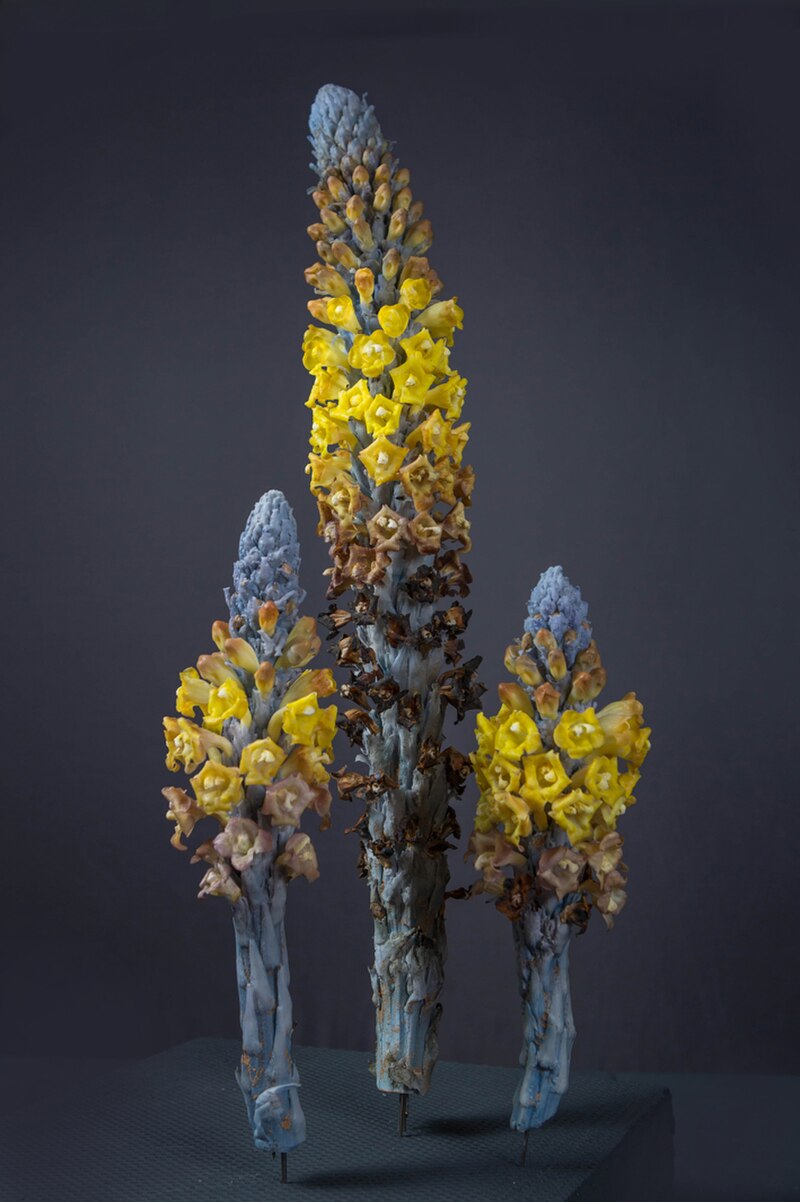
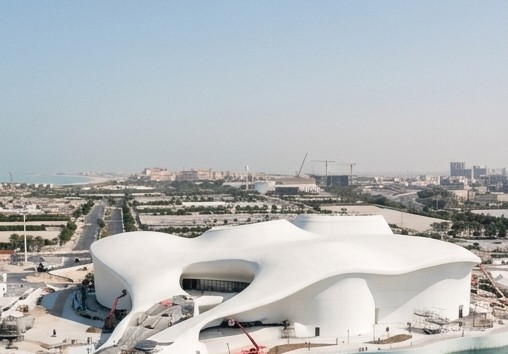
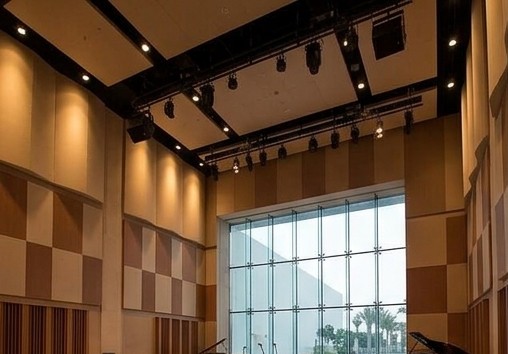

As shadows lengthen across Saadiyat Island, one leaves with the quiet conviction that culture is not an ornament of power, but an enduring dialogue across frontiers. From the silent gaze of archaic antiquities under Jean Nouvel's rain of light to seven-billion-year-old cosmic dust and evening notes drifting across the water, this island affirms that every civilization is an indispensable verse in the single song of human existence.
Take it further
Open the tour in the appThe tour in the app
Saadiyat Cultural Promenade: From Deep Time to Modern LightA contemplative half-day curatorial walk connecting the luminous maritime dome of Louvre Abu Dhabi to cosmic fossils, immersive digital phenomena, community art pavilions, and coastal dining along Saadiyat Island. Experience an unbroken journey that traces the profound dialogue of world civilizations across deep time, art, and natural history.
+ Add the tour to your planIf you have the app the tour opens right away; otherwise you go to the store.FAQ
- What makes the curatorial approach of Louvre Abu Dhabi unique compared to traditional European museums
- Rather than separating collections strictly by geography or national schools, Louvre Abu Dhabi employs a universal chronological layout. Works from ancient Egypt, Greece, China, and the Islamic world are displayed side by side in shared galleries, highlighting parallel developments, shared human concerns, and cross-cultural exchange throughout history.
- How does the architecture of the museums on Saadiyat Island respond to the desert environment
- The designs draw deeply from regional nature and traditional shelter. Jean Nouvel modeled the vast webbed dome of the Louvre on the cooling canopy of oasis date palms, while Mecanoo sculpted the Natural History Museum to reflect geological strata, creating shaded courtyards and maritime pools that protect visitors and artifacts from the coastal heat.
- How should visitors approach the transition between ancient antiquities and digital art installations
- Regard the transition as a continuous inquiry into perception and materiality. Moving from seven-billion-year-old meteorite fragments and classical bronze sculptures into the responsive light vortexes of teamLab Phenomena illustrates how humanity continually invents new visual languages to contemplate its place in the cosmos.