There is a peculiar stillness that gathers over the waters of Saadiyat before the morning heat dissolves the coastal horizon into pale pearl. If you stand along the promenade where the tide laps against pale limestone sea walls, the city behind you seems less an accumulation of concrete towers than an archipelago of reveries rising quietly between desert dunes and turquoise channels. To journey here during the grand congregation of the art fair is to step into a lineage of itinerant observers and writers who have always sought the geographical edges where distinct civilisations fold into one another. We arrive carrying memories of London parks in autumn and the restless corridors of Manhattan, yet this Arabian shore insists upon a fundamentally different tempo of looking. The morning breeze carries the scent of brine and damp sand, whispering that modern institutions are built upon an ancient crossroads of trade. Art here does not simply hang upon white partitions as a transient currency of prestige; it contends directly with the oceanic expanse, the blinding desert sun, and an ancient geography of maritime navigation.
The Ink of Chroniclers and the Wit of Frieze
When Matthew Slotover and Amanda Sharp launched Frieze, they did so not merely as fair organizers but as cultural editors animated by literary sensibilities, summoning incisive critical voices like Lynne Tillman, Hilton Als, and Peter Schjeldahl to articulate the vibrant frictions of our contemporary visual life. Over the seasons, that restless energy produced moments of audacious irony that became legendary in art lore: consider Tracey Emin launching her raw autobiographical volume Strangeland amid the crowded pavilions of two thousand and five while David Bowie and Alexander McQueen wandered through the aisles, or the conceptual prankster David Horvitz hiring an actual pickpocket to slip delicate pocket sculptures into unsuspecting visitors coats. Think too of the Cambridge classics scholar Mary Beard creating an entire satirical museum composed of curious antiquity fragments purchased quietly on the internet. That playful, provocative spirit now meets Saadiyat Island, where the dialogue between text, object, and history assumes an enduring architectural gravitas. Beneath the sheltering geometric canopy of the Louvre Abu Dhabi, the American artist Jenny Holzer chose to carve the introspective French prose of Michel de Montaigne and the profound philosophical historiography of Ibn Khaldun into monumental Marbella limestone, allowing sixteenth-century European skepticism and fourteenth-century Islamic scholarship to converse across open, sunlit courtyards.
A Sanctuary for the Restless Mind
To travel across these precincts on foot is to realise that the true gift of Abu Dhabi is this improbable reconciliation of the fleeting and the eternal. Beyond the bustling fair booths where dealers converse in hushed tones and collectors deliberate over provenance, one discovers quiet university galleries, contemplative gardens of geometry, and floating domes that disperse sunlight like an oasis canopy. The local poet Shamma Al Bastaki, who walked these halls as an ambassador of words, reminds us that contemporary art in the Gulf is not an alien graft, but a living verse written in continuous conversation with salt breezes, maritime memories, and migratory routes. As you prepare to explore these pavilions, quiet university lawns, and grand prayer halls on foot, surrender any impulse toward hurried consumption. Allow the eye to linger upon the subtle interplay of shadow, water, and script, for in this desert archipelago, every gallery is an invitation to pause, read between the lines of architecture, and inhabit the solitary wonder of the open horizon.
Want to walk it yourself? Plan a trip with these places
The walk
On site, play just that chapter
- 1 min · on site
The Awakening Pavilion

Photo: دانية دروبي · CC BY-SA 4.0 · Original file Here at Manarat Al Saadiyat, the day begins where the art fair gathers its initial momentum under broad desert light. As you step through the glass entrance into the airy atrium, the atmosphere carries the brisk hum of international curators and artists mingling beside crisp exhibition walls. It was in these very galleries that Abu Dhabi first previewed its emerging museum collections, presenting ancient Mediterranean terracotta beside modern masterworks. Make your way through the central gallery toward the sunlit terrace, where outdoor sculptures cast sharp diagonal shadows across manicured desert flora. Take a moment to notice how the morning sun strikes the geometric framework of the pavilions, turning industrial surfaces into warm registers of light. There is a palpable sense of anticipation here, as if every hallway were an opening chapter waiting to be penned by wandering observers.
Step out from the sculpture lawn toward the western promenade, where the monumental silver dome of the Louvre beckons above the turquoise shallows.
- 1 min · on site
Rain of Light and Ancient Inscriptions
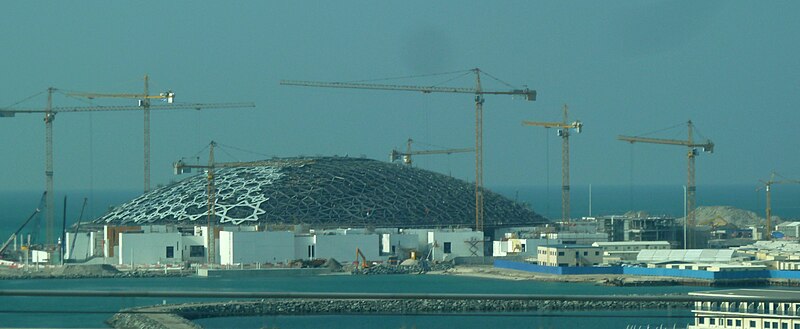
Photo · Wikimedia Commons Approaching the Louvre Abu Dhabi, the sea laps gently beneath white walkways that evoke an Arabian medina floating upon water. Look up as you enter the vast outdoor plaza: above you rests a canopy of seven thousand eight hundred and fifty aluminium stars, woven in eight layers to filter the desert sun into a shimmering rain of light. The French architect Jean Nouvel conceived this perforated shelter to recall sunlight filtering through date palm fronds in a secluded desert oasis. Seek out the courtyard where Jenny Holzer has engraved passages from Montaigne and Ibn Khaldun into pale limestone slabs, their timeless reflections on human nature enduring beneath the shifting daylight. Nearby, Giuseppe Penone bronze tree stretches its slender branches toward the perforated canopy. Pause beside the tidal pools to observe how the ocean breeze ripples across reflections of silver metal and white stone.
Follow the pedestrian concourse eastward along the cultural boulevard until the white organic curves of teamLab Phenomena rise against the desert sky.
- 1 min · on site
The Weightless Architecture of Light
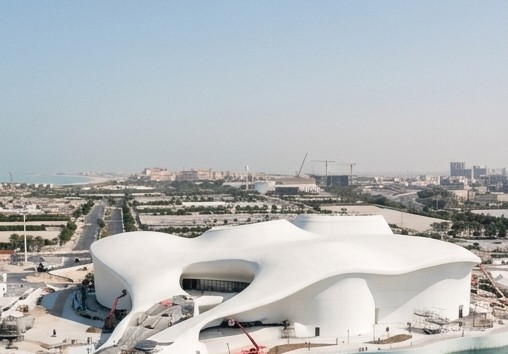
AI-generated image · may differ from the real place Inside teamLab Phenomena, the solid world of concrete and marble gives way to an atmospheric realm where architecture is composed entirely of living illumination. As you step across the threshold into darkened chambers filled with drifting vapor and floating orbs, allow your eyes to adjust to the luminous twilight. Your presence here is not merely that of a detached onlooker; your movements disturb the air currents, causing cascading ribbons of color to part, bloom, and reform in response to your touch. It feels like stepping into a modern mirage, where the ancient desert fascination with optics and cosmic wonder is translated into responsive digital physics. Walk slowly through the central installation chamber, watching how light gathers like bioluminescent currents before dissolving into open space. It is a poetic reminder that form is ephemeral, constantly reborn through our perception.
A gentle stroll toward the marina district leads you to the quiet academic quads of New York University Abu Dhabi, where another sanctuary of thought awaits.
- 1 min · on site
A Scholarly Oasis of New Perspectives

Photo: 110603Ldj. · CC BY-SA 4.0 · Original file Nestled within the palm-lined courtyards of the university, the NYUAD Art Gallery offers the contemplative seclusion of a scholarly sanctuary. As you enter through the cool, high-ceilinged reception hall, the atmosphere shifts from the theatrical spectacles of Saadiyat to the rigorous intimacy of intellectual inquiry. Curators here construct exhibitions that investigate regional histories, experimental modernisms, and overlooked Gulf narratives with the precision of essayists. Take time to inspect the reading corner near the entrance, where monographs and critical texts invite you to sit and digest the artistic dialogues of the broader region. The natural light entering through high clerestory windows illuminates wall texts and rare prints with quiet clarity. Here, art feels like an ongoing seminar, challenging travelers to reconsider the cultural currents connecting South Asia, the Levant, and the Arabian Peninsula with scholarly grace.
Now leave the maritime calm of Saadiyat behind and travel south toward the mainland, where the transcendent white domes of the Grand Mosque crown the city horizon.
- 1 min · on site
The Geometry of Serenity
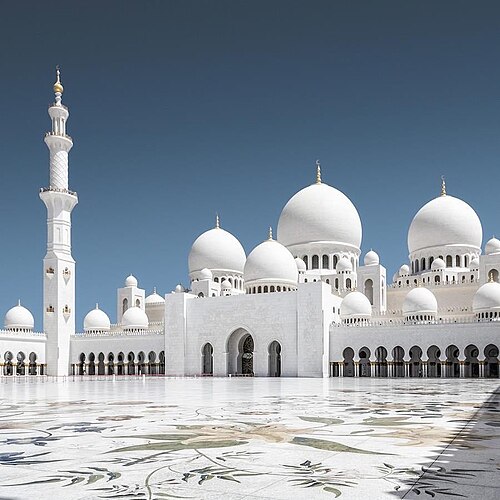
Photo · Wikimedia Commons Standing before the Sheikh Zayed Grand Mosque, eighty-two pure white domes gleam against the azure sky with breathtaking majesty. Remove your footwear and tread softly upon the expansive courtyard, where British artist Kevin Dean designed exuberant floral mosaics of lilies, irises, and tulips winding across seventeen thousand square meters of Macedonian marble. Inside the cavernous prayer hall, look downward at the world largest hand-knotted carpet, woven by over a thousand artisans under Iranian designer Ali Khaliqi, and glance upward at the Faustig chandeliers ablaze with millions of Swarovski crystals. Syrian architect Youssef Abdelke harmonized Moorish archways with classical minarets, while master calligrapher Mohammed Mandi Al Tamimi traced the ninety-nine attributes of God across the illuminated Qibla wall. The reflective pools encircling the colonnades mirror the moonlit sky, offering an unforgettable communion of craftsmanship, devotion, and monumental serenity.


As twilight settles across Abu Dhabi, the desert wind cools the marble courtyards and the sea turns into a deep indigo mirror. To have walked among these pavilions is to have witnessed how a modern capital writes its own chapter in the long annals of human expression, anchoring the fleeting brilliance of contemporary art within the quiet dignity of stone, water, and timeless light.
Take it further
Open the tour in the appThe tour in the app
A Lyrical Art Walk Through Saadiyat and the Grand MosqueBegin your journey at Manarat Al Saadiyat in the morning light, explore the universal masterpieces beneath the rain of light at the Louvre, wander the immersive luminous realms of teamLab Phenomena, contemplate scholarly Gulf narratives at NYUAD, and conclude amid the serene marble courtyards of the Grand Mosque.
+ Add the tour to your planIf you have the app the tour opens right away; otherwise you go to the store.FAQ
- What is the best way to navigate between the Saadiyat cultural venues and the Grand Mosque?
- The cultural institutions on Saadiyat Island are situated close to one another along pedestrian promenades and short drives, while the Sheikh Zayed Grand Mosque rests toward the mainland, easily reached by car across the coastal bridges in about twenty minutes.
- How should visitors dress when exploring both the contemporary art spaces and the religious monuments?
- Contemporary art pavilions welcome elegant casual attire, but when arriving at the Sheikh Zayed Grand Mosque, modest dress covering shoulders, arms, and legs is strictly observed, with headscarves customary for women entering the courtyards and prayer halls.
This piece was newly written based on the Wikipedia articles ‘Louvre Abu Dhabi’, ‘Frieze Art Fair’ · CC BY-SA 4.0